



















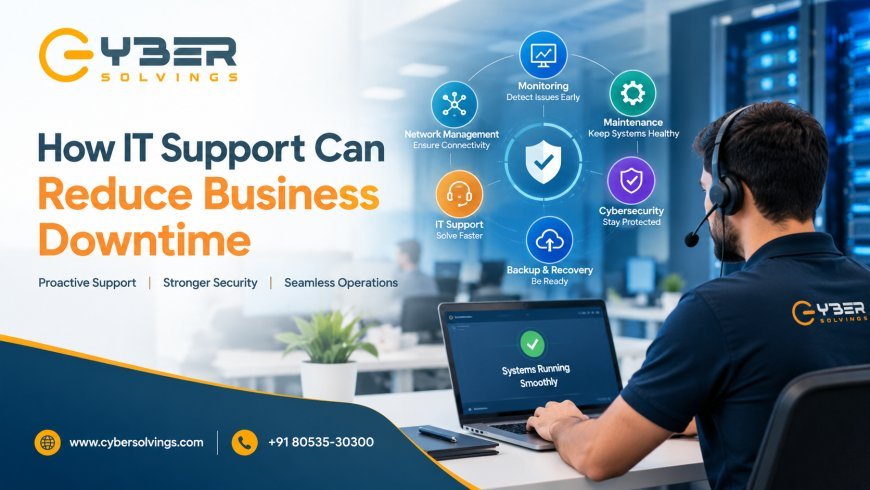
How IT Support Can Reduce Business Downtime
Learn how IT support can reduce business downtime through proactive monitoring, cybersecurity, regular maintenance, backup solutions, and faster technical issue resolution.

In today’s digital business environment, technology is at the heart of almost every operation. Businesses rely on computers, servers, networks, cloud applications, email, cybersecurity systems, and digital communication tools to serve customers and complete daily tasks. When these systems stop working, even for a short period, business productivity can quickly suffer.
Business downtime occurs when employees, customers, or business processes cannot access the technology and systems they need. A server failure, network outage, software problem, cyberattack, hardware failure, or cloud issue can interrupt normal operations and create significant challenges.
The good news is that many technology-related disruptions can be prevented or reduced through professional IT support. Instead of waiting for systems to fail, businesses can use proactive IT services to monitor infrastructure, maintain devices, strengthen cybersecurity, manage backups, and resolve technical issues quickly.
According to recent managed IT guidance, proactive monitoring, preventive maintenance, faster incident response, tested backups, and structured recovery processes are important components of reducing downtime.
For businesses looking to improve technology reliability, Cybersolvings provides IT-focused solutions designed to help organizations maintain secure, stable, and productive IT environments.
What Is Business Downtime?
Business downtime refers to a period when critical systems, applications, networks, or technology resources are unavailable or unusable.
Downtime can be either planned or unplanned.
Planned downtime may occur when IT teams perform scheduled maintenance, upgrades, or system changes. Because these activities are planned, businesses can often schedule them outside important working hours.
Unplanned downtime happens unexpectedly. Common examples include:
-
Server crashes
-
Internet or network failures
-
Hardware breakdowns
-
Software errors
-
Cybersecurity attacks
-
Ransomware incidents
-
Cloud service problems
-
Power interruptions
-
Failed updates
-
Data loss
-
Storage failures
The longer a business remains offline, the greater the potential impact on employees, customers, productivity, and revenue.
Why Is IT Downtime a Serious Problem for Businesses?
Modern businesses depend heavily on technology. Employees may need access to customer databases, accounting software, cloud applications, email, communication platforms, websites, and internal systems throughout the working day.
When these systems become unavailable, employees may be unable to complete important tasks.
Business downtime can result in:
-
Lost employee productivity
-
Delayed customer service
-
Missed business opportunities
-
Delayed orders and transactions
-
Data accessibility problems
-
Emergency repair expenses
-
Increased cybersecurity risks
-
Customer dissatisfaction
-
Operational delays
Downtime is therefore not simply an IT problem. It can become a broader business continuity problem.
This is why businesses should focus on preventing downtime rather than only reacting to it after a failure occurs.
How IT Support Helps Reduce Business Downtime
Professional IT support can reduce downtime through a combination of prevention, monitoring, maintenance, security, and rapid response.
Here are some of the most important ways IT support can help.
1. Proactive IT Monitoring
One of the most effective ways to prevent downtime is to identify problems before they become serious.
With proactive IT monitoring, important systems can be continuously monitored for unusual activity or performance problems.
IT teams may monitor:
-
Servers
-
Network devices
-
Computers
-
Storage systems
-
Firewalls
-
Cloud environments
-
Applications
-
Backup systems
-
Security alerts
For example, if a server's storage is approaching capacity, an IT support team can identify the problem and take corrective action before the storage limitation causes applications to fail.
Similarly, monitoring can identify unusual network behavior or hardware warnings that may indicate a developing problem.
Proactive monitoring changes IT support from a break-fix approach into a prevention-focused approach. Current managed IT practices emphasize continuous monitoring because early detection gives support teams an opportunity to address problems before they become business-impacting outages.
2. Regular IT Maintenance
Technology needs regular maintenance to remain reliable.
Without proper maintenance, outdated software, storage issues, hardware problems, configuration errors, and performance issues can accumulate over time.
Regular IT maintenance may include:
-
Operating system updates
-
Software updates
-
Security patches
-
Hardware health checks
-
Storage management
-
System optimization
-
Network configuration reviews
-
Device maintenance
-
Performance monitoring
Scheduled maintenance allows IT teams to identify potential problems before they result in unexpected failures.
For businesses, this means fewer surprises and a more stable technology environment.
3. Faster Troubleshooting and Issue Resolution
Even with proactive monitoring, technical problems can still occur.
When an issue happens, response time becomes extremely important.
A professional IT support team can quickly investigate the problem, identify its root cause, and implement an appropriate solution.
For example, an employee may suddenly lose access to a business application. Instead of spending hours trying random solutions, an experienced IT technician can diagnose whether the issue is related to the user's device, network connection, permissions, software configuration, or server.
Faster troubleshooting means less disruption.
A structured IT support process can also establish escalation procedures so that serious incidents are quickly passed to the appropriate technical specialist.
4. Stronger Cybersecurity Protection
Cybersecurity incidents can cause significant business disruption.
Ransomware, malware, compromised accounts, phishing attacks, and unauthorized access can prevent employees from accessing important systems and data.
Professional IT support can help businesses strengthen their cybersecurity through measures such as:
-
Endpoint protection
-
Firewall management
-
Security patching
-
Access control
-
Multi-factor authentication
-
Vulnerability monitoring
-
Security awareness
-
Threat detection
-
Security policy management
Keeping software and systems updated is particularly important because outdated technology may contain known vulnerabilities.
Cybersecurity should therefore be treated as part of a broader business continuity strategy, rather than as a separate IT activity.
5. Reliable Backup and Disaster Recovery
A backup is one of the most important tools for reducing the impact of data loss and system failures.
However, simply having backups is not enough.
Businesses should also verify that backups are working correctly and that important information can actually be restored when required.
A professional IT support strategy can include:
-
Automated backups
-
Off-site backups
-
Cloud backups
-
Backup monitoring
-
Backup retention policies
-
Recovery testing
-
Disaster recovery planning
IT teams can also establish Recovery Time Objectives (RTOs) and Recovery Point Objectives (RPOs) based on business requirements.
RTO defines how quickly a system should be restored after an incident, while RPO helps determine how much recent data the business can afford to lose.
Testing recovery procedures is especially important. Industry guidance emphasizes that a successful backup job does not automatically prove that a business can restore its systems quickly; recovery testing helps identify gaps before an emergency occurs.
6. Network Management and Optimization
A slow or unstable network can be almost as disruptive as a complete outage.
Employees may experience:
-
Slow applications
-
Dropped connections
-
Poor Wi-Fi performance
-
Slow file transfers
-
VPN problems
-
Communication issues
IT support teams can monitor network performance and identify problems such as bandwidth limitations, configuration issues, failing equipment, or connectivity problems.
Regular network management helps maintain reliable communication between employees, systems, offices, and cloud applications.
For businesses that rely heavily on cloud platforms and remote employees, dependable network connectivity is particularly important.
7. Cloud and Application Support
Many businesses now rely on cloud-based applications for communication, collaboration, accounting, customer management, file storage, and other important operations.
Cloud technology can provide flexibility and scalability, but businesses still need to manage access, security, performance, permissions, and backups properly.
IT support can help monitor cloud environments and troubleshoot issues involving:
-
User access
-
Account permissions
-
Cloud applications
-
Data synchronization
-
Security settings
-
Cloud backups
-
Application performance
Proper cloud management can reduce avoidable disruptions and help employees remain productive.
8. Hardware Lifecycle Management
Hardware failures are another common source of downtime.
Computers, storage devices, servers, switches, routers, and other equipment have limited lifespans.
If aging hardware is not monitored, businesses may suddenly experience a failure at an inconvenient time.
IT support can maintain an inventory of business technology and identify equipment that is approaching the end of its useful life.
Instead of waiting for a device to fail completely, businesses can plan replacements or upgrades during scheduled maintenance periods.
This approach can reduce unexpected interruptions and make technology spending more predictable.
9. Employee IT Support
Not every IT problem is caused by a server or network failure.
Employees regularly experience smaller technical issues involving:
-
Passwords
-
Email
-
Printers
-
Software
-
VPN connections
-
Computer performance
-
File access
-
Account permissions
When employees cannot resolve these problems quickly, productivity can decrease.
A responsive IT help desk gives employees access to technical assistance when they need it.
Resolving small issues quickly also prevents employees from creating risky workarounds that could introduce additional security or operational problems.
10. IT Documentation and Standardized Processes
Good IT support is not only about fixing computers.
Documentation also plays an important role in reducing downtime.
Businesses should maintain accurate information about their technology environment, including:
-
Network configurations
-
Devices
-
Software
-
User accounts
-
Backup procedures
-
Recovery processes
-
Security policies
-
Vendor information
-
Important system dependencies
When an incident occurs, accurate documentation helps technicians understand the environment more quickly.
Standardized procedures and incident response plans can also reduce confusion during stressful situations.
Reactive vs. Proactive IT Support
There is an important difference between reactive and proactive IT support.
Reactive IT support typically responds after a problem occurs.
For example:
System fails → Employee reports problem → IT investigates → System is repaired.
Proactive IT support focuses on identifying and addressing risks earlier.
For example:
System monitored → Warning detected → IT investigates → Problem fixed before major failure.
Proactive support does not guarantee that every outage will be eliminated. Technology failures, cyber incidents, vendor outages, and other unexpected events can still happen. However, proactive management can reduce avoidable problems and improve the speed and predictability of recovery.
How Businesses Can Build a Downtime Prevention Strategy
Businesses can take several practical steps to improve IT reliability:
1. Identify Critical Systems
Determine which systems are essential to daily operations.
2. Monitor IT Infrastructure
Use appropriate monitoring tools to identify performance and security problems early.
3. Maintain Systems Regularly
Schedule software updates, security patches, hardware checks, and performance reviews.
4. Protect Business Data
Use reliable and monitored backup solutions.
5. Test Recovery Procedures
Regularly verify that important systems and data can be restored.
6. Strengthen Cybersecurity
Use appropriate security controls, access management, endpoint protection, and employee awareness practices.
7. Create an Incident Response Plan
Define who should respond, what steps should be taken, and how employees and customers should be informed when necessary.
8. Review IT Performance
Track useful metrics such as incident response time, system availability, recurring problems, and recovery performance.
How Cybersolvings Can Help Reduce Business Downtime
At Cybersolvings, reliable technology is an important part of keeping businesses productive and operational.
Businesses can benefit from an IT support approach focused on prevention, maintenance, security, troubleshooting, and long-term technology management.
Whether a company needs assistance with everyday technical issues or wants to improve its overall IT infrastructure, professional support can help reduce technology-related disruptions.
Cybersolvings can help businesses focus on their core operations while their IT environment receives the attention required to remain reliable, secure, and efficient.
The goal is not simply to fix technology after it breaks. The goal is to create an IT environment where potential problems can be identified, managed, and addressed before they cause unnecessary disruption.
Conclusion
Business downtime can affect productivity, customer service, revenue, data, and overall operations. As companies become increasingly dependent on technology, maintaining reliable IT infrastructure has become an important business priority.
Professional IT support can reduce downtime through proactive monitoring, regular maintenance, faster troubleshooting, cybersecurity protection, reliable backups, disaster recovery planning, network management, cloud support, and hardware lifecycle management.
A proactive IT strategy helps businesses move away from constantly reacting to technology problems and toward a more organized approach to prevention and recovery.
For businesses looking to improve IT reliability and reduce avoidable interruptions, Cybersolvings can provide technology-focused support designed around business needs.
By investing in proactive IT support today, businesses can build a more stable technology environment, improve employee productivity, protect important data, and be better prepared when unexpected IT problems occur.
Frequently Asked Questions
1. How does IT support reduce business downtime?
IT support reduces downtime through proactive monitoring, regular maintenance, cybersecurity protection, backup management, network management, and faster troubleshooting. These services help identify and resolve problems before or soon after they affect business operations.
2. What is proactive IT support?
Proactive IT support focuses on preventing technology problems rather than waiting for systems to fail. It can include monitoring, maintenance, patch management, cybersecurity, backup checks, and performance optimization.
3. Can IT support prevent all business downtime?
No IT support provider can guarantee that every outage will be prevented. However, proactive IT management can reduce many avoidable failures and help businesses recover more quickly when unexpected incidents occur.
What's Your Reaction?
 Like
0
Like
0
 Dislike
0
Dislike
0
 Love
0
Love
0
 Funny
0
Funny
0
 Angry
0
Angry
0
 Sad
0
Sad
0
 Wow
0
Wow
0