














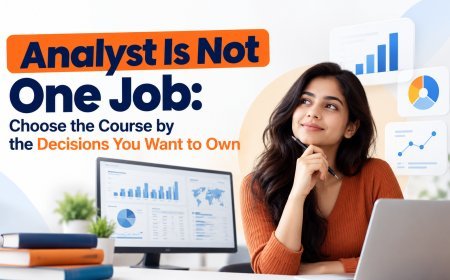





Analyst Is Not One Job: Choose the Course by the Decisions You Want to Own
Explore data, business, product, and operations analyst roles. Learn which skills to develop and how to choose the right analyst course for your career.

When you start looking at job postings for “analyst,” you might think it refers to one specific kind of job. But it actually covers several different roles.
As a data analyst, you might spend most of your week working with dashboards and SQL. As a business analyst, you might spend more time documenting requirements, mapping processes, and talking to stakeholders. As a product analyst, you could look into user behavior and experiments. As an operations analyst, you might work on forecasting, capacity, and costs.
All of these roles need an analytical mindset, but the actual work is different.
This is something you need to keep in mind when choosing analyst courses. An all-in-one certificate might sound useful, but it may not prepare you for the specific role you want. So, when you're comparing analyst courses, first think about the kind of analytical work you actually want to do.
The Job Title Hides Several Different Careers
You can see this clearly in the standards from the International Institute of Business Analysis. Business analysis work can appear in roles such as:
-
Business systems analyst
-
Process analyst
-
Data analyst
-
Product roles
-
Management consulting
So, it's not really about learning one software stack. You also need to understand what a business needs and suggest solutions that can actually add value.
The hiring market in India is just as varied.
Inside quick commerce, foundit's January 2026 tracker revealed that Data, Analytics & BI made up 26% of white-collar hires, Product & Ops Tech 21%, and Supply Chain & Network Planning 18%. Across these areas, skills such as SQL, Power BI, Python, demand forecasting and cost optimisation were becoming more common.
So, even within one sector, you can find several different analyst careers.
If You Want to Explain What Happened, Train for Data Analytics
If you want to work with structured business data and explain what is happening, data analytics is a natural direction.
A good course should help you build skills in:
-
SQL
-
Spreadsheets
-
Data cleaning
-
Visualisation
-
Statistics
You should be able to take raw tables and turn them into a clear, evidence-based explanation of what changed and why it matters.
It's not just about building a dashboard.
For example, you might get an assignment asking you to explore why repeat purchases have dropped, find out whether the drop is concentrated among a particular type of customer, and provide evidence for your findings.
To handle that kind of task, you need technical skills, validation and business understanding.
If You Want to Change How a Business Works, Business Analysis Is Different
Business analysis starts with a slightly different question:
What's really the issue or challenge?
According to IIBA, business analysis is about understanding what a business needs and what solutions can provide value in a particular organisation. You may also need to:
-
Interact with users
-
Clarify their needs
-
Understand processes
-
Connect the business and technical sides
These skills can be just as important as working with data.
So, if you're looking for business analyst jobs, look for courses that cover requirements, process modelling, stakeholder analysis and solution evaluation. You don't necessarily want to end up taking the same classes as someone focusing purely on data analytics.
Product and Operations Analysts Need Context-Specific Skills
If you're interested in product analytics, you'll commonly come across funnels, retention, cohorts and experiments. In operations analytics, you might work with throughput, inventory, capacity, delivery time or costs.
The tools can be similar to those used in data analysis, but the decisions you're trying to make are different.
For example, a product analyst might ask whether a redesigned onboarding process improves activation. Someone working in operations analytics might look at whether increasing capacity at one stage could remove a bottleneck or simply create another one.
That's why the more useful analyst courses are the ones where your projects feel like real decision-making situations rather than generic datasets with predetermined answers.
Domain Knowledge Can Matter as Much as Another Tool
Imagine you're a financial analyst who knows SQL but doesn't understand financial statements. Or you're a marketing analyst who knows dashboards but doesn't understand attribution.
In both cases, knowing another software tool won't necessarily solve the problem.
That's why simply collecting software skills isn't always a good way to choose a course.
Once you have your analytical foundation, you could add something more specialised, such as:
-
A finance course
-
A course on experimentation
-
A supply chain course
-
A product analytics course
-
Another specialised course
Instead of taking yet another general analytics certificate.
This skills-focused approach also fits with India's hiring plans for 2026. According to foundit, digital, AI, cloud, data and cybersecurity segments are showing the highest demand as businesses look for people who can support strategic and complex projects.
Pick the Course Backwards From the Work
AnalytixLabs currently differentiates between its Data Analytics and Business Analytics programmes and doesn't treat them as interchangeable. Its Data Analytics track covers topics such as SQL, statistics and visualisation, while its Business Analytics track has a broader focus on using analytics for business decisions.
That's a useful distinction to keep in mind.
Here's a simple way to approach your own search: open several real job descriptions for the role you want. Note down the decisions, tools, and business knowledge those jobs require. Then compare different programmes against that list.
Don't start with the certificate.
Start with the task you want to be trusted with. That's a much more useful way to evaluate analyst courses and choose one that actually matches the work you want to do.
What's Your Reaction?
 Like
0
Like
0
 Dislike
0
Dislike
0
 Love
0
Love
0
 Funny
0
Funny
0
 Angry
0
Angry
0
 Sad
0
Sad
0
 Wow
0
Wow
0