

























What Are Rubber Molded Products
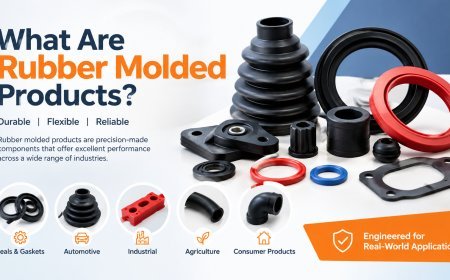
Rubber molded products are rubber components manufactured by shaping and curing rubber inside a mold to achieve specific shapes and properties.

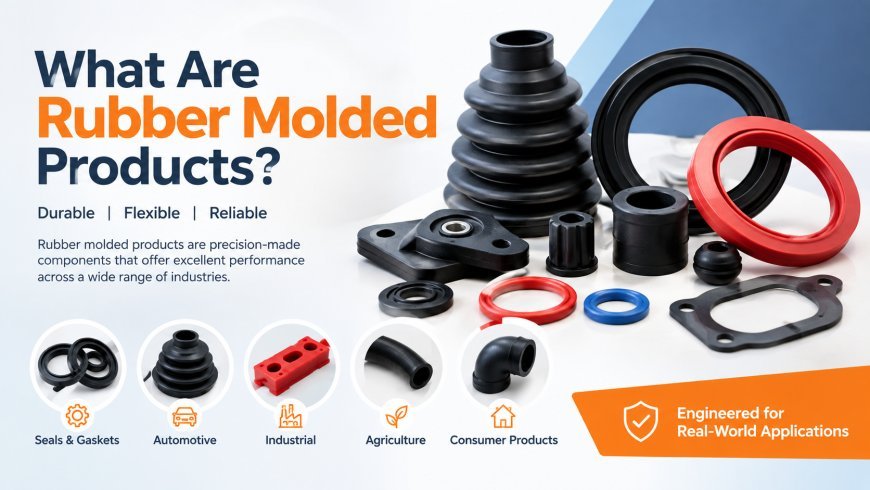
Custom rubber molded products help you meet specific design requirements, unlike standard ones. Whether it's a simple gasket or a complex component, these can ensure a perfect fit for any application with high accuracy and intricate design requirements.
These are quite cost-effective and highly resistant to a wide range of environmental factors, including heat, cold, moisture, and UV radiation. This guide covers the definition, manufacturing process, and types of rubber molded products.
What Are Rubber Molded Products?
Rubber molded parts are made using elastomers by placing the rubber material inside a cavity and subjecting it to heat and pressure to shape and cure it. This process enables uniform dimensions, intricate shapes, customized parts, and even duplicate parts.
Depending on the application, molded rubber can offer various levels of hardness, sealing surfaces, and built-in parts. Common types include rubber gaskets, seals, O-rings, bushings, grommets, vibration dampers, protective shields, and pads.
How Are Rubber Molded Products Manufactured?
Most of the manufacturer’s process follows a step-by-step approach, from selecting the right material to inspecting the molded product to ensure it meets the specified criteria. Here's the thorough procedure for making rubber molded parts:
Every rubber mold manufacturing process begins with choosing the right material. The supplier first selects rubber compounds based on the final part's operating conditions, such as temperature, exposure to chemicals and oils, flexibility, wear and tear, weather, and compression.
Their materials include EPDM rubber, silicone rubber, nitrile rubber, neoprene, natural rubber, and Viton/FKM.
2. Mold Design
They usually design the mold based on the required shape and dimensions of the rubber part. They consider surface finish, parting lines, tolerances, and cavity design to ensure making the desired rubber part.
If conventional molds cannot meet the required shape and dimensions, they customize a rubber mold to provide more flexibility in cavity design and manufacture rubber molded products to specific product specifications.
Once they have the material and the mold, the team prepares the rubber and loads it into the mold. After that, they use heat and pressure during molding to help the material flow into its desired shape and fill the mold cavity.
Next, they cure the rubber to achieve the required properties, then remove the part from the mold and inspect it.
After removing it from the mold, they clean the product of any flash and visually inspect the part for defects. This includes checking the surface finish and ensuring certain dimensions meet the required specifications.
The expert team also conducts functional tests as needed to confirm the part functions as intended. This helps them detect problems and maintain quality standards when manufacturing rubber components.
Types of Rubber Molding Processes
Each rubber molding job has its own requirements, which may make the molding process different for each component. Professional custom rubber mold apply different techniques based on the component design, material, production quantity, and performance requirements. It includes:
The compression molding process begins by cutting a rubber compound, which is then inserted into an open mold cavity. Once the mold is closed under pressure, they use heat to cure the rubber. This technique is effective for producing relatively simple, large-size rubber parts.
Rubber injection molding takes a different approach than rubber compression molding. In rubber injection molding, the manufacturing team injects rubber material into a closed mold under pressure, allowing it to fill the mold cavity.
3. Transfer Molding
Transfer molding combines compression and injection molding processes. Manufacturers put the rubber formulation in the transfer chamber, where pressure pushes it through holes and into the enclosed mold cavities. The process ensures controlled cavity filling. It works well for intricate or complex parts, such as those with metal inserts.
Extrusion molding is widely used to manufacture continuous rubber profiles, such as rubber tubes, strips, and seals. They inject the rubber compound into a die of a particular shape to obtain the desired cross-section, then cure it to develop the necessary properties.
The blow molding process involves applying pressure to the hot rubber material into the inner walls of the mold. The material expands to form a hollow structure when the mold closes. Blow molding is one process used to manufacture parts such as boots.
LSR molding is basically an injection molding process carried out using Liquid Silicone Rubber. In this process, suppliers combine two liquid materials and inject them into a heated mold to form the component in a very short time.
Rubber-to-metal bonding is the process of bonding rubber with metal inserts through the molding process to form a single piece. This process is widely used in manufacturing items like engine mounts, vibration isolators, and industrial bushings that require rubber and metal to function as a single unit.
In rubber overmolding, rubber covers an already manufactured plastic or metal part. The rubber may provide grip, sealing, protection, or cushioning, among other functions. Different molding processes will apply in different situations based on the geometry, volume, material, tolerance, production needs, and overall costs.
Rubber Molded Products in Chicago: What Local Buyers Should Consider
During Rubber Molded Products purchase from any Chicago suppliers, buyers should consider checking the manufacturer’s production capacity, delivery times, and available materials. Verifying the ability to make a prototype and work according to special specifications can help selecting the right manufacturer.
Krishani ensures ongoing projects, clear communication and quality standards to manage the production process. The team always maintains continuous contact with their customers from project start to completion through discussions, prototype design, production, and delivery. So, if you are looking for any reliable custom rubber molded products manufacturer, contact the expert team at Krishani to discuss your project requirements.
Why choose KRISHANI for rubber molded products?
KRISHANI can ensure aesthetic molded rubber product design based on each product's requirements. The engineering team can assist with material selection, mold design, production, testing, and final shipping.
Frequently Asked Questions About Rubber Molded Products
The performance of rubber molded parts depends on the material type, geometry, operating temperature, chemical contact, compression, and molding method. Assess all these elements based on the component's function.
Several processes can be used to manufacture complex rubber parts, such as compression molding, injection molding, and transfer molding, depending on the part design and manufacturing specifications.
What's Your Reaction?
 Like
0
Like
0
 Dislike
0
Dislike
0
 Love
0
Love
0
 Funny
0
Funny
0
 Angry
0
Angry
0
 Sad
0
Sad
0
 Wow
0
Wow
0