























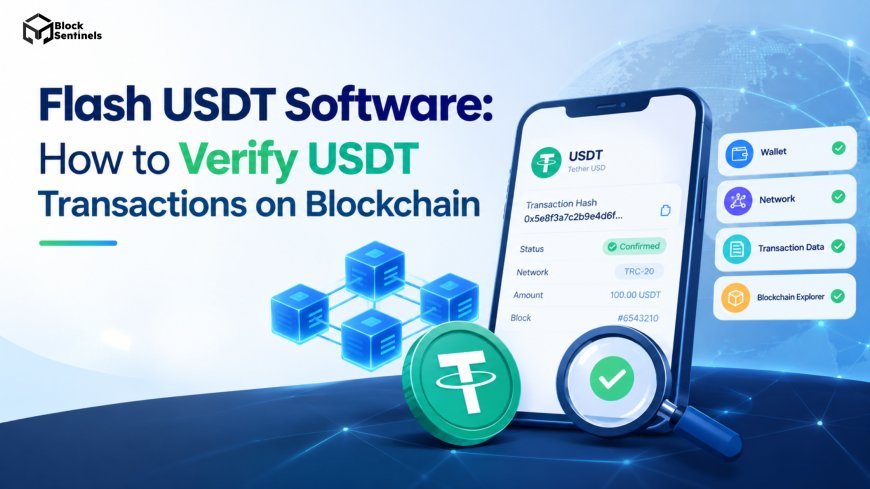
Flash USDT Software: How to Verify USDT Transactions on Blockchain
Learn how to verify USDT transactions on blockchain by checking transaction hashes, wallet addresses, token contracts, network details, confirmations, and transaction status. This blog breaks down Flash USDT Software and shows how blockchain verification helps distinguish genuine on-chain transactions from unverified or misleading transaction displays.
Have you ever received a USDT transaction notification and wondered whether the funds actually exist on the blockchain?
A wallet can display a transaction as pending, a balance can appear to change, or someone can provide a transaction hash as proof. But none of these details should be trusted blindly. The reliable way to determine whether a USDT transfer actually occurred is to verify the transaction and token movement directly on the relevant blockchain.
This is especially important when researching Flash USDT Software, because the term “Flash USDT” is commonly used in the market for software or transaction concepts that can create confusion around temporary balances, displayed transactions, or simulated transfers. Tether itself issues USDT across multiple blockchain networks, including Ethereum, Tron, BNB Smart Chain, Solana, and others.
Understanding how blockchain verification works helps users distinguish a genuine confirmed USDT transfer from a wallet display or an unverified claim.
What Is Flash USDT Software?
“Flash USDT Software” is a market term rather than the name of an official Tether protocol. Different software products may use the term to describe transaction related tools, wallet interfaces, demonstrations, or other blockchain applications.
For anyone working with such software, the most important principle is simple: a USDT balance should be treated as genuine only when the corresponding token movement can be independently verified on the correct blockchain.
A legitimate blockchain transaction leaves records that can be inspected through a blockchain explorer. Depending on the network, those records can include the transaction hash, sender address, recipient address, token contract, amount, block number, timestamp, confirmation status, and transaction result.
This makes blockchain explorers valuable for checking whether a claimed USDT transfer actually happened.
Why Blockchain Verification Matters
A screenshot or wallet notification is not sufficient evidence that USDT has been successfully transferred.
A transaction may appear in an interface while it is still pending. A wallet may display a token using an incorrect contract address. A transaction can fail or revert. A user may also be looking at the wrong blockchain network.
Blockchain verification provides an independent source of information.
For example, TRONSCAN transaction records can provide information such as the transaction hash, block, sender, recipient, contract type, confirmation status, number of confirmations, and contract execution result.
This information makes it possible to compare what a wallet claims with what the blockchain actually records.
Step 1: Identify the Blockchain Network
The first step in verifying a USDT transaction is identifying the network used for the transfer.
USDT exists on multiple blockchain protocols, and the verification method depends on the network. Tether currently lists USDT support across several protocols, including ERC-20 on supported networks and TRC-20 on Tron.
For example:
-
TRC-20 USDT → verify on the Tron blockchain.
-
ERC-20 USDT → verify on the relevant Ethereum-compatible blockchain.
-
USDT on BNB Smart Chain → use the appropriate BNB Smart Chain explorer.
-
USDT on Solana → use a Solana-compatible explorer.
Using the wrong explorer can make a genuine transaction appear to be missing.
Step 2: Find the Transaction Hash
A blockchain transaction normally has a unique identifier called a transaction hash, transaction ID, or TxID.
This hash works like a reference number for the transaction.
If someone claims that USDT has been transferred, the transaction hash is one of the most useful pieces of information to request. Instead of relying only on a screenshot, the hash can be entered into the appropriate blockchain explorer.
For TRON transactions, TRONSCAN supports searching by transaction, account, token, contract, or block.
If the transaction cannot be found on the correct network using the supplied hash, further verification is necessary before considering the transfer complete.
Step 3: Check the Sender and Recipient Addresses
Finding a transaction is only the beginning.
The next step is checking whether the addresses shown in the blockchain record match the expected sender and recipient.
Suppose a user expects 500 USDT to arrive at Wallet B from Wallet A. The blockchain record should show the appropriate sender and recipient addresses.
TRONSCAN's transaction information can provide both the initiating address and recipient address. Its token transfer records can also identify the sender, recipient, token contract, amount, block, and transaction hash.
Always compare the full wallet address rather than relying on a shortened address displayed by an application.
Step 4: Verify the Token Contract
One of the most important checks is the token contract address.
A token's name and symbol alone are not enough to establish authenticity. Different tokens can use similar names or symbols.
For USDT, the contract or token identifier should correspond to the official token deployment on the relevant blockchain. Tether publishes information about its supported protocols and token integration.
This is particularly important when evaluating software or wallet interfaces that display “USDT.”
A balance showing “USDT” does not automatically prove that the asset is the official Tether token. The underlying contract and blockchain network must also be checked.
Step 5: Check the Transaction Status
A transaction can have different states during its lifecycle.
Depending on the blockchain and explorer, you may encounter statuses such as:
-
Pending
-
Confirmed
-
Successful
-
Failed
-
Reverted
A successful transaction should have an appropriate successful execution result and should be included in the blockchain according to the network's confirmation model.
TRONSCAN's transaction data, for example, includes fields for confirmation status, confirmations, revert status, and contract execution result.
This distinction matters because a transaction hash existing does not necessarily mean the intended token transfer successfully completed.
Step 6: Verify the Actual USDT Amount
The amount shown in a wallet should be compared with the token transfer recorded on-chain.
Blockchain explorers may represent token quantities using the token's decimal system. For example, TRONSCAN's documentation shows that TRC-20 token information includes decimal precision and that raw token quantities must be interpreted using those decimals.
Therefore, users should not rely only on an application's formatted balance.
Check:
-
Token name
-
Token contract
-
Sender
-
Recipient
-
Transfer amount
-
Transaction hash
-
Block
-
Confirmation status
Together, these details provide much stronger evidence than a screenshot.
Step 7: Check Block Inclusion and Confirmations
A blockchain transaction becomes more meaningful when it has been included in a block and has achieved the required confirmations.
A block provides the on-chain record containing transactions processed by the network.
TRONSCAN transaction information can return the block height, timestamp, confirmation count, and confirmation status.
For applications handling USDT transactions, monitoring block inclusion and confirmation status is therefore an important part of transaction management.
A wallet interface may update quickly, but the blockchain record remains the independent source for determining what happened on-chain.
Flash USDT and the Difference Between Display and Settlement
One of the biggest areas of confusion around Flash USDT is the difference between what an interface displays and what the blockchain has actually recorded.
A displayed balance does not automatically represent settled funds.
Similarly, a screenshot of a transaction, a temporary wallet notification, or a transaction-like interface should not be treated as proof of a completed USDT transfer.
A genuine transfer should be traceable to an appropriate blockchain record containing the relevant token movement.
This distinction is particularly important for businesses, exchanges, merchants, and developers that need reliable transaction verification.
Common Mistakes When Verifying USDT
Checking the Wrong Network
A TRC-20 transaction will not appear on an Ethereum explorer simply because both assets are called USDT.
Always identify the blockchain first.
Trusting Screenshots
Screenshots can be useful for communication, but they are not independent blockchain evidence.
Checking Only the Transaction Hash
A transaction hash should be examined together with the sender, recipient, token contract, amount, status, and block information.
Ignoring the Token Contract
A token can use a familiar symbol without being the official asset.
Assuming “Pending” Means Completed
Pending means the transaction has not reached the required final state. The actual explorer status should be checked before treating funds as received.
How Developers Can Build Better USDT Verification
For developers working on Flash USDT Software Development or broader USDT transaction applications, verification should be based on blockchain data rather than only wallet-side information.
A robust verification system can monitor:
-
Transaction hashes
-
Sender and recipient addresses
-
Token contract addresses
-
Transfer amounts
-
Block numbers
-
Confirmation counts
-
Transaction status
-
Contract execution results
-
Network selection
TRONSCAN provides transaction and TRC-20 transfer data that can be used for transaction monitoring and application level verification.
For Ethereum based applications, Etherscan provides transaction and token endpoints that can retrieve transaction receipt status, token balances, transfer information, and other blockchain data.
The key development principle is to make the blockchain the source of truth rather than relying exclusively on an application's internal database or interface.
Final Thoughts
Understanding how to verify USDT transactions is essential for anyone exploring Flash USDT Software, crypto wallets, blockchain applications, or digital asset transfers.
The safest approach is straightforward: identify the correct network, locate the transaction hash, verify the sender and recipient, confirm the token contract, check the amount, review the transaction status, and confirm that the transaction has been included on-chain.
Most importantly, do not treat a displayed balance, screenshot, or software-generated transaction record as proof of settled USDT.
Blockchain verification provides a clearer and more reliable way to determine whether a USDT transfer actually exists and was successfully completed. As digital asset applications continue to develop across multiple blockchain networks, understanding these verification fundamentals will become increasingly important for users, developers, businesses, and blockchain professionals.
What's Your Reaction?
 Like
0
Like
0
 Dislike
0
Dislike
0
 Love
0
Love
0
 Funny
0
Funny
0
 Angry
0
Angry
0
 Sad
0
Sad
0
 Wow
0
Wow
0