



















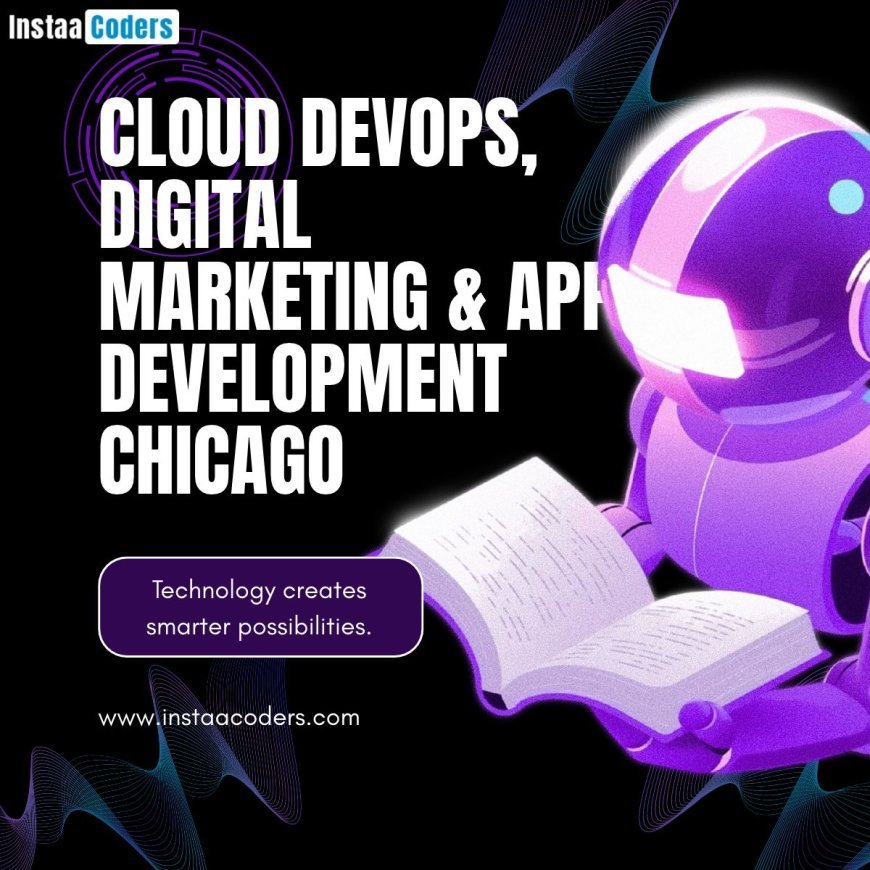
Cloud DevOps, Digital Marketing & App Development Chicago
Explore cloud DevOps engineering services, digital marketing agency services, and mobile app development services in Chicago to grow your US business faster.
Most growing businesses hit the same wall sooner or later. The website slows to a crawl during a big promotion. The app crashes after an update. The marketing team sends thousands of visitors to a product that engineering can’t ship fast enough. These problems look unrelated, but they usually share one root cause: technology, product, and marketing were built in separate boxes.
This guide shows how three services fit together as one growth system: cloud DevOps engineering services, digital marketing agency services, and mobile app development services in Chicago. You might run a startup in the Loop, a retail brand in the suburbs, or a software company serving customers coast to coast. Either way, understanding how these pieces connect will help you spend smarter and grow steadier.
Why Growth Depends on Three Connected Pillars
Think of your business as a restaurant. The kitchen is your infrastructure, the dining room is your product, and the street sign is your marketing. A beautiful sign draws people in, but if the kitchen is slow, they leave unhappy. A perfect kitchen with no sign sits empty. You need all three, and they must communicate.
In digital terms, cloud and DevOps work is the kitchen. It decides how fast and how safely you can release features and handle traffic. Mobile and web applications are the dining room, where customers actually experience your brand. Digital marketing is the sign and the word of mouth that bring people through the door.
When these functions are handled by disconnected vendors, gaps appear. Marketers promise features developers haven’t built. Developers ship updates that break tracking. Infrastructure costs climb because nobody forecasted a campaign spike. Connecting the three removes those gaps and makes every dollar work harder.
Cloud DevOps Engineering Services: The Foundation
DevOps is a way of working that brings development and operations together so software can be built, tested, and released quickly without sacrificing stability. Cloud DevOps engineering services apply that approach on platforms such as AWS, Microsoft Azure, and Google Cloud.
For a US business, the practical benefits are easy to recognize:
- Faster releases. Automated build and deployment pipelines (often called CI/CD) let your team ship improvements in hours instead of weeks.
- Higher reliability. Monitoring and automated recovery catch problems before customers notice them.
- Smarter spending. Right-sized cloud resources and auto-scaling mean you pay for what you use, not for idle servers.
- Stronger security. Building security checks into the pipeline, sometimes called DevSecOps, helps protect customer data and supports compliance needs in industries like healthcare and finance.
- Consistency. Infrastructure as code makes your environments repeatable, so what works in testing also works in production.
A good DevOps partner starts by understanding your goals, not by pushing tools. They review your current architecture, identify bottlenecks, and build a roadmap that fits your size and budget. A small company may only need a clean deployment pipeline and basic monitoring. A larger one may need container orchestration, multi-region failover, and detailed cost governance.
The key point for everything that follows is that DevOps is what makes the other two services dependable. Marketing campaigns and app launches both depend on a platform that stays up under pressure.
Digital Marketing Agency Services: Bringing the Right Audience
Once your platform is solid, the next question is who is going to use it. That is where digital marketing agency services come in. Today’s customers research online, compare options, read reviews, and often decide before ever speaking to a salesperson. Being visible and credible at each of those moments matters.
A well-rounded agency typically covers several connected channels:
Search engine optimization (SEO). Ranking for the terms your customers actually search is one of the most durable ways to earn traffic. That means technical health, helpful content, and strong site structure. Google rewards pages that are fast, mobile-friendly, and genuinely useful, which is another place infrastructure quality quietly matters.
Content marketing. Articles, guides, and videos that answer real questions build trust over time. They also give search engines more reasons to surface your brand.
Paid media. Search and social advertising can deliver quick, measurable traffic while organic efforts mature, especially when campaigns are tightly targeted by location, intent, and audience.
Email and lifecycle marketing. Reaching people who already know you is often the most cost-effective growth lever, particularly for app users who need onboarding and re-engagement.
Analytics and conversion optimization. Measurement ties everything together. Tracking where visitors come from, what they do, and where they drop off lets you improve continuously instead of guessing.
The best agencies treat marketing as a conversation with data. They don’t just send traffic; they ask whether the landing page loads quickly, whether the signup flow works on a phone, and whether the product delivers on the promise. Those questions lead naturally to the next pillar.
Mobile App Development Services in Chicago
For many US customers, your mobile app is your business. It is where they shop, book, learn, and return. That makes the quality of your app a direct growth driver, not just a technical project.
Choosing mobile app development services in Chicago comes with some genuine advantages. The city has a deep technology talent pool, a strong mix of industries including finance, logistics, healthcare, retail, and manufacturing, and a central time zone that makes collaboration with teams on both coasts easier. Working with a local or Chicago-based team also means you can meet face to face during discovery and planning, which often prevents expensive misunderstandings later.
A professional app development process usually includes:
- Discovery and strategy. Defining users, goals, and the smallest version of the product that proves value.
- UX and UI design. Creating flows that feel natural on a small screen and meet accessibility standards.
- Development. Building native apps for iOS and Android, or cross-platform apps using frameworks such as React Native or Flutter, depending on performance needs and budget.
- Quality assurance. Testing across devices, operating systems, and network conditions.
- Launch and iteration. Releasing to the App Store and Google Play, then improving based on real usage data.
Apps also need backends, APIs, databases, and push-notification systems, all of which run in the cloud. This is where the connection with DevOps becomes obvious. An app built without a scalable backend can feel great in testing and fall apart the day a campaign succeeds. And an app without proper analytics gives your marketing team nothing to optimize.
How the Three Services Work Together
Here is what an integrated approach looks like in practice.
Step one: plan together. Before anything is built, product, engineering, and marketing agree on the target customer, the core value, and the key numbers to track. Everyone works from the same goals.
Step two: build on a strong base. Your cloud DevOps team sets up environments, pipelines, and monitoring while the app is being designed. When development starts, releases are already smooth and repeatable.
Step three: launch with visibility. Marketing prepares search content, ads, and email sequences ahead of launch. Engineering forecasts the traffic and scales resources in advance, so nothing breaks at the exact moment attention peaks.
Step four: measure and learn. Analytics from the app and website flow back to everyone. If users abandon signup, designers adjust the flow, developers ship a fix through the pipeline, and marketers update their messaging, all within days.
Step five: repeat. Every cycle makes the product better, the infrastructure leaner, and the marketing sharper.
This loop is the real advantage. Each service strengthens the others. Faster releases let marketing test ideas quickly. Better marketing data guides smarter product decisions. A reliable platform protects your reputation and your search rankings. The result is compounding growth instead of isolated wins.
How to Choose the Right Partner
Whether you hire one team for everything or several specialists, a few principles help you decide well.
Look for communication, not just credentials. The people who will work on your project should explain things clearly, ask thoughtful questions, and be honest about trade-offs. Vague promises are a warning sign.
Ask how they connect the dots. A strong partner will describe how their work interacts with other functions. If a DevOps provider never asks about your marketing calendar, or an agency never asks about your site performance, you may end up managing the gaps yourself.
Check for transparency. You should understand what you are paying for, how progress is reported, and who owns your code, accounts, and data at the end of the engagement.
Match the partner to your stage. An early-stage company needs speed and flexibility. An established enterprise needs governance and scale. The best partner for one is rarely right for the other.
Prioritize security and compliance. If you handle personal, financial, or health information, confirm the team understands relevant US requirements and builds protection into the process from day one.
Plan for the long term. Digital products are never finished. Look for a team that offers ongoing support, maintenance, and optimization rather than disappearing after launch.
A Practical 90-Day Roadmap
If you are unsure where to begin, here is a simple way to start without overextending.
Days 1 to 30: assess and align. Audit your current website, app, and cloud setup. Review search visibility and analytics. Define two or three measurable goals, such as faster load times, higher conversion rates, or a successful app launch.
Days 31 to 60: fix and build. Address the biggest infrastructure and performance issues first. Set up automated deployments and monitoring. Begin core content and technical SEO improvements. If you are building an app, finalize design and start development on the essential features.
Days 61 to 90: launch and learn. Release your improvements or minimum viable product, run focused marketing campaigns, and watch your data closely. Hold a review at the end of the period to decide what to scale, what to adjust, and what to drop.
Small, steady steps like these build momentum and reduce risk. You do not need to transform everything at once; you need to make sure each piece supports the next.
Final Thoughts
Technology, product, and marketing are no longer separate departments with separate goals. For US businesses competing online, they are three parts of the same machine. Cloud DevOps engineering services keep your platform fast, secure, and ready for growth. Digital marketing agency services bring the right customers to your door. Mobile app development services in Chicago give those customers an experience worth returning to.
When these pieces are planned together, built on a solid foundation, and measured with honest data, your business becomes easier to scale and harder to disrupt. Start by looking at where your own gaps are, choose partners who care about the whole picture, and build step by step. That is how sustainable growth is made.
What's Your Reaction?
 Like
0
 Dislike
0
 Love
0
 Funny
0
 Angry
0
 Sad
0
 Wow
0