

























Custom Software Development Cost in the USA
Custom software development cost in the USA ranges from $25,000 to $500,000+. See price drivers, pricing models, hidden costs, and savings tips.

Custom software development cost is the first question most US business owners ask, and it rarely has a simple answer. A basic internal tool can cost less than a new car. A full platform can cost more than a house. At Untitle Tech, we help American companies plan their budgets before a single line of code exists. This guide breaks down real price ranges, cost drivers, pricing models, and hidden expenses. You will also learn how to cut waste without cutting quality. Let's start with the numbers.
How Much Does Custom Software Development Cost in the USA?
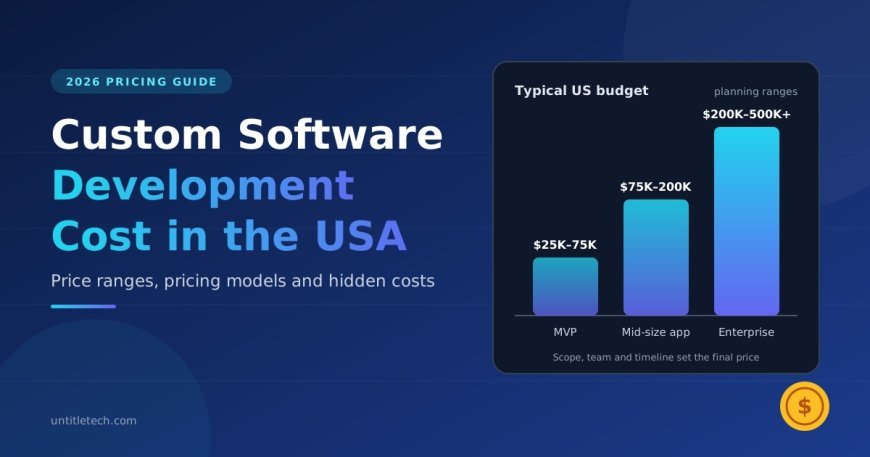
Most custom projects in the United States fall between $25,000 and $500,000. Some enterprise systems go far higher. The final number depends on scope, team, and timeline. Treat the ranges below as planning estimates, not quotes. Every project is different, so a proper discovery phase always gives a sharper figure.
|
Project type |
Typical US budget |
Typical timeline |
|---|---|---|
|
Simple tool or MVP |
$25,000–$75,000 |
2–4 months |
|
Mid-size web or mobile app |
$75,000–$200,000 |
4–8 months |
|
Complex platform or enterprise system |
$200,000–$500,000+ |
8–18 months |
Why is the spread so wide? Custom software is built from scratch around your workflow. Therefore, no two projects need the same features, integrations, or security level. A simple appointment tool and a payment platform both count as custom software. Yet their price tags look nothing alike.
Off-the-shelf software costs less on day one. However, it forces your team to adapt to the tool. Custom software flips that rule. You pay more at the start, but you get a product that fits how you work. Over several years, many companies find that one tailored system beats a stack of overlapping licenses.
New to the topic? Read our guide on what software development is and how the process works before you dive into budgets.
What Drives Custom Software Development Cost?
Six factors shape almost every quote. Understanding them helps you compare proposals fairly.
Scope and Feature Complexity
Features are the biggest cost driver. A login screen takes hours. A real-time analytics dashboard takes weeks. Each extra feature adds design, coding, testing, and support time. Consequently, a clear feature list is the best way to control your budget.
It also helps to separate must-have features from nice-to-have ones. Teams that rank features early avoid expensive surprises later.
Team Size and Skill Level
Senior engineers cost more per hour. They also finish complex work faster and make fewer mistakes. A mixed team usually works best. For example, a senior architect guides the design while mid-level developers build the features.
Team size matters too. A small team keeps communication simple. A larger team ships faster but adds management overhead.
Technology Stack and Integrations
Your tech stack affects both build time and long-term upkeep. Popular stacks have larger talent pools, so hiring and maintenance stay easier. Rare or experimental tools can raise costs.
Integrations add cost as well. Connecting to payment gateways, CRMs, ERPs, or legacy systems takes careful work. Every outside system has its own rules and quirks.
UX and UI Design
Good design reduces support tickets and boosts adoption. Research, wireframes, prototypes, and usability tests all take time. Still, this work pays off. Fixing a confusing screen after launch costs far more than fixing a prototype. Our UI/UX design services cover this stage from research to final screens.
Security and Compliance
US businesses often face strict rules. Healthcare apps must follow HIPAA. Payment tools must meet PCI DSS. Financial products may need SOC 2 reports. These requirements add design, testing, and documentation work. Even so, skipping them costs much more in fines and lost trust.
Timeline and Urgency
Fast deadlines raise prices. Teams must add people, work longer hours, or run tasks in parallel. As a result, rushed projects often cost 20 to 30 percent more than the same project on a normal schedule. If you can stay flexible, you can save real money.
Software Development Cost Estimation: How the Math Works
Software development cost estimation sounds mysterious, but the core formula is simple. Estimated hours multiply by a blended hourly rate. Then teams add a buffer for risk.
Here is a quick example. Suppose a team estimates 1,200 hours of work. The blended rate is $150 per hour. The base cost is $180,000. Next, the team adds a 15 percent contingency for unknowns. The final budget lands near $207,000.
What Do US Developers Earn?
Salary data gives a useful floor. According to the U.S. Bureau of Labor Statistics, software developers earned a median annual wage of $133,080 in May 2024. That equals roughly $64 per hour in wages alone.
Agency rates run higher. Why? Because the price also covers benefits, tools, project management, quality assurance, and company overhead. Many US agencies charge somewhere between $100 and $250 per hour, depending on seniority and specialty. Rates outside major tech hubs often sit lower.
Common Estimation Methods
Teams use three main approaches:
- Bottom-up estimation: The team lists every task and estimates each one. This method is detailed and accurate.
- Analogous estimation: The team compares your project to similar past work. It is fast but less precise.
- Three-point estimation: The team gives best-case, likely, and worst-case numbers for each task. This method handles uncertainty well.
Strong agencies often combine all three. Moreover, they re-estimate after discovery, because early guesses always improve once requirements get clearer.
Software Development Pricing Models Compared
How you pay matters as much as how much you pay. Three models dominate the US market.
Fixed Price
You agree on scope and price upfront. This model gives budget certainty. It works best for small projects with clear requirements. However, any change request usually adds extra charges. Also, vendors often add a risk premium to protect themselves.
Time and Materials
You pay for the actual hours worked. This model offers flexibility, so scope can evolve as you learn. It suits Agile projects and products with changing needs. The trade-off is less budget certainty. Therefore, set monthly caps and review progress often.
Dedicated Team
You hire a team that works only on your product. You pay a monthly fee per person. This model fits long-term products that need steady development. Costs stay predictable, and the team learns your business deeply over time.
Which Model Should You Choose?
Start with how clear your requirements are. Clear scope favors fixed price. Evolving scope favors time and materials. Long-term growth favors a dedicated team. If you feel unsure, begin with a short paid discovery phase. Then pick the model that fits what you learn. You can compare delivery styles in our post on agile vs waterfall methodology.
Where the Money Goes: Cost by Development Stage
Every project follows the same basic steps for software development. Each step carries its own cost.
Discovery and Planning
This stage defines goals, users, and requirements. It takes little money compared with later stages. Yet it prevents the costliest mistakes. If your team lacks experience, tech consulting services can shape a realistic plan and budget before you commit.
Design
Design covers wireframes, prototypes, and visual systems. It reduces rework because stakeholders approve the look and flow early. In other words, design spending acts like insurance.
Development
Development usually takes the largest share of the budget. Front-end, back-end, database, and integration work all happen here. Businesses with unique workflows often choose custom software development services because off-the-shelf tools cannot match their needs.
Testing and Quality Assurance
QA protects your investment. Testers check functions, speed, security, and compatibility. Many founders try to trim this line item. That move backfires. Bugs found after launch cost far more to fix than bugs found during testing. For details, see our overview of software testing types and the QA process.
Deployment
Deployment includes servers, pipelines, and release management. Cloud hosting keeps upfront costs low, but monthly bills grow with usage. Automation also saves money, because it reduces manual release work. Learn more in our post on DevOps CI/CD pipeline best practices.
Maintenance and Support
Launch is not the end of spending. Software needs updates, security patches, and bug fixes. Many teams budget roughly 15 to 20 percent of the original build cost per year for upkeep. Our support and maintenance services keep products stable long after release.
Cost by Product Type
The kind of product you build also changes the price.
Web Applications
Web apps run in the browser, so one codebase serves every device. This keeps costs lower than building several native apps. Complex dashboards, user roles, and integrations still raise the price. Explore our web application development services if you need a scalable platform.
Mobile Applications
Mobile apps cost more when you support both iOS and Android natively. Cross-platform frameworks can cut that cost. However, they may limit performance for heavy features. Our mobile app development services help you weigh those trade-offs.
Web3 and Blockchain Products
Web3 projects need rare skills and thorough security audits. Smart contracts cannot change easily after deployment, so mistakes are expensive. Consequently, budgets run higher than for standard apps. If you plan a decentralized product, review our Web3 development services.
Enterprise Systems
Enterprise platforms connect many departments and legacy tools. They need strong security, detailed access controls, and long testing cycles. Therefore, they sit at the top of the cost range.
Hidden Costs Many Businesses Miss
The quote is rarely the full story. Several hidden costs catch US businesses off guard.
Technical Debt
Quick shortcuts save money today and cost more tomorrow. The Consortium for Information & Software Quality estimated that accumulated technical debt in the US reached about $1.52 trillion in 2022, according to its Cost of Poor Software Quality report. That same report put the total cost of poor software quality at roughly $2.41 trillion. These figures show how expensive weak engineering becomes at scale.
Third-Party Licenses and Cloud Fees
Paid APIs, map services, payment processors, and cloud hosting all add monthly fees. Costs grow as your user base grows. Add them to your forecast early.
Scope Creep
Small requests pile up fast. One extra report here, one new role there. Soon the timeline slips and the budget swells. A change-control process keeps this risk in check.
Training and Adoption
Great software fails if people refuse to use it. Plan time for training, documentation, and onboarding. This effort costs little compared with a failed rollout.
Security Incidents
A breach can erase years of savings. Build secure coding practices into the project from day one. Follow our advice on secure software development practices to lower that risk.
In-House vs. Outsourced vs. Hybrid Teams
Hiring choices change your budget more than most people expect.
Building an In-House Team
An in-house team gives you full control. However, hiring is slow and costly. One developer earning the BLS median of $133,080 costs at least that much in salary alone. A team of five reaches $665,400 per year in base pay. Benefits, equipment, recruiting, and management come on top.
Hiring a Development Partner
Outsourcing converts fixed hiring costs into project costs. You get a ready team with proven processes. As a result, you can start faster and scale up or down as needed. This route suits companies that lack engineering leadership.
Using a Hybrid Model
Some companies keep a small core team and bring in a partner for peaks. This model balances control and flexibility. It also protects knowledge inside your company.
Software Development Strategy and Management: How to Reduce Cost
A solid software development strategy cuts costs without hurting quality. Software development and management also play a big role here. Untitle Tech applies the following tactics on every build, and you can use them too.
Start with an MVP
A minimum viable product includes only the core features. You launch sooner, learn from real users, and spend money only on what works. Our guide to building an MVP walks through the steps.
Prioritize Ruthlessly
Rank every feature by user value and effort. Build the high-value, low-effort items first. Delay everything else. This habit alone often trims budgets by double digits.
Use Agile Delivery
Short sprints expose problems early. You review working software every two weeks. Consequently, you can change direction before costs balloon.
Reuse Proven Components
Do not reinvent login systems, payment flows, or notification tools. Trusted libraries and services save weeks of work. Reserve custom code for the features that make your business unique.
Test Early and Often
Automated tests catch bugs while they are cheap to fix. They also speed up future releases. In short, early testing pays for itself.
Plan for Growth
Choose an architecture that can scale. Rebuilding a system that outgrew its design costs far more than designing it well the first time.
Make Your Product Findable
A great product still needs customers. Budget for marketing from the start. Technical SEO services help your site earn organic traffic instead of relying only on paid ads.
A Realistic Budget Example
Consider an illustrative scenario. A Florida healthcare startup wants a patient scheduling platform with a web portal and a mobile app. This example is a planning model, not a client quote.
First, the team runs a four-week discovery phase. Next, designers build prototypes and test them with real patients. Then developers launch an MVP with booking, reminders, and secure messaging. The MVP lands in the $60,000 to $90,000 range. Meanwhile, the company budgets for HIPAA safeguards, cloud hosting, and a QA cycle.
After launch, user feedback shapes phase two. The team adds insurance checks and reporting. Over two years, total spending reaches the low six figures. Yet the startup avoided a $250,000 first build that included features nobody asked for. This approach shows why staged budgets beat all-at-once builds.
Conclusion
Custom software development cost depends on scope, team, technology, security needs, and timeline. Most US projects range from about $25,000 to $500,000, and hidden costs can add more. The smartest buyers start small, plan for maintenance, and choose a pricing model that matches their clarity. The BLS wage data and the CISQ quality report both confirm one point: good engineering saves money in the long run.
Ready to get a clear number for your idea? Untitle Tech offers transparent estimates and a practical roadmap for US businesses of every size. Contact us today for a free consultation, and let's price your project the smart way.
Frequently Asked Questions About Custom Software Development Cost
How much does custom software development cost in the USA?
Most US projects cost between $25,000 and $500,000. Simple tools and MVPs sit at the low end. Complex platforms and enterprise systems sit at the high end. Your exact price depends on features, integrations, security needs, and team location. A discovery phase gives the most accurate estimate.
Why is custom software more expensive than off-the-shelf software?
Custom software is built from scratch for your exact workflow. You pay for research, design, engineering, and testing. Off-the-shelf tools spread those costs across thousands of customers. However, custom software removes license fees, fits your process, and can become a lasting business asset.
How long does it take to build custom software?
Simple MVPs usually take two to four months. Mid-size web or mobile apps often need four to eight months. Large platforms can take a year or more. Clear requirements, fast feedback, and a stable team shorten the timeline.
What are the ongoing costs after launch?
Expect hosting, third-party licenses, security updates, bug fixes, and new features. Many teams budget about 15 to 20 percent of the original build cost each year for maintenance. Costs rise if your user base grows quickly or if you add major features.
How can I reduce software development cost without hurting quality?
Start with an MVP and rank features by value. Use Agile sprints so you can adjust early. Reuse proven components and test continuously. Also, avoid scope creep with a clear change process. These habits cut waste while protecting quality.
What's Your Reaction?
 Like
0
 Dislike
0
 Love
0
 Funny
0
 Angry
0
 Sad
0
 Wow
0