


























Einstein’s IQ: What Was Albert Einstein’s IQ Really
Albert Einstein is one of the most recognizable scientists in history. His name has become almost synonymous with intelligence, genius, and extraordinary scientific achievement. His theories transformed modern physics, while his distinctive appearance and famous quotations made him a cultural icon. Because of this reputation, people have remained fascinated by one particular question: What was Einstein’s IQ really

Albert Einstein is one of the most recognizable scientists in history. His name has become almost synonymous with intelligence, genius, and extraordinary scientific achievement. His theories transformed modern physics, while his distinctive appearance and famous quotations made him a cultural icon. Because of this reputation, people have remained fascinated by one particular question: What was Einstein’s IQ really?
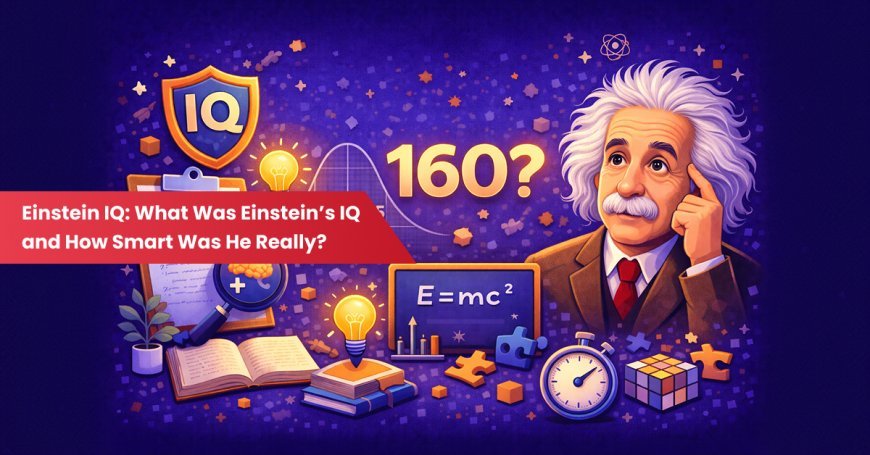
You may have seen claims that Einstein's IQ was 160, 170, or even 180. These figures are repeated frequently online, but there is an important fact that often gets overlooked: there is no verified record showing that Albert Einstein ever took a standardized IQ test and received an official score.
This means that his exact IQ cannot be established. The numbers commonly associated with Einstein are estimates rather than documented test results. His extraordinary intelligence is much better demonstrated through his scientific achievements, reasoning, creativity, and approach to difficult problems.
What Was Einstein's IQ?
The most accurate answer is simple: Einstein's exact IQ is unknown.
There is no authenticated IQ test result that historians can use to establish a numerical score for him. Although intelligence testing existed during Einstein's lifetime, there is no reliable evidence that he completed a standardized IQ examination that produced the score often quoted online.
Some popular sources estimate that Einstein's IQ may have been between 160 and 180. These numbers are generally based on his scientific accomplishments and intellectual reputation.
However, an estimated IQ should not be confused with an actual IQ score.
If someone claims that Einstein "had an IQ of 170," that wording suggests that he actually sat for an IQ test and received a score of 170. There is no reliable historical documentation confirming that.
Why Are Specific IQ Numbers Associated With Einstein?
The popularity of specific numbers is understandable. People often want a simple way to describe extraordinary intelligence.
Einstein produced scientific ideas that were difficult, innovative, and enormously influential. It can therefore seem natural to assume that someone capable of such achievements must have possessed an exceptionally high IQ.
The problem is that scientific accomplishments cannot be translated directly into IQ points.
IQ tests measure specific cognitive abilities under standardized conditions. Scientific achievement involves many additional factors, including education, knowledge, creativity, curiosity, motivation, persistence, opportunity, and the ability to recognize important problems.
Consequently, there is no reliable formula that allows researchers to calculate Einstein's IQ from his scientific achievements.
Einstein Lived Before Modern IQ Testing Became Common
Historical context also matters.
Einstein was born in 1879 and died in 1955. Intelligence testing developed considerably during this period, but modern IQ testing was not identical to the systems used today.
Early intelligence tests were designed for particular purposes and populations. Testing methods have also changed substantially over time.
Even though intelligence assessments existed during Einstein's life, there is no established record that he took one and received an official score.
This is why modern claims about Einstein's IQ need to be treated carefully.
Einstein's Scientific Achievements Tell Us More
Although Einstein's IQ is unknown, his intellectual accomplishments are extensively documented.
In 1905, Einstein published several important papers that had major consequences for physics. This period is often called his "miracle year."
His work on Brownian motion provided theoretical support for the existence of atoms and molecules. He also explained the photoelectric effect, making a major contribution to the emerging field of quantum theory.
Einstein's work on special relativity introduced a new understanding of space and time. He also established the relationship between mass and energy expressed by the famous equation E = mc².
These contributions alone would have established an important place in scientific history. Einstein later went further by developing the general theory of relativity.
General Relativity and Einstein's Thinking
General relativity represented a major change in how scientists understood gravity.
Instead of describing gravity simply as a conventional force between objects, Einstein's theory connected gravity with the geometry of spacetime.
The theory required sophisticated mathematical reasoning, but it also required Einstein to rethink basic assumptions about physical reality.
This ability to question established ideas was a major feature of his scientific approach.
Einstein did not simply attempt to solve familiar problems more quickly. He often asked whether the assumptions behind those problems were correct in the first place.
That distinction is important when considering Einstein's IQ.
Einstein and Thought Experiments
Einstein was famous for using thought experiments to explore difficult scientific concepts.
A thought experiment involves imagining a hypothetical situation and using logical reasoning to investigate what would happen.
Einstein used these mental exercises when thinking about light, motion, clocks, observers, and gravity. They allowed him to explore questions that were difficult to investigate through direct experimentation.
This ability to visualize hypothetical situations is one reason why describing Einstein only through an IQ score can be limiting.
A standardized intelligence test can measure certain forms of reasoning, but it does not necessarily measure someone's ability to create new conceptual frameworks.
Einstein's scientific achievements often depended on precisely this kind of original thinking.
Was Einstein Naturally Gifted?
It is tempting to describe Einstein as someone who was simply born with extraordinary intelligence. However, his development was more complicated.
He showed early interest in scientific questions and mathematics, but his accomplishments also reflected years of learning and intellectual effort.
Einstein developed extensive knowledge of physics and mathematics. He read scientific works, studied established theories, discussed ideas with colleagues, and spent years refining his own concepts.
Exceptional ability and sustained effort can work together. Focusing only on innate intelligence can give an incomplete picture of how major scientific achievements happen.
Einstein's Education and Career
Einstein studied at the Swiss Federal Polytechnic in Zurich, where he received training in mathematics and physics.
His early professional career was not immediately associated with academic fame. He worked at the Swiss Patent Office in Bern, where he evaluated patent applications.
Despite working outside a traditional academic research position, he continued developing his scientific ideas.
His 1905 publications eventually brought him international attention.
This part of his story is particularly interesting because it shows that intellectual achievement does not always follow a predictable career path.
Einstein's Nobel Prize
Einstein's scientific contributions were eventually recognized with the Nobel Prize in Physics.
He received the 1921 Nobel Prize in Physics for his explanation of the photoelectric effect.
The award provides documented evidence of the importance of his scientific work.
The photoelectric effect involves the emission of electrons from a material when electromagnetic radiation interacts with it. Einstein's explanation helped establish the idea that light can behave in discrete energy units, an important development in quantum physics.
His Nobel Prize is therefore a concrete historical measure of his scientific contribution, unlike the unverified IQ figures commonly attributed to him.
Was Einstein's IQ 160?
The claim that einstein's iq was 160 is widespread.
However, there is no verified test record demonstrating that he received this score.
The same applies to claims that he had an IQ of 170 or 180.
These numbers are estimates created after considering his intellectual achievements. They may be used to suggest the level of cognitive ability someone like Einstein might have demonstrated on a modern intelligence test, but that remains speculative.
It is therefore more accurate to say that Einstein is sometimes estimated to have had an IQ in the 160 to 180 range than to say that he definitely had such a score.
How Does Einstein Compare With Other Famous Thinkers?
Comparing Einstein's IQ with other famous intellectuals is also complicated.
Historical figures such as Isaac Newton and Leonardo da Vinci are sometimes assigned estimated IQ scores. Yet they generally do not have standardized test results that allow meaningful numerical comparisons.
A score estimated from someone's achievements cannot be directly compared with an actual standardized test score.
Even modern comparisons can be difficult because different intelligence tests use different scales, populations, and testing methods.
For this reason, claims about which famous historical thinker had the highest IQ should be viewed cautiously.
Does a High IQ Explain Genius?
The idea that IQ explains genius is another common misconception.
IQ can measure certain cognitive abilities, including reasoning, problem-solving, memory, and pattern recognition. These abilities can be relevant to academic and scientific performance.
However, scientific creativity involves much more.
A scientist may need to identify an important question, develop an original hypothesis, understand existing research, remain persistent after failures, and communicate ideas effectively.
Einstein's career demonstrates the importance of these broader qualities.
His intellectual impact was not simply the result of solving difficult problems. He helped redefine the questions scientists were asking.
What Made Einstein Brilliant?
Several characteristics help explain Einstein's remarkable scientific influence.
Curiosity encouraged him to investigate fundamental questions about nature.
Imagination allowed him to explore hypothetical situations through thought experiments.
Independent thinking helped him challenge assumptions that were widely accepted.
Mathematical reasoning allowed him to express and develop complex theories.
Persistence helped him work through difficult problems over many years.
Scientific knowledge provided the foundation for his original ideas.
Together, these qualities offer a richer explanation of Einstein's intellectual achievements than a single IQ number.
Facts Versus Myths About Einstein's IQ
When researching Einstein's IQ, it helps to distinguish between established facts and popular claims.
Fact: Einstein was one of the most influential physicists of the twentieth century.
Fact: He developed the special and general theories of relativity.
Fact: He made important contributions to quantum theory.
Fact: He received the 1921 Nobel Prize in Physics for his explanation of the photoelectric effect.
Fact: There is no verified official IQ score for Einstein.
Claim: Einstein had an IQ of 160.
Claim: Einstein had an IQ of 170.
Claim: Einstein had an IQ of 180.
The final three claims are estimates rather than confirmed test results.
Why the Myth Continues
The Einstein IQ story continues to spread because numerical claims are easy to understand and remember.
A number such as 170 seems to provide a definitive answer to a complicated question. It gives people a way to compare Einstein with other famous thinkers.
But when there is no documented test result, the apparent precision is misleading.
Repeating the same estimate across many websites does not make it a verified historical fact.
Readers should therefore pay attention to whether a source distinguishes between an estimated IQ and an actual test score.
The Real Meaning of Einstein's Intelligence
Perhaps the most interesting question is not what Einstein's IQ was, but how he used his intellectual abilities.
Einstein approached fundamental questions differently from many scientists of his time. He was willing to challenge assumptions and consider possibilities that initially seemed counterintuitive.
His theories required him to combine abstract reasoning with physical intuition.
This combination allowed him to rethink concepts that had been treated as fundamental.
His intellectual legacy therefore provides a broader lesson about intelligence. Exceptional achievement can emerge from the interaction of knowledge, curiosity, creativity, reasoning, imagination, and persistence.
The Real Answer
So, what was Einstein's IQ really?
The exact number is unknown.
The often-repeated estimates of 160 to 180 are not supported by a verified IQ test. They are retrospective estimates based on his extraordinary achievements.
What we can say with confidence is that Einstein demonstrated exceptional intellectual ability through his scientific work.
His theories changed modern physics. His explanation of the photoelectric effect contributed to quantum theory. His work on relativity transformed scientific thinking about space, time, and gravity.
These accomplishments provide direct historical evidence of his influence.
Conclusion
The mystery surrounding Einstein's IQ is unlikely to disappear. People will continue to search for a number that explains how such an extraordinary scientist could produce revolutionary ideas.
But the historical record does not provide a confirmed answer.
Einstein's exact IQ is unknown, and the figures of 160, 170, and 180 should be regarded as estimates rather than documented test results.
His intelligence is better understood through his scientific achievements and the way he approached complex problems. His curiosity, imagination, independent thinking, mathematical ability, and persistence all contributed to his remarkable career.
Ultimately, Einstein's legacy does not depend on an IQ score. His ideas transformed our understanding of the universe, and that documented intellectual contribution is far more meaningful than any unverified number.
What's Your Reaction?
 Like
0
Like
0
 Dislike
0
Dislike
0
 Love
0
Love
0
 Funny
0
Funny
0
 Angry
0
Angry
0
 Sad
0
Sad
0
 Wow
0
Wow
0