























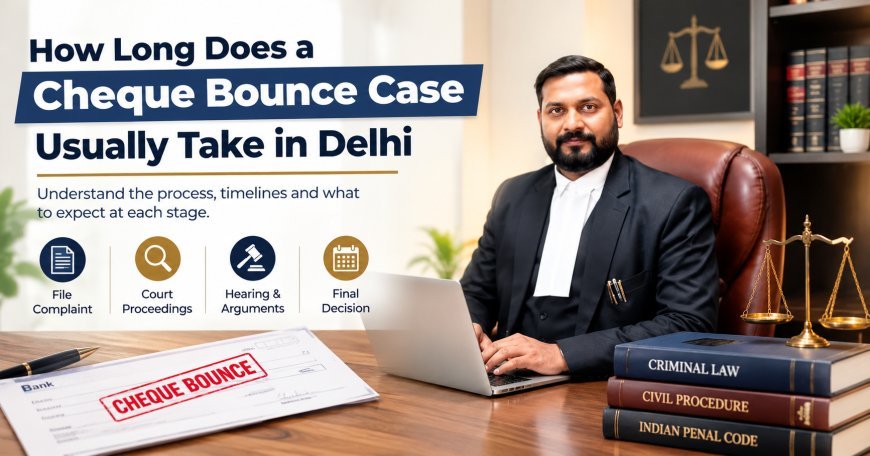
How Long Does a Cheque Bounce Case Usually Take in Delhi?
A cheque bounce occurs when a bank refuses to honour a cheque presented for payment.
A cheque bounce can create financial problems for individuals, business owners, and companies. When a cheque is returned unpaid by a bank, the person receiving it may face delays in recovering their money. In Delhi, the time required to resolve a cheque bounce case depends on several factors, including the reason for dishonour, the response of the person who issued the cheque, the availability of evidence, and the court's workload. Understanding the legal process can help you take the right steps and avoid unnecessary delays.
If you are dealing with a bounced cheque, consulting the best cheque bounce lawyer in delhi can help you understand your legal rights, prepare the necessary documents, and follow the correct procedure under Indian law.
What Is a Cheque Bounce Case?
A cheque bounce occurs when a bank refuses to honour a cheque presented for payment. Common reasons include insufficient funds, an account closure, or certain discrepancies in the cheque. However, not every dishonoured cheque automatically results in criminal liability.
Under Section 138 of the Negotiable Instruments Act, 1881, a cheque bounce may become a criminal offence when the cheque was issued to discharge a legally enforceable debt or liability and the statutory requirements are satisfied.
The law provides a legal remedy to the cheque recipient, but the required notices, deadlines, and court procedures must be followed carefully.
How Long Does a Cheque Bounce Case Take in Delhi?
There is no fixed timeline for every cheque bounce case in Delhi. A straightforward matter may be resolved within several months if the parties reach a settlement early. However, a contested case may take one to three years or longer, depending on the circumstances, court workload, and procedural developments. These are general estimates rather than guaranteed timelines.
The process usually involves the following stages:
1. Cheque Presentation and Dishonour
The first step is presenting the cheque to the bank within its validity period. If the bank returns it unpaid, the cheque recipient should obtain the bank's return memo, which records the reason for dishonour.
Under the Negotiable Instruments Act, a cheque generally needs to be presented within three months from its date, subject to applicable banking rules.
2. Sending a Legal Notice
After receiving information about the dishonour, the cheque recipient must send a written demand notice to the cheque issuer within 30 days of receiving the bank's information about the dishonour.
The notice demands payment of the cheque amount. The person who issued the cheque then has 15 days from receiving the notice to make the payment.
If payment is made within this period, the statutory requirements for a Section 138 complaint are generally not completed on that occasion.
3. Filing the Court Complaint
If the cheque issuer fails to pay within the 15-day notice period, the cause of action arises. The recipient can file a complaint under Section 138 after that period expires.
The complaint must generally be filed within one month from the date the cause of action arises, although the court may condone a delay if sufficient cause is established.
Preparing accurate documents and filing within the prescribed deadline can help prevent avoidable complications.
4. Court Proceedings and Evidence
Once the complaint is filed, the court considers the matter according to the applicable procedure. The process may involve examining the complaint, issuing summons, recording the accused person's plea, considering evidence, hearing arguments, and delivering a judgment.
If the cheque issuer disputes the liability, challenges the evidence, or fails to appear, additional hearings may be necessary. These factors can increase the time required to complete the case.
5. Settlement or Final Judgment
Some cheque bounce disputes are resolved through mutual settlement before the final judgment. Settlement can reduce legal expenses and save time when both parties agree on acceptable payment terms.
If the matter proceeds to trial, the court will decide the case based on the evidence and applicable law. Further proceedings, including an appeal, may extend the overall timeline.
Factors That Affect the Duration of a Cheque Bounce Case
Several factors can influence how quickly a cheque bounce case moves through the legal system.
Quality of documentation: Complete records, including the original cheque, bank return memo, legal notice, delivery proof, and evidence of the underlying debt, can make the case easier to prepare.
Cooperation between parties: When both parties participate in proceedings and consider reasonable settlement options, unnecessary delays may be avoided.
Court workload: The number of pending cases and availability of hearing dates can affect the speed of proceedings.
Disputed liability: If the cheque issuer challenges the debt, signature, or circumstances surrounding the cheque, the court may need to examine additional evidence.
Legal representation: A lawyer familiar with cheque bounce proceedings can help identify procedural requirements, prepare documents, meet deadlines, and respond to legal objections.
Why Choose the Best Cheque Bounce Lawyer in Delhi?
Choosing suitable legal representation is important when you want to recover outstanding payments or defend yourself against a cheque bounce complaint. The best cheque bounce lawyer in delhi should understand the Negotiable Instruments Act, court procedures, documentation requirements, and possible settlement options.
An experienced lawyer can review the facts, explain the available legal remedies, draft a demand notice, prepare a complaint, and represent you during court proceedings. Legal guidance can also help you understand the risks, costs, and likely next steps in your particular case.
Legals365 provides legal assistance for individuals and businesses dealing with legal disputes. By understanding your circumstances and reviewing the available documents, the team can help you explore appropriate legal options and approach the matter with greater clarity.
Documents Required for a Cheque Bounce Case
Before consulting a lawyer, it is useful to arrange the following documents:
-
Original cheque or a clear copy, as applicable.
-
Bank return memo stating the reason for dishonour.
-
Copy of the legal demand notice.
-
Postal receipt, tracking report, or other proof of notice delivery.
-
Invoices, agreements, loan records, or other evidence of the legally enforceable debt.
-
Relevant payment records and communication between the parties.
Having these documents ready can help your lawyer assess the matter and identify any missing information.
Conclusion
A cheque bounce case in Delhi can take several months or years, depending on whether the dispute is settled or proceeds through a contested trial. The statutory notice and filing deadlines are particularly important because missing them can affect your legal options.
If you have received a bounced cheque or are facing a complaint, seeking timely guidance can help you understand the process and make informed decisions. Legals365 can help you explore appropriate legal assistance for your situation. With proper documentation, attention to deadlines, and suitable legal representation, you can approach a cheque bounce dispute more confidently and work towards a practical resolution.
Frequently Asked Questions
1. Can a cheque bounce case be settled outside court?
Yes. The parties may reach a settlement, and cheque bounce offences under Section 138 are compoundable under Section 147 of the Negotiable Instruments Act, subject to the applicable procedure.
2. Is there a deadline for filing a cheque bounce complaint?
Generally, the complaint must be filed within one month from the date the cause of action arises after the 15-day payment period expires. The court may allow a delay for sufficient cause.
3. Can a lawyer help speed up a cheque bounce case?
A lawyer can help ensure that documents are prepared correctly, deadlines are met, and procedural issues are addressed. However, no lawyer can guarantee a particular outcome or completion date.
4. What happens if the cheque issuer refuses to pay?
If the statutory requirements are met and payment is not made within the notice period, the cheque recipient may file a complaint under Section 138 of the Negotiable Instruments Act.
5. Where can I get legal guidance for a cheque bounce dispute in Delhi?
You can contact Legals365 to explore legal assistance and understand the appropriate steps for your circumstances.
What's Your Reaction?
 Like
0
Like
0
 Dislike
0
Dislike
0
 Love
0
Love
0
 Funny
0
Funny
0
 Angry
0
Angry
0
 Sad
0
Sad
0
 Wow
0
Wow
0