
















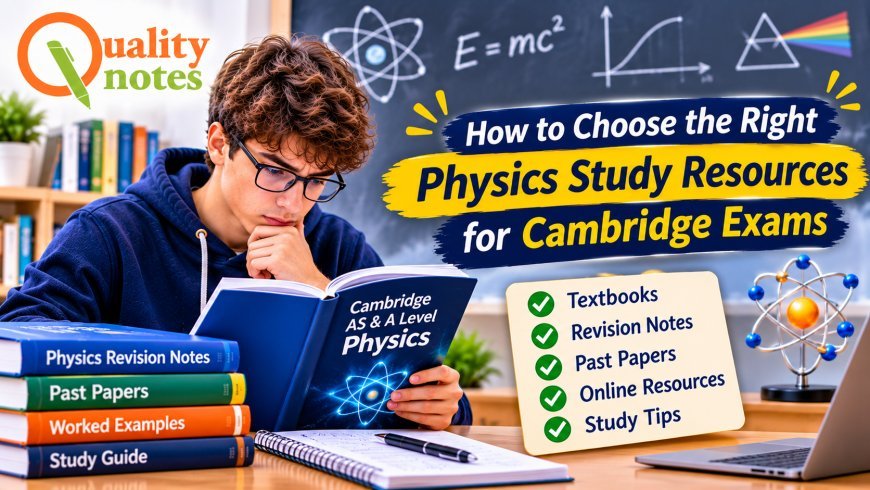
How to Choose the Right Physics Study Resources for Cambridge Exams
Find out how to choose the best Physics study resources for Cambridge exams. Learn how to use revision notes, textbooks, practice questions, and online learning tools.
Preparing for Cambridge AS & A Level Physics requires a smart approach to learning. Students need to understand scientific concepts, remember important definitions, practice mathematical calculations, and develop strong examination skills.
However, choosing the right study materials can be difficult. Many students download numerous revision notes, watch different educational videos, and collect several textbooks without knowing which resources will actually help them.
Using too many learning materials can create confusion and waste valuable revision time. Instead, students should choose resources that explain topics clearly, follow the Cambridge syllabus, and provide opportunities to practice examination questions.
The right Physics study resources for Cambridge exams can make learning more organized and help students understand difficult concepts more effectively.
In this guide, we explore how to find useful Physics learning materials, identify reliable educational resources, and build a study routine that supports better examination results.
1. Understand Your Learning Needs Before Choosing Resources
Every student has different learning requirements. Some students struggle with mathematical calculations, while others find scientific explanations, practical experiments, or examination questions more challenging.
Before selecting study materials, identify the areas where you need the most support.
Ask yourself a few important questions:
- Do I understand the main concepts in each Physics topic?
- Can I select the correct formula for numerical questions?
- Do I struggle with rearranging equations?
- Can I interpret graphs and experimental results?
- Do I understand Cambridge examination questions?
- Can I explain scientific ideas using accurate terminology?
Your answers will help you choose suitable learning resources.
For example, if you struggle with calculations, look for materials that include detailed worked examples. If you find theoretical concepts difficult, choose resources with clear explanations and helpful illustrations.
Do not follow another student's revision method without considering your own weaknesses.
2. Look for Resources That Follow the Cambridge Syllabus
One of the most important things to consider is syllabus coverage.
Cambridge AS & A Level Physics includes several topics, and students need to understand the specific learning objectives required for their examination.
Some online resources may explain Physics topics in great detail but include information that is not necessary for your course.
Always check the latest syllabus for your examination year before choosing revision materials.
Look for resources that:
- Cover the topics included in your syllabus.
- Explain the required learning objectives.
- Use correct scientific terminology.
- Include relevant equations and definitions.
- Support your examination preparation.
- Match your AS or A Level study requirements.
Following the syllabus helps you focus on the right information and avoid unnecessary revision.
3. Choose Learning Materials That Explain Difficult Topics Simply
A good study resource should make complicated ideas easier to understand.
Physics contains concepts that students cannot always observe directly. Topics such as electric fields, magnetic fields, quantum physics, and nuclear physics may require additional explanations.
If a resource uses complicated language without explaining the basic principles, students may struggle to understand the topic.
Look for learning materials that introduce concepts gradually.
For example, when studying electric fields, a useful explanation should help you understand what an electric field is, how charges interact, and how field strength relates to force.
Similarly, when learning circular motion, students should understand the relationship between velocity, acceleration, and centripetal force.
Choose resources that explain the reasoning behind scientific principles rather than simply providing definitions to memorize.
4. Use Different Resources for Different Learning Activities
Students do not need to depend on one type of learning material.
Different resources support different parts of Physics preparation. Textbooks help explain concepts, revision notes support quick reviews, and past papers develop examination skills.
Try combining several useful learning methods.
Textbooks for Understanding
Use textbooks when you need detailed explanations of scientific principles. Read examples carefully and make notes about concepts you find difficult.
Revision Notes for Reviewing
Use concise notes to revise important definitions, equations, and scientific relationships. They are particularly helpful when reviewing previously studied topics.
Worked Examples for Calculations
Study step-by-step solutions to understand how to select equations, substitute values, and calculate answers.
Past Papers for Examination Practice
Solve Cambridge questions to understand how examiners test your knowledge and apply Physics concepts.
Educational Videos for Visual Learning
Use suitable videos when diagrams, demonstrations, or animations can help explain difficult scientific ideas.
Combining these resources creates a more balanced approach to learning.
5. Find Resources That Improve Your Mathematical Confidence
Mathematical ability plays a major role in Cambridge Physics.
Students regularly use algebra, trigonometry, standard form, ratios, and graphs to solve scientific problems.
Sometimes, students understand the Physics concept but cannot complete the calculation because they struggle with the mathematical steps.
Choose learning resources that provide clear explanations of numerical problems.
Pay particular attention to:
- Rearranging physics equations.
- Converting units correctly.
- Using significant figures.
- Working with standard form.
- Calculating gradients.
- Applying trigonometric relationships.
- Interpreting mathematical results.
Practice calculations regularly rather than waiting until the examination period.
When reviewing a worked example, try solving the same question independently without looking at the solution. This helps you check whether you genuinely understand the method.
6. Check Whether the Resources Include Examination-Style Questions
Understanding Physics theory is important, but students must also know how to apply their knowledge in examinations.
Choose study materials that include questions similar to those used in Cambridge examinations.
These questions should challenge you to:
- Apply scientific principles.
- Select appropriate equations.
- Explain physical processes.
- Interpret graphs.
- Analyze experimental information.
- Solve multi-step calculations.
- Use correct scientific terminology.
Start with straightforward questions and gradually attempt more challenging problems.
This method helps you build confidence before moving on to complete past papers.
7. Use Mark Schemes to Understand How Marks Are Awarded
Mark schemes provide useful information about what Cambridge examiners expect from students.
Many learners lose marks because their answers contain incomplete explanations or incorrect scientific terminology.
Reading mark schemes helps students recognize the key points they should include in their answers.
However, avoid memorizing mark schemes without understanding the concepts.
After completing a question, compare your answer with the mark scheme and identify:
- Important points you missed.
- Scientific terms you used incorrectly.
- Calculation steps that need improvement.
- Units or significant figures you forgot.
- Explanations that lacked sufficient detail.
Use this feedback to improve your next attempt.
Over time, you will become more familiar with examination expectations and develop better answering techniques.
8. Select Online Resources That Offer Real Learning Value
The internet provides access to many educational websites, revision platforms, and Physics learning materials.
However, students should evaluate online resources before depending on them.
A useful educational website should provide accurate information, clear explanations, and content relevant to Cambridge Physics.
Before choosing an online resource, consider whether it:
- Explains topics in understandable language.
- Covers relevant Cambridge Physics concepts.
- Provides useful revision materials.
- Helps students develop problem-solving skills.
- Organizes information clearly.
- Supports independent learning.
Avoid spending too much time switching between different websites.
Choose a few reliable educational platforms and use them consistently throughout your preparation.
9. Make Sure Your Resources Support Practical Physics
Practical knowledge is another important part of Cambridge Physics.
Students need to understand how experiments work, how scientists collect measurements, and how they interpret experimental results.
Reading theoretical notes alone may not provide enough preparation for practical and experimental questions.
Look for resources that explain:
- How to identify experimental variables.
- How to select suitable measuring instruments.
- How to record accurate measurements.
- How to plot experimental graphs.
- How to calculate gradients.
- How to understand measurement uncertainties.
- How to identify sources of experimental errors.
- How to suggest improvements to experimental methods.
Try connecting practical explanations with the relevant theory.
For example, when studying waves, understand how experimental methods can help determine wavelength and frequency.
This connection makes scientific concepts easier to apply.
10. Avoid Depending on Too Many Study Materials
Collecting more study resources does not automatically improve examination performance.
Some students download multiple revision guides and save dozens of educational videos. They spend more time searching for information than actually learning Physics.
This habit can make revision confusing.
Instead, build a small collection of reliable resources.
Start with your Cambridge syllabus and one main textbook. Add clear revision notes for reviewing difficult concepts. Use worked examples to practice calculations and past papers to develop examination skills.
Only introduce additional materials when they solve a specific learning problem.
A focused approach helps you spend more time practicing and less time organizing unnecessary resources.
11. Build a Consistent Study Routine Around Your Resources
Choosing suitable learning materials is only the beginning. You also need a regular study routine to use them effectively.
Start by dividing your Physics syllabus into manageable topics.
Set realistic daily goals and focus on understanding one concept at a time.
During each study session:
- Review the theory before attempting questions.
- Write down important equations and definitions.
- Solve numerical problems independently.
- Practice examination-style questions.
- Check your answers using mark schemes.
- Record mistakes that you need to review.
At the end of each week, identify the topics that still require attention.
If you continue making mistakes in a particular area, find another explanation or practice additional questions.
A consistent routine helps you develop stronger knowledge and improve your confidence over time.
12. Know When to Change Your Study Resources
Sometimes students continue using learning materials that do not match their learning needs.
For example, a student may repeatedly read a textbook chapter without understanding the main concept.
Instead of wasting more time, try a different learning approach.
Use a diagram, watch a suitable explanation, or find worked examples that demonstrate the concept step by step.
You should consider changing or adding resources when:
- Explanations remain unclear.
- Practice questions are too easy or too difficult.
- The material does not match your syllabus.
- You cannot apply the information independently.
- The resource does not help you understand your mistakes.
The purpose of study materials is to improve learning. Choose resources based on how effectively they help you understand and apply Physics concepts.
How Quality Notes Supports Cambridge AS & A Level Physics Students
Finding suitable educational materials can make Cambridge Physics preparation more organized and effective.
Quality Notes offers educational Physics content designed to support AS & A Level students. It helps learners explore important concepts, improve their subject understanding, and develop stronger study habits.
Students can use Quality Notes as part of their wider revision strategy alongside classroom lessons, textbooks, and Cambridge past papers.
Rather than relying only on memorization, learners should focus on understanding scientific principles and applying them to different examination questions.
Visit Quality Notes to explore Physics learning resources and find helpful study support for your Cambridge examinations.
Final Thoughts
Choosing the right Physics study resources for Cambridge exams is an important step towards successful preparation.
Students should begin by understanding their learning needs and checking the Cambridge syllabus. They should then select clear textbooks, useful revision notes, worked examples, practical learning materials, and examination questions.
Remember that effective revision is not about collecting the largest number of resources. It is about choosing materials that help you understand difficult concepts and improve your ability to solve problems.
Stay organized, practice consistently, and review your progress regularly.
With the right learning approach and suitable study resources, you can strengthen your Physics knowledge and prepare for Cambridge AS & A Level examinations with greater confidence.
What's Your Reaction?
 Like
0
 Dislike
0
 Love
0
 Funny
0
 Angry
0
 Sad
0
 Wow
0