






















Playinmatch: KARDS Guide for World War II Card Game Fans
Explore KARDS, the WWII strategy card game. Learn its gameplay, nations, card types, deck-building methods and beginner tips with Playinmatch.
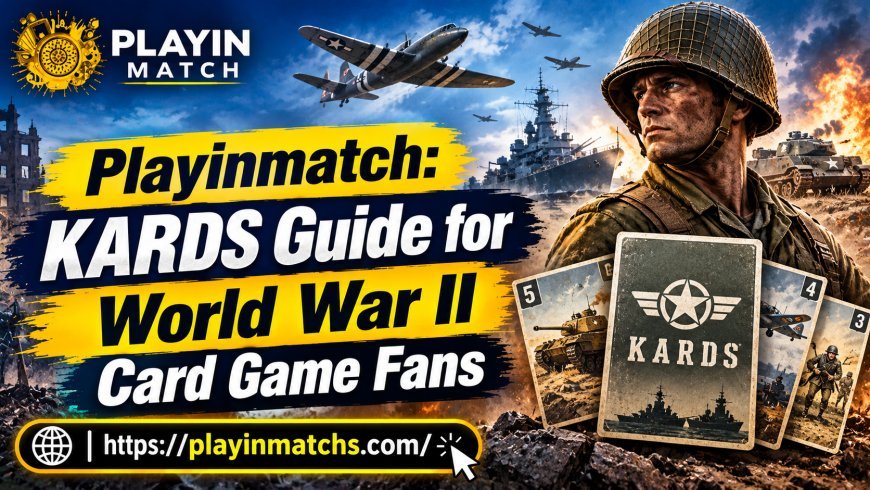
World War II strategy games offer an interesting combination of history, military planning and competitive gameplay. While many games allow players to control soldiers, tanks and aircraft directly, some use cards to represent military units, battlefield orders and important tactical decisions. KARDS: The WWII Card Game brings these elements together in a strategic card game where every move can influence the result of a battle.
KARDS combines traditional collectible card game mechanics with ideas inspired by classic strategy games and real military operations. Players build decks around major World War II nations and use infantry, tanks, artillery, aircraft and special orders to challenge opponents. The game focuses on battlefield control, resource management and careful planning rather than quick actions alone.
For players exploring different online gaming experiences through Playinmatch, KARDS is an interesting title to understand. Its gameplay rewards patience, tactical thinking and knowledge of card combinations. This guide explains the main features of KARDS, how its battles work, how players can build effective decks and what beginners should understand before entering competitive matches.
What Is KARDS: The WWII Card Game?
KARDS is a digital collectible card game based on the military setting of World War II. It combines familiar card game rules with battlefield mechanics that make players think like military commanders. Instead of simply placing cards on a table and attacking an opponent, players must manage a battlefield with different areas, military units and resource requirements.
The game features several nations associated with World War II. Each nation has its own collection of cards and strategic identity. Players choose a main nation and can include cards from an allied nation to create a deck that supports their preferred approach. This system makes deck construction an important part of the experience.
KARDS is designed around battles between two players. Each player commands a headquarters, deploys military units and attempts to reduce the opponent's headquarters defence to zero. Units can attack enemy forces or help control important battlefield positions. Players can also use Order cards to create immediate effects and Countermeasures to respond to certain enemy actions.
The official game combines ground, air and naval warfare themes with a frontline system. This gives battles a stronger tactical feel because controlling the right position can determine which units are able to attack or defend. For fans of military history and strategy card games, this approach offers a different experience from fantasy-based collectible card games.
Understanding the Basic Gameplay
The first step towards understanding KARDS is learning how a typical battle works. Each player begins with a headquarters that has defence points. The main objective is to reduce the opponent's headquarters defence to zero through attacks and card effects.
Players draw cards from their decks and use a resource called Kredits to play them. Kredits are required to deploy units and use certain cards. The available resource capacity increases as the battle progresses, allowing players to introduce stronger units and more expensive strategies during later turns.
Resource management is important because every card has a cost. Spending all available Kredits on one unit may leave no resources for an important Order card or another defensive move. A player should therefore consider the value of each action before using available resources.
The battlefield is divided into different areas, including the Support Line and the Frontline. The Support Line is where the headquarters and supporting units are positioned. The Frontline is a key area that allows certain ground units to attack enemy forces and headquarters. Control of this area can create opportunities for offensive pressure while also protecting important assets.
Players must understand how units move between these areas and how their abilities affect attacks. A strong deck is not enough if its cards are played without considering their position, cost and timing. Successful gameplay depends on combining the right cards with suitable battlefield decisions.
Main Nations and Their Strategic Identity
One of the most interesting parts of KARDS is its selection of World War II nations. Each nation has a different military identity, which influences its available cards and common tactical approaches. Choosing a nation is not only a visual preference; it also affects how a player builds a deck and approaches battles.
Germany is commonly associated with aggressive attacks and mechanised forces. Its strategy can focus on powerful armoured units, fast pressure and offensive combinations. Players who enjoy taking control of the battlefield early may find this style interesting. However, aggressive decks still require careful resource management because a poorly planned attack can leave the headquarters exposed.
The United States offers strategic possibilities based on production strength, powerful military units and air support. Its cards can support different approaches, including large-scale attacks and steady battlefield development. Players can explore combinations that allow them to build pressure over several turns.
The British Empire has a strong identity connected with air and naval power, defence and intelligence. Its cards can support players who prefer controlling the pace of a match and responding to enemy movements. A defensive approach can be effective when supported by the right units and carefully timed orders.
The Soviet Union is associated with large military forces, strong battlefield presence and determined attacks. Its strategic identity can appeal to players who want to develop a powerful ground presence and maintain pressure on the opponent.
France also has its own historical identity and card options. In addition to the main nations, KARDS includes allied nations that can provide additional deck-building choices. These combinations allow players to bring together different tactical strengths and create strategies that suit their preferred style.
Understanding the Different Card Types
Cards are the foundation of every KARDS battle. Understanding their roles helps players make better decisions and avoid wasting resources. Military units, Orders and Countermeasures each serve a different purpose.
Military Unit cards represent forces that remain on the battlefield after deployment. These units can attack, defend, control positions and use special abilities. Their value depends on several factors, including deployment cost, attack strength, defence and operational requirements.
The game includes different unit categories. Infantry units often provide useful ground presence and can support affordable strategies. Tanks are generally associated with strong attacks and armoured pressure. Artillery can damage targets from protected positions, while aircraft such as Fighters and Bombers provide air-based options.
Order cards work differently from military units. They create an immediate or delayed effect when played and are not placed on the battlefield as permanent units. An Order may damage an enemy, strengthen a friendly unit, provide additional resources or support another tactical objective. Choosing the correct moment to use an Order can change the direction of a match.
Countermeasures allow players to prepare hidden responses to certain opponent actions. These cards can create uncertainty because the opponent may not know which action will trigger a response. Understanding when to activate a Countermeasure is an important part of defensive planning.
Players should read card descriptions carefully. Some abilities activate when a unit enters the battlefield, while others depend on movement, destruction or specific conditions. Learning these details makes it easier to recognise useful combinations and avoid mistakes.
How to Build a Balanced KARDS Deck
Deck-building is one of the most important skills in KARDS. A deck should support a clear strategy while remaining flexible enough to respond to different opponents. Selecting powerful cards without considering how they work together can create an unreliable deck.
A balanced deck needs a suitable combination of low-cost and high-cost cards. Low-cost units help players establish an early presence, while more expensive cards can provide stronger effects later in the battle. If a deck contains too many expensive cards, players may struggle to defend themselves during the opening turns. On the other hand, a deck with only low-cost units may find it difficult to deal with powerful enemy forces.
Players should also consider the relationship between units and Orders. Military units create a presence on the battlefield, while Orders can support them or deal with specific threats. A deck with a useful combination of both can respond to more situations than one that depends entirely on a single card type.
The main nation and allied nation should also work well together. An allied nation can provide useful abilities that support the main strategy, but adding cards simply because they look powerful may weaken the overall deck. Players should choose cards that improve the deck's resource balance, battlefield control or finishing potential.
It is also helpful to identify a clear win condition. Some decks aim to defeat the opponent quickly through aggressive attacks. Others focus on controlling the Frontline, removing enemy units and building an advantage over several turns. Knowing the main objective makes card selection more organised.
Beginner Strategies for Better Results
New players should begin by learning the basic rules rather than trying to create a complicated deck immediately. The training mode and beginner campaigns provide opportunities to understand the controls, card effects and battlefield layout. These experiences can help players become comfortable with the game before entering competitive battles.
Resource management should be a priority from the beginning. Before playing a card, consider how many Kredits will remain and whether another action may be more useful. A player who spends resources carefully can maintain more options throughout a turn.
Controlling the Frontline is another important part of the game. Ground units often need access to this area to attack enemy units and the opponent's headquarters. However, moving forward without considering the opponent's possible response can lead to unnecessary losses. Players should think about whether a move creates a real advantage or simply exposes a valuable unit.
It is also important to protect the headquarters. Focusing only on attacking can leave a player vulnerable to enemy units and direct damage. Defensive units, suitable Orders and careful positioning can help prevent the opponent from gaining an easy advantage.
Reading the opponent's strategy is equally valuable. If the opponent repeatedly deploys low-cost units, they may be trying to win through early pressure. If they spend several turns preparing expensive cards, they may be planning a stronger late-game attack. Recognising these patterns allows players to adjust their own decisions.
After each match, beginners should review the moves that created problems. A lost battle can reveal whether the deck lacked defensive cards, used resources inefficiently or struggled to respond to a particular strategy. Making small improvements over time is often more useful than changing the entire deck after every defeat.
Exploring KARDS Game Modes
KARDS offers several game modes for different types of players. Battle mode allows players to compete against other people. It includes Ranked and Casual options, making it suitable for both competitive players and those who want to practise against real opponents.
Ranked matches provide a competitive environment where players can progress through seasonal ranks. Performance in these matches can contribute towards seasonal rewards. Players who want to test their skills against opponents of a similar level can use this mode as they improve.
Casual matches offer a less competitive setting. They are useful for testing new decks, learning unfamiliar cards and experimenting with different combinations without focusing entirely on rank progression.
Draft mode provides a different deck-building experience. Instead of relying only on a prepared deck, players select cards from offered groups and gradually create a deck for the run. This mode tests adaptability because players must make decisions based on the cards available to them.
Training mode allows players to practise against AI opponents. It is a helpful place to understand card effects and test strategies. Campaigns provide structured missions inspired by different World War II settings and can help new players learn the game.
The game also offers options such as Skirmish events, Classic mode, Battle Codes and Friend Challenges. Availability and rules can differ by mode or event, so players should check the in-game information before joining. These different options give KARDS more variety than a standard one-on-one card battle.
Why KARDS Appeals to World War II Game Fans
KARDS has a clear appeal for players who enjoy military history. Its cards are inspired by historical nations, units and equipment, giving the game a recognisable World War II setting. The artwork and battlefield presentation help create an atmosphere that is different from fantasy or science-fiction card games.
The strategic mechanics are another reason for its appeal. Players must think about unit placement, resource use, card combinations and battlefield control. A strong card may be useful in one situation but less effective in another. This makes decision-making an important part of the experience.
The game also offers variety through its nations and deck-building system. Players can explore different approaches instead of following one fixed strategy. A person who enjoys aggressive attacks can build around fast units, while another player may prefer defence, air support or gradual control.
For readers discovering games through Playinmatch, KARDS can be an example of how competitive gaming combines planning, timing and knowledge. It is not simply about choosing the strongest card. Players need to understand how each decision affects the rest of the battle.
How Playinmatch Login and the Playinmatch App Fit into Gaming Research
Players who follow online gaming content often look for guides that explain game mechanics in simple language. Playinmatch provides a platform-related topic for readers interested in gaming information, strategy discussions and different types of competitive entertainment.
When exploring the Playinmatch app or using Playinmatch Login, readers should focus on understanding the platform's available features and checking the relevant terms before using any service. They should also distinguish between a strategy card game such as KARDS and any separate online entertainment or gaming platform. The two should not be treated as the same product.
KARDS is a game that rewards practice and informed decisions. Its results depend on the cards available, deck construction, opponent actions and choices made during a match. No guide or strategy can guarantee a win. Players should approach competitive gaming responsibly, set personal limits and avoid treating game outcomes as a source of guaranteed returns.
Common Mistakes New KARDS Players Should Avoid
One common mistake is using all available Kredits without considering future turns. Although deploying several units may look attractive, it can leave a player without enough resources to respond to an unexpected threat. Keeping some flexibility can be more valuable than making the largest possible move.
Another mistake is ignoring unit abilities. Some cards have special effects that can influence nearby units, respond to specific actions or create value when deployed. Players who focus only on attack and defence numbers may overlook these advantages.
Poor battlefield positioning can also create problems. A powerful unit placed in the wrong area may not be able to perform its intended role. Players should understand how the Frontline and Support Line work before moving units into dangerous positions.
New players sometimes change their decks too frequently. A deck needs enough matches to reveal its strengths and weaknesses. Instead of replacing several cards after one loss, players should identify the specific problem and make a measured adjustment.
Finally, beginners should avoid focusing only on winning. Learning the rules, understanding different nations and recognising useful card combinations are important parts of long-term improvement. Consistent practice can help players make better decisions over time.
Final Thoughts
KARDS: The WWII Card Game offers a strategic experience that combines collectible cards with battlefield planning inspired by World War II. Its nation-based deck system, military unit types, resource management and frontline mechanics create a game where careful decisions matter. Players must balance attacks with defence, understand card abilities and build decks that support a clear strategy.
Beginners can start with training and campaign modes before moving towards competitive battles. As they gain experience, they can explore different nations, test allied combinations and learn how to respond to different opponents. Draft, Casual, Ranked and special event modes also provide different ways to enjoy the game.
For readers exploring gaming guides through Playinmatch, KARDS is worth understanding because it demonstrates how strategy and planning can shape a competitive card game. Whether a player enjoys military history, tactical challenges or deck-building, the game offers several areas to explore. The best approach is to learn the mechanics, practise regularly and make informed decisions while keeping gaming enjoyable and responsible.
What's Your Reaction?
 Like
0
 Dislike
0
 Love
0
 Funny
0
 Angry
0
 Sad
0
 Wow
0