















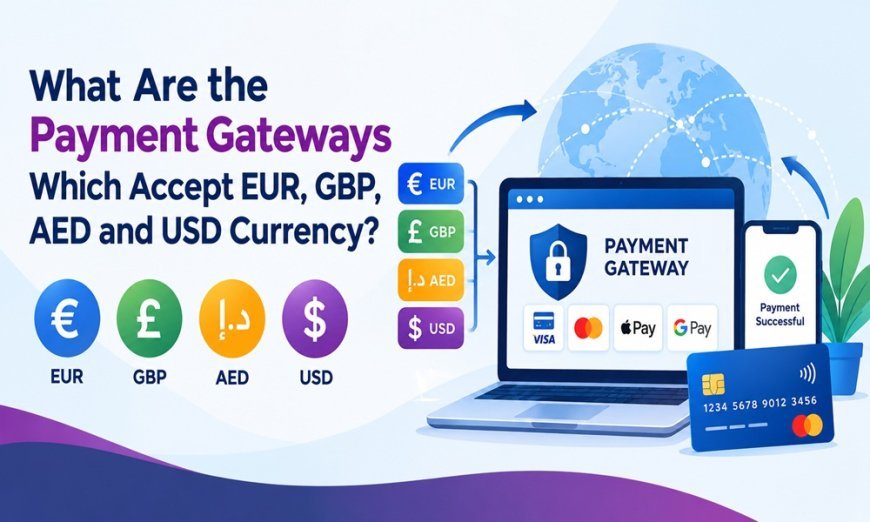
What Are the Payment Gateways Which Accept EUR, GBP, AED and USD Currency?
Selling across Europe, the UK, the UAE, and the US? Here's how multi-currency payment gateways handle EUR, GBP, AED, and USD — and how to pick one.
Selling to customers across Europe, the UK, the UAE, and the US means accepting four currencies with very different banking systems, regulatory regimes, and customer payment habits behind them. The gateway you choose needs to handle that complexity without pushing conversion costs and settlement delays onto your business.
Key Takeaways
-
Businesses operating across the Eurozone, UK, UAE, and US need a gateway that supports EUR, GBP, AED, and USD natively, not just through manual currency conversion.
-
High-risk or specialized-vertical businesses often rely on multi-currency gateways like Webpays alongside standard providers such as PayPal, Stripe, Razorpay, and Apple Pay.
-
The right choice depends on your risk profile, transaction volume, settlement speed needs, and whether your business falls into a standard or high-risk category.
-
Local payment method support matters as much as currency support — a gateway that processes AED but has no relationship with UAE-preferred payment rails is only solving half the problem.

Why Multi-Currency Support Matters Beyond Just "Accepting" a Currency
Technically accepting a currency and processing it efficiently are different things. A gateway can technically process an AED transaction by converting it to USD behind the scenes, but that introduces conversion fees, exchange rate risk, and potential customer confusion at checkout. True
-
Displaying prices to customers in their local currency
-
Settling in the currency your business actually wants to receive
-
Minimizing unnecessary currency conversion steps
-
Supporting local payment preferences alongside the currency itself
[INTERNAL-LINK: understanding cross-border settlement and FX fees → guide on international payment costs]
EUR: Payment Considerations for the Eurozone
The Eurozone Single Euro Payments Area (SEPA) standardizes bank transfers across member countries, making EUR one of the more straightforward currencies to support from an infrastructure standpoint. Card payments remain dominant for e-commerce, but many European markets also expect support for local bank-transfer-based methods and buy-now-pay-later options. Regulatory requirements under PSD2 (strong customer authentication) also apply broadly across EUR transactions, so a gateway serving this market needs SCA-compliant checkout flows.
GBP: Payment Considerations for the UK Market
The UK sits outside SEPA post-Brexit but maintains its own well-developed instant payment infrastructure (Faster Payments) alongside standard card rails. UK consumers have high card and digital wallet adoption, and UK-specific compliance (FCA oversight for payment institutions) is a factor gateways need to account for separately from EU regulation, even though card network rules largely mirror European standards.
AED: Payment Considerations for the UAE Market
The UAE payment landscape combines strong card adoption in urban centers with growing demand for local payment methods and digital wallets tied to UAE banks. Businesses processing AED transactions, particularly in higher-risk verticals, often need a gateway with specific banking relationships in the region, since not every international processor has direct UAE bank partnerships — some route AED transactions through intermediary conversion, adding cost and delay.
USD: Payment Considerations for the US Market
USD remains the most universally supported currency across virtually all payment gateways, but the US market has its own complexity: a fragmented card network and processor landscape, state-level compliance variation, and — for higher-risk verticals — a more selective onboarding environment among mainstream processors.
comparing standard vs. high-risk payment gateway categories → guide on payment gateway risk classification]
Standard vs. High-Risk Multi-Currency Gateways
This is where the choice of provider really splits, and it's worth being direct about it: not every business needing EUR/GBP/AED/USD support falls into the same risk category.
For Standard, Lower-Risk Businesses
Mainstream providers such as PayPal, Stripe, Razorpay, and Apple Pay offer solid multi-currency support for conventional e-commerce, SaaS, and retail businesses. These providers generally offer:
-
Broad currency and payment method coverage
-
Well-documented APIs and fast integration
-
Standard settlement timelines
-
Lower per-transaction fees for qualifying business categories
For High-Risk or Specialized Verticals
Businesses in categories that mainstream processors are more cautious about — subscription services with high chargeback rates, certain regulated industries, or businesses with unconventional risk profiles — typically need a provider built specifically to underwrite and support that risk category. Webpays is one such provider serving multicurrency needs (including EUR, GBP, AED, and USD) for businesses that fall outside standard processor risk appetites, alongside other specialized providers in this space.
Choosing the Right Gateway for Your Currency Mix
A practical checklist:
-
Confirm native settlement currency support — not just "acceptance" through backend conversion
-
Check local payment method coverage in each target market, not just currency support
-
Understand your own risk classification — this determines whether standard providers will onboard you at all
-
Compare total cost — processing fees, FX conversion fees, and settlement fees combined, not just the headline transaction rate
-
Verify compliance coverage for each region (PSD2/SCA for EU, FCA requirements for UK, relevant UAE central bank regulations)
-
Test settlement speed — some multi-currency payment providers batch settlement by currency, which can affect cash flow timing
The Bottom Line
Accepting EUR, GBP, AED, and USD well — not just technically — requires a gateway with real banking relationships and local payment method support in each of those markets, not just backend currency conversion. Standard providers like PayPal, Stripe, Razorpay, and Apple Pay cover most conventional businesses well; specialized multi-currency providers like Webpays fill the gap for higher-risk or more complex use cases across these four currencies.
Frequently Asked Questions
Can I just use one payment gateway for all four currencies?
Often yes, if the gateway has genuine multi-currency infrastructure and banking relationships in each region. The risk is choosing a gateway that technically "accepts" a currency through backend conversion rather than direct settlement, which adds cost and delay.
Why would a business need a specialized gateway instead of PayPal or Stripe?
Mainstream processors are selective about the business categories they onboard. Businesses in higher-risk verticals, or with unconventional transaction patterns, may not qualify for standard processor accounts and need a provider built to underwrite that risk profile.
Does currency support affect checkout conversion rates?
Yes — showing customers prices in their local currency and offering familiar local payment methods generally improves checkout completion compared to forcing a foreign-currency transaction with unfamiliar payment options.
What compliance rules apply differently across EUR, GBP, AED, and USD transactions?
EU transactions fall under PSD2 and require strong customer authentication; UK transactions are regulated separately by the FCA post-Brexit; UAE transactions are subject to UAE central bank oversight; and US transactions vary by state and card network rules. A capable gateway should handle these differences without requiring separate manual compliance work from the merchant.
How do settlement times typically differ across these currencies?
Settlement speed varies by provider and banking relationships in each region rather than by currency alone — some providers settle EUR and GBP faster due to SEPA and Faster Payments infrastructure, while AED and cross-border USD settlement can take longer depending on banking partnerships.
What's Your Reaction?
 Like
0
Like
0
 Dislike
0
Dislike
0
 Love
0
Love
0
 Funny
0
Funny
0
 Angry
0
Angry
0
 Sad
0
Sad
0
 Wow
0
Wow
0