





















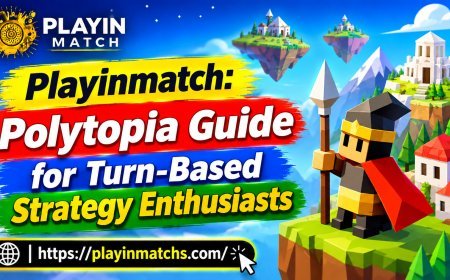


Playinmatch: Polytopia Guide for Turn-Based Strategy Enthusiasts
Explore The Battle of Polytopia with beginner tips on tribes, technology, city growth, combat and smart strategies in this Playinmatch guide.

Turn-based strategy games offer a different kind of excitement compared with fast-paced action titles. Instead of depending on quick reflexes, players must think carefully, manage resources and plan their next moves. One game that brings these elements together in an accessible way is The Battle of Polytopia. With its colourful world, simple presentation and deep strategic options, it appeals to both casual players and experienced strategy enthusiasts.
The Battle of Polytopia is a turn-based civilisation strategy game developed by Midjiwan AB. Players take control of a tribe and work to explore the map, discover new technologies, develop cities and compete against other tribes. Each decision can influence the future of the civilisation, making planning an important part of every match.
For readers exploring different gaming experiences through Playinmatch, Polytopia is an interesting title because it combines exploration, expansion, resource management and combat. Its basic rules are easy to understand, but mastering the game requires practice and an understanding of how different systems work together.
This guide explains the main features of Polytopia, its tribes, technology system, city development, combat mechanics and game modes. It also shares practical strategies that can help beginners become more confident and make better decisions during matches.
What Is The Battle of Polytopia?
The Battle of Polytopia is a turn-based 4X strategy game. The term 4X refers to four important activities: exploring the map, expanding territory, exploiting available resources and eliminating opponents. These activities form the foundation of the gameplay.
At the beginning of a match, players select a tribe and enter a procedurally generated map. They start with a city and a limited number of units. As the game progresses, they explore nearby areas, discover villages, develop settlements and research technologies.
The main objective depends on the selected game mode. Some modes focus on achieving a high score, while others require players to defeat their opponents and establish control over the map. This variety allows players to enjoy the game in different ways.
One of Polytopia's strengths is its simple visual design. The game uses a colourful, low-poly art style that makes the map and units easy to understand. Despite its clean presentation, the game offers several strategic choices involving movement, technology, city growth and diplomacy.
Polytopia supports single-player and multiplayer experiences. Players can practise against computer-controlled opponents or compete with other people. The game also supports offline play in supported modes, which makes it suitable for casual sessions when an internet connection is unavailable.
Understanding Tribes and Their Unique Features
Tribes are central to the Polytopia experience. Each tribe represents a different civilisation with its own visual identity, starting conditions and strategic characteristics. Choosing a tribe is an important early decision because it can influence how a player approaches exploration and development.
Some tribes begin with technologies that make particular resources or activities easier to access. Others offer different advantages based on their starting environment or special units. These differences can affect the opening turns and influence the strategy players follow throughout a match.
For beginners, it is useful to select a tribe whose starting style is easy to understand. A familiar starting technology can make the early stages more comfortable because players can focus on learning exploration, city growth and resource management rather than adjusting to an unfamiliar system.
However, players should not assume that one tribe is always the strongest. The effectiveness of a tribe can depend on the map type, the location of nearby resources, the number of opponents and the player's overall strategy. A tribe that performs well on a land-based map may require a different approach on a map with large areas of water.
As players gain experience, they can experiment with different tribes and learn how their strengths influence the game. This makes repeated matches more interesting because each starting choice can encourage a different approach.
Exploring the Map and Expanding Your Territory
Exploration is one of the most important parts of Polytopia. At the beginning of a match, much of the map remains hidden. Players must move their units into unknown areas to discover villages, resources, terrain and rival tribes.
Exploring early can provide valuable information. It helps players understand where nearby settlements are located and identify possible expansion routes. It can also reveal whether an opponent is approaching from a particular direction.
Villages are especially important because capturing them allows players to establish additional cities. More cities generally mean greater opportunities for population growth, resource generation and military development. However, expanding without considering the surrounding map can create problems. A distant settlement may be difficult to defend if opponents are already controlling nearby territory.
Players should balance exploration with expansion. Sending every available unit far away may leave the starting city vulnerable. Keeping some units close to important settlements can provide protection while other units explore.
Map awareness becomes increasingly valuable as a match develops. Players should pay attention to natural barriers, narrow routes and areas where opponents may attempt to move. A good understanding of the map can help prevent unnecessary battles and create opportunities for future expansion.
Building and Developing Cities
Cities are the foundation of a successful civilisation in Polytopia. They provide resources, support population growth and allow players to produce units. Developing cities efficiently is therefore essential for long-term progress.
A city's population determines when it can reach the next level. Players can increase population by making use of nearby resources and selecting suitable development options. Reaching higher city levels can provide rewards that improve the civilisation's overall position.
Resource management is an important part of this process. Players should study the terrain around each city and consider which improvements can provide the greatest benefit. Some choices support immediate growth, while others may offer advantages over several turns.
City development also affects the number of stars a player can generate. Stars are the main currency used for research, unit production and other actions. A civilisation with more developed cities can often support a wider range of strategic options.
It is important not to spend every available star immediately. Players should consider future needs before making purchases. For example, researching a technology may be useful, but producing a unit could be more important if an opponent is approaching. A balanced approach to city development helps players respond to changing situations.
Understanding Technology and Research
The technology system gives Polytopia much of its strategic depth. Players can research different technologies to unlock new units, improvements and abilities. Each technology has a star cost, so choosing what to research requires careful planning.
The technology tree includes several branches connected with activities such as movement, farming, construction, navigation and military development. Each branch provides access to different options. Players should choose technologies based on their current needs rather than researching everything as quickly as possible.
For example, a player surrounded by forests may benefit from technologies that help use those resources. A civilisation located near large areas of water may need to consider navigation-related research. A player facing an aggressive opponent may prioritise military technologies that improve defensive or offensive options.
Technology costs can also change as a civilisation grows. This makes research planning important because a decision that seems affordable early in a match may become more expensive later. Players should consider whether a technology will provide enough value to justify its cost.
Beginners should avoid researching technologies simply because they are available. It is better to identify a clear purpose for each purchase. A technology that supports city growth, improves exploration or strengthens the military can be valuable when it fits the current situation.
Managing Stars and Other Resources
Stars are essential for almost every major action in Polytopia. Players use them to research technologies, purchase units and improve cities. Since the available amount is limited, resource management can decide whether a civilisation develops smoothly or struggles to keep up with opponents.
The number of stars available depends largely on the development of the player's cities. Building a strong economy early can create more options later. However, spending too much on expansion may leave insufficient resources for defence.
Players should think about both immediate and future requirements. If a city is close to reaching a higher level, investing in population growth may provide a useful long-term benefit. If an enemy unit is threatening an important settlement, producing a defensive unit may be the better choice.
It is also important to avoid unnecessary purchases. Every unit and technology should contribute to a clear objective. Careful spending allows players to maintain flexibility and respond to unexpected developments.
Understanding Combat and Military Units
Combat is an important part of Polytopia, but winning battles requires more than producing a large number of units. Players must understand movement, attack range, unit strengths and the position of enemy forces.
Different units have different roles. Basic ground units are useful for early exploration and defence. Other units offer specialised abilities, stronger attacks or improved movement. Ranged units can attack from a distance, while certain advanced units can provide powerful battlefield advantages.
Positioning is particularly important. A unit placed near an enemy city may create pressure, but moving too close without support can result in its destruction. Players should consider the possible response before sending units into dangerous areas.
The game's movement and combat rules also make terrain and unit abilities important. Some units can move across specific types of terrain more effectively than others. Understanding these details helps players plan attacks and avoid wasting valuable units.
A strong military strategy should support the wider goals of the civilisation. Attacking an opponent may create opportunities to capture cities, but unnecessary battles can waste stars and reduce the ability to expand elsewhere. Players should decide when combat is useful and when it is better to focus on development.
Diplomacy and Strategic Relationships
Polytopia includes diplomacy features that allow players to approach certain situations without relying entirely on combat. Depending on the game mode and available options, players can establish peaceful relationships, create embassies and manage interactions with other tribes.
Diplomacy can be useful when a player wants to focus on developing cities or dealing with another opponent. A peaceful relationship may reduce pressure on one side of the map and give the civilisation more time to strengthen its economy.
However, diplomacy should be considered part of a wider strategy. Players should remain aware of the positions and strengths of other tribes. A peaceful arrangement does not remove the need to protect important settlements or prepare for future changes.
The best approach depends on the match. Some situations reward cooperation, while others require military action. Understanding when to negotiate and when to defend territory is an important skill for players who want to improve.
Exploring the Main Game Modes
Polytopia offers different game modes to suit different play styles. Perfection Mode focuses on achieving a high score within a limited number of turns. Players must develop their civilisation efficiently, explore the map and make decisions that support long-term progress.
Domination Mode focuses more directly on defeating opponents. Military strength, city control and battlefield decisions become especially important. Players must balance expansion with defence and consider how their actions affect the overall map.
Creative Mode provides a more relaxed environment for players who want to experiment. It allows them to explore the game's systems without following the same competitive pressure as other modes.
Multiplayer adds another layer of challenge because human opponents may use different strategies and respond in unexpected ways. The game supports online matchmaking and other multiplayer options, including pass-and-play experiences. Map settings and the number of participants can also influence the type of match.
For beginners, starting with single-player matches is a useful way to understand the rules. Once the basics become familiar, multiplayer can provide a more challenging environment for testing strategic decisions.
Beginner Strategies for Better Gameplay
New players should focus on developing a strong opening. The first few turns can influence the rest of the match because early exploration helps reveal nearby villages and resources. A player who understands the surrounding map can make better decisions about expansion and research.
City growth should also be a priority. Developing the starting city and capturing additional villages can increase the number of available stars. This creates more opportunities to research technologies and produce units.
Players should avoid researching too many technologies without a clear purpose. Instead, they should select upgrades that support their current environment and strategy. A technology that improves movement or resource use may be more valuable than one that does not help the immediate situation.
It is also important to protect settlements. Expanding quickly can be useful, but an exposed city may become an easy target. Players should maintain enough military presence to defend important areas while continuing to explore.
Finally, beginners should learn from every match. A defeat can show where resources were wasted, which cities were poorly defended or when an attack was started too early. Reviewing these decisions can help players improve without changing their entire strategy after every loss.
Common Mistakes to Avoid in Polytopia
One common mistake is focusing only on military development. A large army may appear powerful, but it cannot always compensate for a weak economy. Without enough stars, players may struggle to research important technologies or replace lost units. A balanced civilisation is usually more flexible.
Another mistake is ignoring exploration. Remaining close to the starting city can prevent players from discovering villages and useful resources. Early exploration provides information that can influence both expansion and defence.
Some beginners also spend stars too quickly. Purchasing units and technologies without considering future requirements can leave a civilisation unable to respond to threats. It is better to plan purchases around a clear objective.
Poor positioning can create unnecessary losses as well. Sending individual units into enemy territory without support may give opponents an easy opportunity to remove them. Players should consider the strength of nearby forces and possible enemy responses before attacking.
A final mistake is following the same strategy on every map. Different map types create different challenges. A map with large water areas may require more attention to navigation, while a land-focused map may reward early settlement expansion and ground-based combat. Adapting to the environment is an important part of becoming a better player.
Why Polytopia Appeals to Turn-Based Strategy Enthusiasts
The Battle of Polytopia appeals to strategy fans because it combines several gameplay systems without making the experience unnecessarily complicated. Exploration, technology research, city development, diplomacy and combat all contribute to the result of a match.
Its turn-based structure also gives players time to think. Unlike real-time strategy games, where decisions must often be made quickly, Polytopia allows players to study the map and consider different options before ending a turn.
The different tribes and map settings provide variety. A new match can require a different approach depending on the starting position, nearby resources and opponent locations. This encourages experimentation and gives experienced players reasons to continue improving.
For casual players, the simple interface and short learning curve make it easy to begin. For experienced players, multiplayer matches and deeper strategic choices provide opportunities to develop advanced skills.
Exploring Gaming Guides Through Playinmatch
Players who enjoy strategy games often look for reliable explanations of gameplay systems, useful beginner advice and information about different gaming experiences. Playinmatch provides a platform-related topic for readers interested in exploring gaming content and learning about a range of titles.
Readers using Playinmatch Login or exploring the Playinmatch app should understand the platform's available features and terms before using any service. The Battle of Polytopia is a separate game developed by Midjiwan AB, with its own gameplay, progression and multiplayer systems. Its features should not be confused with those of another platform.
Polytopia is best approached as a game of planning and strategic decision-making. Its results depend on the tribe selected, the map, resource management and the choices made during a match. No strategy can guarantee victory, but learning the mechanics and practising regularly can help players become more confident.
Final Thoughts
The Battle of Polytopia is an engaging turn-based strategy game that combines civilisation building, exploration, technology research and combat. Its simple design makes it approachable for beginners, while its different tribes, map settings and multiplayer options provide plenty of depth for experienced players.
Understanding how to develop cities, manage stars, research useful technologies and position military units can make a major difference. Beginners should focus on exploration and steady growth before experimenting with more advanced strategies. As they gain experience, they can explore diplomacy, different tribes and competitive multiplayer matches.
For readers discovering strategy games through Playinmatch, Polytopia is a worthwhile title because it rewards patience, planning and adaptability. By learning the basic systems and making thoughtful decisions, players can enjoy a satisfying experience while gradually improving their skills.
What's Your Reaction?
 Like
0
 Dislike
0
 Love
0
 Funny
0
 Angry
0
 Sad
0
 Wow
0