























What Is the Difference Between Research Paper Submission and Publication?
Understand the difference between research paper submission and publication, including peer review, journal acceptance, revisions, and final publication.
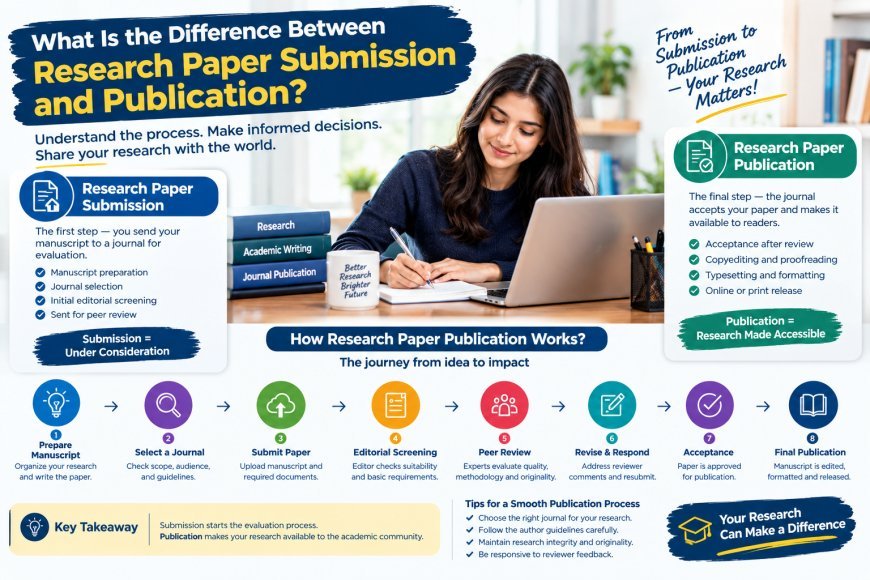
The publication of a student’s, scholar’s, academician’s, or professional’s research is a significant event for those individuals to disseminate their results to the broader research community. However, most beginning researchers confuse the submission of a research paper with the publication of a research paper. While both stages of the process of publish research paper are related to each other, each represents a distinct phase of the academic publishing process.
Understanding the distinction will assist researchers with manuscript preparation, selecting appropriate journals, responding to reviewer feedback, and establishing realistic expectations. Knowing what occurs once you submit your manuscript to be considered for publication within a journal is crucial if you intend to publish an article in a journal.
What Is Research Paper Submission?
Submission of a research paper is the act of providing your finished manuscript to an academic journal for review. When you submit, you feel that your work is complete enough to be assessed by others, however, the journal has not made a decision to accept your work for publication.
Researchers must choose an appropriate journal for their paper, read through the journal's instructions for authors, format the paper according to the journal's requirements, compile a list of references, and provide all necessary statements and/or supplementary materials prior to submitting.
The editorial team typically reviews each paper for compliance with minimum standards and relevance to the journal after submission. Papers which pass this first level of review can then go through a process called peer review, where other experts in the field assess the quality of the research, methods used, how original the work is, and how important the work is.
Submission of your paper does not automatically mean that it will be accepted for publication. The editor can decide to reject the manuscript, ask you to make changes to the manuscript, or further evaluate your submission.
What Is Research Paper Publication?
Complete guide to Research paper publication begins with the acceptance of the manuscript by the journal. After acceptance, the journal takes all the necessary steps to produce and distribute the published version of the manuscript. These include but are not limited to, copy editing, proof reading, typesetting, author approval of final product and assigning publication details.
After being published, the article may appear on the Internet, in an issue of a journal, or via some other type of publication that is utilized by the publisher. Many journals provide access to articles online prior to placing them into an assigned issue.
As long as a reader is allowed to view the research based on the journal's access policy, he or she can read the article. In addition, once the article is published it may be assigned a DOI (digital object identifier) so that other people can easily find and reference the article.
Acceptance of an article does not mean it will be published right away. There can be a delay between when an article is accepted and when it is available to the public.
Key Differences Between Research Paper Submission and Publication
The most significant distinction between submitting an article for review by a journal and having it published is that submission initiates the journal's review of your work and publication provides access to your reviewed research to others.
Purpose
Submission allows a journal to determine if a paper is appropriate for publication. Publication provides the accepted research to the academic community.
Editorial Status
A submitted paper is currently being evaluated. A published paper has gone through the process of acceptance and publication required by the journal.
Peer Review
Your submission will result in peer review, rejection by the editor, or a request for revision. After your submission has been reviewed and accepted for publication (usually after an evaluation of its quality), it is published. However, the process of reviewing submissions differs greatly from journal to journal.
Visibility and Citations
When you submit your paper to a journal for consideration, it does not mean your work will immediately become part of the journal's published literature. Your paper may eventually appear in print, at which time you can cite your work with the correct bibliographic information.
Time Required
Once the manuscript has been completed, submission may occur within days. Depending on the journal and the research area, reviewing, revising, accepting, and ultimately publishing the article will vary from weeks to months.
How Research Paper Publication Works: A Step-by-Step Overview
Researchers who are curious about how a research paper gets published typically follow this sequence of events:
Research is complete; organize your results and then prepare your paper following the proper academic structure.
Select a appropriate journal: Review the journals subject matter, target audience, reputation, publishing policies and authors guidelines.
Submit the document: Use the journal's submission process to upload the document along with any other necessary materials.
The editor reviews whether the article is relevant for publication and meets the minimum submission standards.
Peer reviews assess the submitted work, and can lead to either an accepted, revised, or rejected manuscript.
Revise your manuscript: Please address each comment from the reviewers and write a response stating how you have addressed their comments.
Receive an editorial decision: If accepted, the paper moves toward production.
Finalize publication: review proof copies, confirm all aspects of the final version, and await publication.
In addition, researchers should check the legitimacy of the journals they are considering publishing with and avoid publishing with companies that guarantee acceptance of articles prior to review.
Tips to Improve Your Chances of Publication
Select a journal which has a focus on the same area of study as yours; adhere to the submission requirements for that journal; utilize reliable sources of data; and accurately describe how you conducted your research and what you found. Review your reference list to verify that all entries are correct; uphold ethical standards throughout your research process; and make sure your manuscript is original.
When reviewers suggest edits to your paper, respond professionally to explain how you have responded to their concerns. The preparation for this process may help to ease some of the stress that comes with it. However, please remember that even if you do everything right in terms of following these guidelines, a legitimate journal will still not be able to promise you that your paper will be accepted.
Conclusion
The process of submitting a research paper for consideration by a journal is a separate step from the publication of that same research. When you submit your research paper to a journal, you begin the journal's review process of your work. After your paper has been accepted by the journal, it will then be published and made accessible to the people who are interested in reading it.
What's Your Reaction?
 Like
0
 Dislike
0
 Love
0
 Funny
0
 Angry
0
 Sad
0
 Wow
0