






















Is AP Chemistry Really That Hard? Tips to Make Learning Easier
AP Chemistry is hard, but it is also very learnable. Most students struggle because the course stacks one idea on top of another, not because they lack talent.
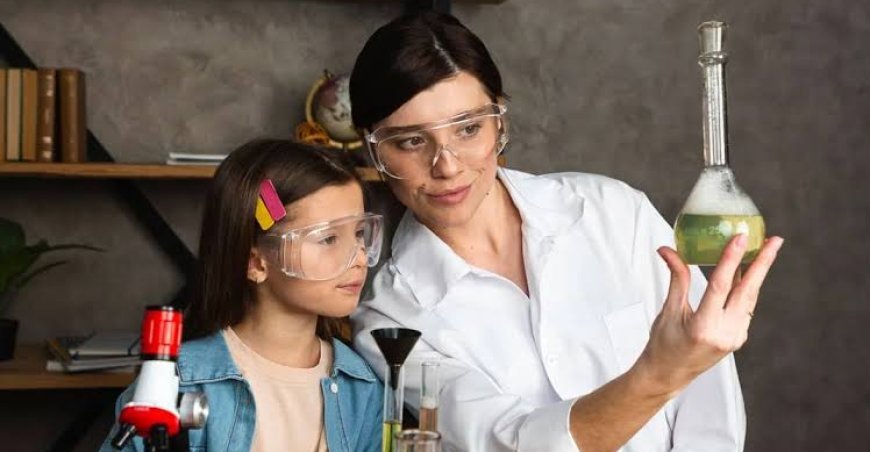
Yes, AP Chemistry is hard, but it is also very learnable.
Most students struggle because the course stacks one idea on top of another, not because they lack talent.
With smart study habits and, when needed, AP Chemistry Tutoring, most students can get comfortable with it.
If you worry about the math, the memorizing, or the exam itself, the sections below take each worry one at a time.
Why AP Chemistry feels harder than most classes
AP Chemistry is hard because it asks you to do three things at once: understand ideas, solve math problems, and explain your thinking in words.
Many classes only ask for one or two of these. In chemistry, you might need to balance an equation, run a calculation, and then explain why the result makes sense, all in one question.
It is also a course where early gaps hurt later. If you never quite understood moles in September, equilibrium in the spring will feel like a different language. That is why students often say the class "got hard all of a sudden." It did not. The foundation just started to show cracks.
Which topics trip students up the most?
Thermodynamics and chemical equilibrium are the two that many students find toughest.
Thermodynamics is about energy changes in reactions. You deal with heat transfer, entropy, and Gibbs free energy, which together tell you whether a reaction will happen on its own. The words sound heavy, but the core question is simple: does this reaction want to go forward?
Chemical equilibrium is about reactions that reach a balance between reactants and products. You learn how conditions change that balance (Le Chatelier's principle) and how to use equilibrium constants in calculations.
Both topics lean on earlier basics like matter, energy, and how substances interact. Shaky basics make them feel impossible. Solid basics make them feel like puzzles.
5 habits that make AP Chemistry feel lighter
-
Rebuild the basics first. Before a new unit, spend 20 minutes on the older idea it depends on. A quick review now saves hours of confusion later.
-
Say the reaction out loud. Explain what is happening in plain words before touching a calculator. If you cannot explain it, the math will not save you.
-
Write down units on every step. Units catch silly errors early and show you when an answer cannot be right.
-
Keep a "mistake log." Note what went wrong on each missed problem. After a few weeks, you will see your own patterns.
-
Study in short, regular sessions. Thirty focused minutes most days beats one long weekend cram.
How do you practice so the exam stops feeling like a surprise?
Practice with questions that look like the real exam, and do it under a bit of time pressure.
Here is a common scenario. A student reads the chapter, nods along, and feels ready. Then they sit down with an exam-style free-response question and freeze, because the question does not tell them which idea to use. Understanding a lesson and choosing the right tool on a new problem are two different skills.
To build the second skill, work through AP-style questions and past exam papers. After each one, ask two things: what was this question really testing, and what clue in the wording pointed to it? Learning exam strategies, like how to show your work clearly and how to manage your time, also counts. Many points are lost to rushed or unclear answers, not to missing knowledge.
Is AP Chemistry Tutoring worth it, or can you study alone?
AP Chemistry Tutoring is worth it when you keep getting stuck on the same ideas even after reading, rewatching, and trying again. Studying alone works well for some students, but it has an honest limit: you cannot always see your own blind spots.
A quick comparison helps. Self-study is flexible and free of schedules, but nobody catches a wrong habit before it sticks. A school class gives structure, but the pace is set for the whole room, so you may not get time on the topic that confuses you. One-on-one help lets you slow down on exactly the idea that is blocking you and speed through what you already know.
Tutoring is not magic, though. It will not replace your own practice. The students who gain the most are those who bring their real questions and keep doing problems between sessions.
What good AP Chemistry Tutoring should cover
Good AP Chemistry Tutoring should match both the course content and the way the exam tests it. Use this checklist when you compare options:
-
Clear coverage of the fundamentals, including matter, energy, and how they interact
-
Advanced topics such as thermodynamics, chemical equilibrium, and organic chemistry
-
Hands-on analytical work, including lab-style experiments and problem solving
-
Practice with AP-style questions and past exam papers
-
Guidance on exam strategies and techniques
-
A focus on critical thinking, so you learn to ask questions and connect ideas instead of memorizing
If a program skips the exam practice, or only teaches formulas without the "why," keep looking.
The bottom line: hard, but not out of reach
AP Chemistry is demanding, yet it follows a pattern. Fix your foundation, practice like the exam, track your mistakes, and ask for help early instead of late. That combination works far better than simply working harder.
If you want expert support, Smart Math Tutoring offers online AP Chemistry Tutoring that covers core concepts, advanced topics, and AP exam preparation. You can explore the details here:AP Chemistry Tutoring.
What's Your Reaction?
 Like
0
 Dislike
0
 Love
0
 Funny
0
 Angry
0
 Sad
0
 Wow
0