


























How to Choose Between Custodial and Non-Custodial Crypto Wallets in UAE?
Compare custodial and non-custodial crypto wallets. Explore security, features, benefits, and development solutions for UAE businesses with Appcrex.

Cryptocurrency adoption continues to create opportunities for businesses exploring blockchain technology and digital financial services. As the UAE strengthens its position as a growing hub for digital assets, businesses are increasingly investing in cryptocurrency wallets, blockchain applications, and secure digital payment solutions.
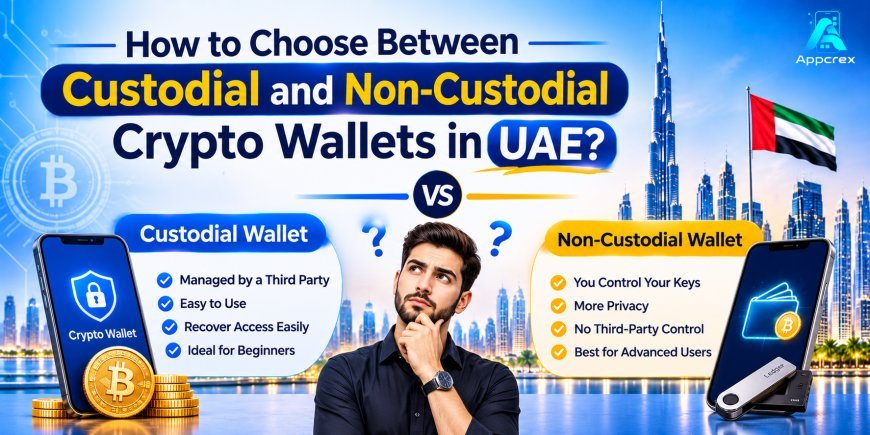
A crypto wallet plays an important role in managing digital assets. However, choosing between custodial and non-custodial wallets requires an understanding of security, ownership, accessibility, and user responsibilities.
A crypto custodial wallet allows a third-party service provider to manage users' private keys, while a non-custodial wallet gives users direct control over their private keys.
For businesses planning to enter the UAE cryptocurrency market, selecting the right wallet model is an important development decision.
Appcrex helps businesses explore modern software and application development solutions designed around their technical and operational requirements.
In this guide, we will compare custodial and non-custodial crypto wallets, explain their features, discuss development considerations, and explore how businesses can select the right solution.
What Is a Custodial Crypto Wallet?
A custodial crypto wallet is a digital wallet where a third-party service provider manages and safeguards users' private keys.
Users access their cryptocurrency through an account created on the wallet provider's platform. The provider manages key storage, transaction processing, and selected security operations.
For example, centralized cryptocurrency exchanges often provide custodial wallets to customers.
Key Features of a Custodial Wallet
- Third-party private key management.
- Account-based access.
- Password recovery options.
- Customer support services.
- Integrated cryptocurrency trading.
- Transaction monitoring.
- Identity verification and KYC procedures.
Benefits of Custodial Wallets
1. Easy Account Recovery
Users generally have account recovery options through the service provider if they forget their passwords.
2. Beginner-Friendly Experience
Custodial wallets offer a familiar account-based experience, making cryptocurrency management easier for new users.
3. Integrated Services
Businesses can combine wallet functionality with cryptocurrency exchanges, payment services, and other financial features.
4. Managed Security
The wallet provider manages private key protection and related security processes.
However, users depend on the provider to safeguard their assets and maintain access to the wallet.
What Is a Non-Custodial Crypto Wallet?
A non-custodial crypto wallet gives users direct control over their private keys and digital assets.
Unlike custodial wallets, the service provider does not hold the user's private keys. Users manage their wallet access through private keys or recovery phrases.
A non-custodial mobile wallet allows users to access their cryptocurrency through smartphones while maintaining control over their wallet credentials.
Popular examples include MetaMask and Crypto.com Onchain.
Key Features of Non-Custodial Wallets
- User-controlled private keys.
- Recovery phrase management.
- Direct blockchain transactions.
- Decentralized application connectivity.
- Token storage and transfers.
- Multi-network support.
- Wallet-to-wallet transactions.
Benefits of Non-Custodial Wallets
1. Complete Key Ownership
Users maintain control over their private keys instead of depending on a third-party custodian.
2. Greater User Control
Users manage their transactions and interact directly with supported blockchain networks.
3. Access to DeFi Applications
Non-custodial wallets support connections with decentralized applications, depending on network and wallet compatibility.
4. Direct Blockchain Interaction
Users send and receive supported digital assets through blockchain networks.
However, users must protect their recovery phrases. Losing access credentials without a valid backup might result in permanent loss of wallet access.
What Is the Difference Between Custodial and Non-Custodial Crypto Wallets?
Both wallet types help users manage cryptocurrency, but they differ in private key ownership, security responsibilities, and account recovery.
|
Comparison |
Custodial Wallet |
Non-Custodial Wallet |
|
Private Key Control |
Third-party provider |
User |
|
Asset Management |
Provider-managed custody |
User-controlled |
|
Account Recovery |
Provider-supported options |
Recovery phrase or backup |
|
User Responsibility |
Relatively lower |
Higher |
|
KYC Requirements |
Depends on service and regulations |
Depends on service and activity |
|
Blockchain Access |
Depends on provider |
Direct wallet interaction |
|
DeFi Connectivity |
Depends on platform |
Generally supported |
|
Beginner Experience |
Usually simpler |
Requires key management knowledge |
The right option depends on your business model, target audience, security requirements, and regulatory responsibilities.
Is Crypto.com Wallet Non Custodial?
Yes, but the answer depends on which Crypto.com product you are referring to.
Crypto.com offers different wallet services with different custody models.
Crypto.com Onchain Wallet is a non-custodial wallet. Users control their private keys and manage their recovery phrases.
Crypto.com App operates as a custodial service for cryptocurrency held through the application. Crypto.com manages the private keys associated with those assets.
Therefore, when asking whether a Crypto.com wallet is non-custodial, you should distinguish between Crypto.com Onchain and the main Crypto.com App.
This distinction is important when comparing wallet providers and selecting cryptocurrency storage solutions.
How to Create a Non Custodial Wallet?
Businesses and developers planning to build a cryptocurrency wallet should understand the technical steps involved.
If you are researching how to create a non custodial wallet, the following development process provides a useful starting point.
Step 1: Define Wallet Requirements
Start by identifying the wallet's purpose and target users.
Decide whether the wallet will support:
- Single or multiple blockchain networks.
- Cryptocurrency storage and transfers.
- Token swapping.
- NFT management.
- DeFi application connectivity.
- Mobile or web access.
Step 2: Select Blockchain Networks
Choose blockchain networks according to your business requirements.
Popular options include Ethereum, Polygon, BNB Chain, and Solana.
Each network has different technical standards, transaction fees, and integration requirements.
Step 3: Develop Private Key Management
Private key management is one of the most important components of non-custodial wallet software.
The system should support secure key generation, encryption, backup, and recovery processes.
Developers should follow established cryptographic standards and avoid exposing private keys through application logs or insecure storage.
Also read: How to Choose the Best Crypto Trading Platform Development Company in UAE?
Step 4: Integrate Wallet Functions
The wallet should support essential operations, including:
- Creating new wallets.
- Importing existing wallets.
- Sending and receiving cryptocurrency.
- Checking wallet balances.
- Viewing transaction history.
- Connecting to supported blockchain networks.
Step 5: Design the User Interface
A simple interface helps users manage their digital assets without unnecessary complexity.
Include clear navigation, wallet balances, transaction details, and security settings.
Step 6: Conduct Security Testing
Test the application for vulnerabilities before launch.
Security testing should cover private key storage, authentication, API security, transaction signing, and recovery mechanisms.
Independent security audits help identify potential weaknesses.
Step 7: Launch and Maintain the Wallet
After successful testing, deploy the wallet and monitor its performance.
Regular updates help maintain compatibility with blockchain networks and improve the overall user experience.
What Features Should Non-Custodial Wallet Software Include?
Modern non custodial wallet software needs a combination of security, usability, and blockchain integration features.
Here are some important features businesses should consider.
1. Secure Wallet Creation
Allow users to generate wallets and receive recovery phrases through a secure setup process.
2. Multi-Chain Support
Enable users to manage digital assets across supported blockchain networks.
3. Biometric Authentication
Fingerprint and facial authentication add an additional access control layer on supported devices.
4. Token Management
Display supported cryptocurrency balances, token details, and transaction information.
5. QR Code Transactions
Allow users to scan wallet addresses and simplify cryptocurrency transfers.
6. DeFi Integration
Enable connections with compatible decentralized applications and blockchain services.
7. Transaction Notifications
Provide notifications about successful transactions, pending transfers, and wallet activities.
8. Backup and Recovery
Offer secure recovery options and clear instructions for protecting recovery phrases.
Why Is Crypto Wallet Development Growing in UAE?
The UAE has developed a supportive digital business environment for companies exploring blockchain and virtual asset services.
Dubai and Abu Dhabi attract businesses interested in financial technology, digital payments, and cryptocurrency infrastructure.
Several factors support this interest.
Digital Transformation: Businesses are investing in modern digital financial services and blockchain-based applications.
Business Opportunities: Cryptocurrency wallets support different business models, including digital asset management, payments, and decentralized applications.
Blockchain Adoption: Companies are exploring blockchain technology for transparent transactions and digital asset management.
Regulatory Development: The UAE has established regulatory frameworks for virtual asset activities.
Businesses should identify the relevant regulatory authority before launching wallet-related services.
In Dubai, the Virtual Assets Regulatory Authority (VARA) regulates relevant virtual asset activities, excluding the Dubai International Financial Centre. Other UAE jurisdictions operate under their applicable regulatory frameworks.
Businesses offering regulated custody services must assess licensing and operational requirements. A non-custodial wallet model does not automatically exempt a business from applicable regulations.
How Much Does Crypto Wallet Development Cost in UAE?
The cost of cryptocurrency wallet development depends on the features, blockchain networks, security requirements, and platform complexity.
Here are illustrative development estimates:
|
Wallet Development Type |
Estimated Cost |
|
Basic Crypto Wallet |
AED 25,000–50,000 |
|
Standard Multi-Feature Wallet |
AED 50,000–100,000 |
|
Advanced Non-Custodial Wallet |
AED 100,000–200,000 |
|
Enterprise Crypto Wallet |
AED 200,000+ |
These figures are indicative planning estimates, not fixed market quotations.
Factors affecting development costs include:
- Blockchain network integration.
- Private key management.
- Mobile application development.
- UI/UX design.
- Security audits.
- Third-party integrations.
- Ongoing maintenance.
Businesses should prepare a clear feature list before requesting a development estimate.
Why Choose Appcrex for Crypto Wallet Development?
Choosing the right development partner helps businesses turn cryptocurrency wallet concepts into functional digital products.
Appcrex is a software and application development company focused on building user-centric digital solutions.
Our development approach focuses on technical requirements, user experience, and scalable software architecture.
Custom Wallet Development
Every business has different requirements. Appcrex focuses on development approaches aligned with individual project goals and technical specifications.
User-Friendly Design
A simple and responsive interface helps users manage digital assets and access wallet features.
Modern Technology
Selecting appropriate technologies supports blockchain connectivity, application performance, and future expansion.
Scalable Architecture
Scalable architecture helps businesses prepare their applications for additional features, networks, and growing user requirements.
Ongoing Technical Support
Maintenance and technical improvements help businesses keep their applications updated and functional.
Whether you are planning a custodial wallet, a non-custodial mobile wallet, or a custom blockchain application, Appcrex helps you explore suitable software development solutions.
5 Key Takeaways
- Wallet Ownership: Custodial wallets rely on third-party key management, while non-custodial wallets give users private key control.
- Security: Both wallet types require strong security measures and reliable backup systems.
- Development: Non-custodial wallets need secure key generation, blockchain integration, and recovery features.
- UAE Opportunities: The UAE offers opportunities for businesses exploring cryptocurrency and blockchain solutions.
- Appcrex: Build user-friendly and scalable cryptocurrency wallet solutions with Appcrex.
Conclusion
Choosing between custodial and non-custodial crypto wallets depends on your business objectives, security requirements, and target audience. Custodial wallets offer managed access and convenient account recovery, while non-custodial wallets provide users with direct control over their private keys.
For businesses entering the UAE cryptocurrency market, investing in reliable wallet technology is an important step towards developing digital asset services.
Appcrex provides modern software and application development services to support businesses building customized blockchain and cryptocurrency solutions.
Planning to develop a crypto wallet? Connect with Appcrex and discuss your wallet development requirements.
Frequently Asked Questions (FAQs)
1. What is the difference between custodial and non-custodial wallets?
A custodial wallet allows a third party to manage private keys, while a non-custodial wallet gives users direct control over their private keys and recovery phrases.
2. Is Crypto.com Wallet non custodial?
Crypto.com Onchain is non-custodial because users control their private keys. The main Crypto.com App uses a custodial model for cryptocurrency held through the application.
3. How to create a non custodial wallet?
Creating a non-custodial wallet involves selecting blockchain networks, developing secure private key management, integrating wallet functions, designing the interface, and conducting security testing.
4. What is non custodial wallet software?
Non-custodial wallet software is an application that allows users to store, send, and receive cryptocurrency while maintaining control over their private keys.
5. Is a non-custodial mobile wallet secure?
A non-custodial mobile wallet offers direct user control over private keys. Its security depends on secure key storage, device protection, recovery phrase management, and safe transaction approvals.
6. Which crypto wallet is better for beginners?
Custodial wallets are often easier for beginners because they offer account recovery and managed services. Non-custodial wallets suit users who prefer direct control over their digital assets.
7. How much does crypto wallet development cost in UAE?
Crypto wallet development costs depend on functionality and technical complexity. A basic wallet might start around AED 25,000, while advanced enterprise solutions require larger budgets.
8. Can Appcrex develop a custom cryptocurrency wallet?
Appcrex offers software and application development services. Businesses can discuss custom cryptocurrency wallet requirements, blockchain integrations, and application development with the team.
What's Your Reaction?
 Like
0
 Dislike
0
 Love
0
 Funny
0
 Angry
0
 Sad
0
 Wow
0