





















EMR vs EHR: What’s the Difference and Which One Does Your Clinic Need?
EMR and EHR sound the same but work very differently. Learn the key differences, who needs which, and how to choose the right system for your practice.
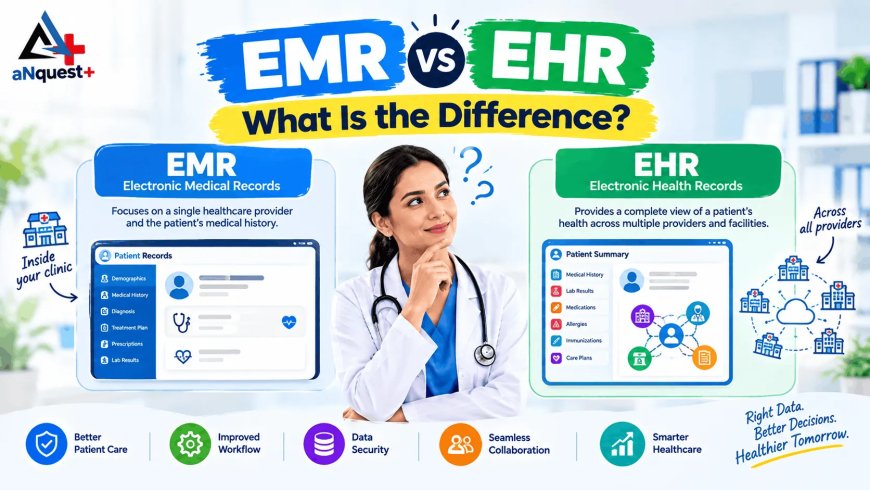
Ask a doctor, a receptionist, and a software vendor what separates an EMR from an EHR, and you will probably get three different answers. The two terms get used as if they mean the same thing. They don’t, and mixing them up can lead a clinic to buy software it will outgrow in a year or pay for features it will never use.
Here is the difference in plain terms.
What is an EMR?
An EMR (electronic medical record) is the digital version of the paper chart a clinic used to keep. It holds a patient’s diagnoses, prescriptions, visit notes, test results, and vaccination history for one practice.
It replaces the filing cabinet. Staff find records faster, handwriting stops being a problem, and prescriptions are easier to track. But the record stays inside the clinic that created it. If the patient visits another doctor, the new doctor starts from scratch or relies on whatever paperwork the patient carries.
What is an EHR?
An EHR (electronic health record) covers the same clinical information, but it is built to travel. It is designed to be shared, with the patient’s consent, across clinics, hospitals, labs, pharmacies, and specialists. The patient can often see it too.
An EMR is one practice’s record of a patient. An EHR is closer to the patient’s full health story, assembled from everyone who has treated them.
The US government’s health IT office draws the same line, noting that EHRs are designed to be accessed by everyone involved in a patient’s care, including the patient. You can read that explanation on HealthIT.gov.
EMR vs EHR at a glance
| EMR | EHR | |
|---|---|---|
| Scope | One practice | Multiple providers and settings |
| Data sharing | Mostly internal | Built for exchange across organisations |
| Patient access | Limited | Often includes a patient portal |
| Best for | Single clinics, focused practices | Multi-specialty groups, hospital networks |
| Setup effort | Lower | Higher (integrations, standards) |
Which one does your practice need?
The honest answer depends on how your patients move through the healthcare system.
An EMR is often enough if:
-
You run a single clinic or a focused practice, such as dental, dermatology, or general practice.
-
Most patients are treated entirely within your clinic.
-
Your priority is cutting paperwork, speeding up billing, and keeping clean records.
An EHR makes more sense if:
-
You regularly refer patients to labs, specialists, or hospitals and need their results back in one place.
-
You operate several branches or work inside a hospital network.
-
You want patients to view reports, prescriptions, and appointments themselves.
Many modern platforms blur the line, offering EMR features today with sharing options you can switch on later. When you compare vendors, ask which stage of that journey the product supports, not just which label it carries.
Why this matters in India
India is moving toward connected health records. Under the Ayushman Bharat Digital Mission, patients can link their records to a digital health ID and share them with providers. Clinics that capture data in clean, structured digital form now will find it much easier to take part in that system later. Clinics still running on paper or scattered spreadsheets will have to catch up.
Five questions to ask before you choose
-
Do my patients see other providers often, or mostly just me?
-
Will I need to share records with labs, pharmacies, or hospitals?
-
Can the system grow with my practice, or will I need to migrate in two years?
-
Is it easy enough for my front-desk staff to use without weeks of training?
-
How does it handle patient data security and consent?
If you want a fuller side-by-side comparison, with practical examples for different practice types, this guide on EMR vs EHR walks through the decision step by step.
Conclusion
An EMR keeps your own records in order. An EHR keeps the patient’s wider story connected. Neither is better in every case. The right choice depends on the size of your practice, how often patients cross between providers, and where you want to be in three years.
Pick for the practice you are building, not just the one you run today. A system that matches your real workflow will save hours every week. One that doesn’t will become another thing your staff work around.
What's Your Reaction?
 Like
0
Like
0
 Dislike
0
Dislike
0
 Love
0
Love
0
 Funny
0
Funny
0
 Angry
0
Angry
0
 Sad
0
Sad
0
 Wow
0
Wow
0