



























Factors That Influence the Choice of an Insurance Broker in India
Explore key factors for choosing an insurance broker in India, including IRDAI registration, industry expertise, policy options, transparency, and customer support.
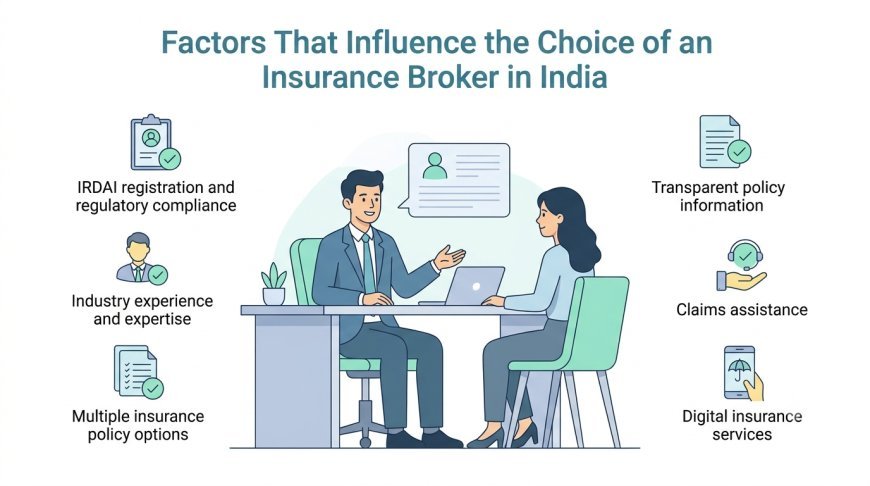
Introduction
Selecting an appropriate insurance policy is an important part of financial planning, but choosing the right professional to assist with the process is equally important. Individuals, families, and businesses often face difficulties understanding policy conditions, comparing insurance products, evaluating coverage limits, and identifying suitable protection against financial risks. With several insurance companies offering different products, making an informed decision requires proper research and an understanding of individual requirements.
An insurance broker can help simplify this process by providing information about available insurance options and assisting customers in evaluating suitable coverage. However, not every broker offers the same level of expertise, service quality, or customer assistance. Therefore, selecting a reliable insurance broker in India requires careful consideration of several factors.
From regulatory registration and industry knowledge to transparency and claims support, understanding these factors can help customers choose a broker who can support their insurance requirements effectively.
1. IRDAI Registration and Regulatory Compliance
The first factor to consider when choosing an insurance broker is their regulatory registration. In India, insurance brokers operate under the regulatory framework established by the Insurance Regulatory and Development Authority of India (IRDAI).
A registered insurance broker must follow applicable regulations, professional standards, and operational requirements. Checking the broker's registration details helps customers verify whether the intermediary is authorised to carry out insurance broking activities.
Customers should consider:
· Valid IRDAI registration.
· Applicable category of broker registration.
· Compliance with regulatory requirements.
· Transparent business practices.
· Proper documentation and disclosures.
Verifying these credentials provides an important foundation for selecting a professional insurance intermediary.
2. Experience and Knowledge of the Insurance Industry
Insurance products involve different coverage structures, exclusions, eligibility conditions, and claim procedures. A broker with relevant industry knowledge can help customers understand these aspects more effectively.
Experience is particularly important when dealing with specialised insurance requirements, such as commercial property insurance, employee-related coverage, liability insurance, and complex motor insurance needs.
Before selecting a broker, customers should evaluate their understanding of:
· Different insurance categories and products.
· Policy benefits and exclusions.
· Premium calculation factors.
· Insurance documentation.
· Renewal and claims procedures.
· Changing customer and business requirements.
A knowledgeable insurance broker in India should be able to explain insurance concepts clearly rather than simply recommending a policy based on its premium.
3. Range of Insurance Products and Insurer Partnerships
The availability of multiple insurance options is another important consideration. Different insurance companies may offer varying benefits, premiums, coverage limits, add-on features, and policy conditions.
A broker with access to multiple insurers can help customers evaluate different products according to their requirements.
For instance, a customer looking for health insurance may want to compare policies based on hospital networks, waiting periods, room rent limits, pre-existing disease coverage, and claim conditions. Similarly, a vehicle owner may compare comprehensive insurance, third-party coverage, and relevant add-on benefits.
Customers should check whether the broker can assist with different insurance categories, including:
· Health insurance.
· Life insurance.
· Car insurance.
· Two-wheeler insurance.
· Travel insurance.
· Commercial insurance.
· Property insurance.
· Liability insurance.
However, customers should also understand that a broker's insurer partnerships may differ. A wider selection does not automatically guarantee that every available insurance product will be suitable.
4. Understanding of Individual Customer Requirements
Insurance needs vary according to age, income, family responsibilities, lifestyle, assets, and business activities. Therefore, a broker should understand the customer's circumstances before suggesting any insurance solution.
For example, a family with dependent children may prioritise health and life insurance, while a business owner may require protection for commercial property, machinery, employees, and third-party liabilities.
A suitable broker should consider:
· Current financial responsibilities.
· Existing insurance coverage.
· Potential financial risks.
· Required coverage amount.
· Budget and premium affordability.
· Future financial objectives.
This requirement-based approach helps customers avoid selecting policies that provide unnecessary benefits or insufficient financial protection.
5. Transparency in Premiums, Benefits, and Exclusions
Transparency is one of the most important qualities of a professional insurance broker. Customers should receive clear information about policy costs, coverage conditions, exclusions, deductibles, and other applicable charges.
Sometimes, two insurance policies may have similar premiums but significantly different coverage provisions. Selecting a policy based only on its price can result in unsuitable protection.
A transparent broker should explain:
· What the insurance policy covers.
· Which situations are excluded.
· Applicable deductibles and co-payments.
· Additional benefits and optional covers.
· Premium payment conditions.
· Important claim requirements.
Customers should also receive accurate information about the broker's remuneration and other disclosures wherever required under applicable regulations.
Clear communication helps establish trust and allows customers to evaluate insurance products with greater confidence.
6. Quality of Customer Support and Communication
Insurance assistance may be required at different stages, including policy selection, documentation, renewal, endorsement, and claims. Therefore, the quality of customer support should be an important part of the selection process.
Customers should assess how effectively a broker responds to questions, explains complicated policy conditions, and communicates important updates.
Some useful indicators include:
· Timely responses to customer queries.
· Clear explanations of policy provisions.
· Assistance with documentation.
· Availability of policy-related information.
· Support during renewals and claims.
· Consistent communication throughout the policy lifecycle.
A broker who maintains effective communication can make insurance management more convenient, especially for customers holding multiple policies.
7. Claims Assistance and Service Capabilities
Insurance claims are among the most important aspects of an insurance relationship. Customers purchase coverage to receive financial protection when an insured event occurs, subject to the policy terms and conditions.
Therefore, it is important to understand what type of claims assistance a broker provides.
A professional broker may help customers understand claim procedures, required documents, submission timelines, and communication with the insurance company.
Before selecting a broker, customers should ask about:
· Guidance on claim documentation.
· Assistance in understanding claim requirements.
· Coordination with the insurer.
· Information about claim status.
· Support in addressing claim-related queries.
It is important to remember that the insurer evaluates and decides claims according to the applicable policy conditions. A broker cannot guarantee claim approval or settlement.
8. Digital Services and Technology Infrastructure
Technology has changed how customers purchase, manage, and renew insurance policies. Many insurance brokers now use digital platforms to simplify policy comparisons, documentation, communication, and servicing.
Digital capabilities can improve convenience and help customers access important insurance information without relying entirely on physical documentation.
Before choosing a broker, customers can evaluate whether they offer:
· Online policy purchasing facilities.
· Digital policy documentation.
· Online renewal assistance.
· Policy management tools.
· Digital communication channels.
· Convenient access to customer support.
A well-organised digital system can be particularly beneficial for customers who manage multiple insurance policies or require frequent policy updates.
9. Reputation and Customer Feedback
A broker's reputation can provide useful insights into its service quality and business practices. Customer experiences may help potential policyholders understand how effectively the broker handles communication, policy servicing, renewals, and claims-related assistance.
However, customers should not rely entirely on promotional claims or isolated online reviews.
Instead, consider multiple indicators, such as:
· Consistency of customer feedback.
· Transparency in insurance recommendations.
· Responsiveness to customer concerns.
· Quality of after-sales support.
· Professional conduct.
· Clarity of service commitments.
Evaluating these aspects can help customers make a more balanced decision.
10. Long-Term Relationship and Policy Management
Insurance is not a one-time financial decision. As personal circumstances and business requirements change, existing policies may need to be reviewed or updated.
A suitable insurance broker should be capable of supporting customers beyond the initial purchase.
For example, an individual may require additional health coverage after starting a family, while a business may need to revise its insurance arrangements after expanding operations.
A broker who understands changing requirements can help customers review existing protection, assess potential coverage gaps, and explore relevant policy options.
This ongoing relationship can make insurance management more organised and effective.
Conclusion
Choosing the right insurance broker in India requires more than comparing service charges or looking at the number of insurance companies associated with the broker. Customers should carefully evaluate regulatory registration, industry expertise, insurer partnerships, transparency, customer support, digital services, and claims assistance before making a decision.
A professional insurance broker should understand individual requirements, explain policy conditions clearly, and help customers evaluate suitable insurance solutions without overlooking important coverage details.
Square Insurance Brokers Private Limited helps individuals and businesses explore insurance solutions by understanding their requirements and comparing policies from multiple insurance partners. With a focus on convenient, transparent, and customer-oriented services, Square Insurance aims to simplify policy selection, renewals, and insurance-related assistance.
Frequently Asked Question (FAQs)
Q1. What factors should I consider when choosing an insurance broker in India?
Consider IRDAI registration, industry experience, insurer partnerships, product availability, transparency, customer support, claims assistance, and digital servicing facilities.
Q2. How can I verify whether an insurance broker is registered with IRDAI?
Customers can check the broker's registration details through the official IRDAI records and verify the applicable registration category and validity.
Q3. Why is experience important when selecting an insurance broker?
Industry experience helps brokers understand different insurance products, policy conditions, coverage requirements, and claims procedures, allowing them to provide more informed assistance.
Q4. Can an insurance broker compare policies from multiple insurance companies?
Yes. An insurance broker can help customers compare available policies from multiple insurers based on premiums, coverage, benefits, exclusions, and other relevant conditions.
Q5. Does an insurance broker provide claims assistance?
Yes. Brokers can guide policyholders through claim procedures, documentation requirements, and communication with insurers. However, the insurer makes the final claim decision.
Q6. Is customer support important when choosing an insurance broker?
Yes. Effective customer support helps policyholders receive assistance with policy selection, documentation, renewals, servicing, and claims-related queries.
Q7. Can businesses consult an insurance broker in India?
Yes. Businesses can consult insurance brokers to evaluate commercial insurance requirements, compare suitable coverage options, and manage risks involving property, employees, equipment, and liabilities.
Q8. Should I choose an insurance broker based only on lower premiums?
No. Customers should evaluate coverage benefits, exclusions, deductibles, claim conditions, and service quality rather than selecting a policy or broker based only on price.
What's Your Reaction?
 Like
0
 Dislike
0
 Love
0
 Funny
0
 Angry
0
 Sad
0
 Wow
0