























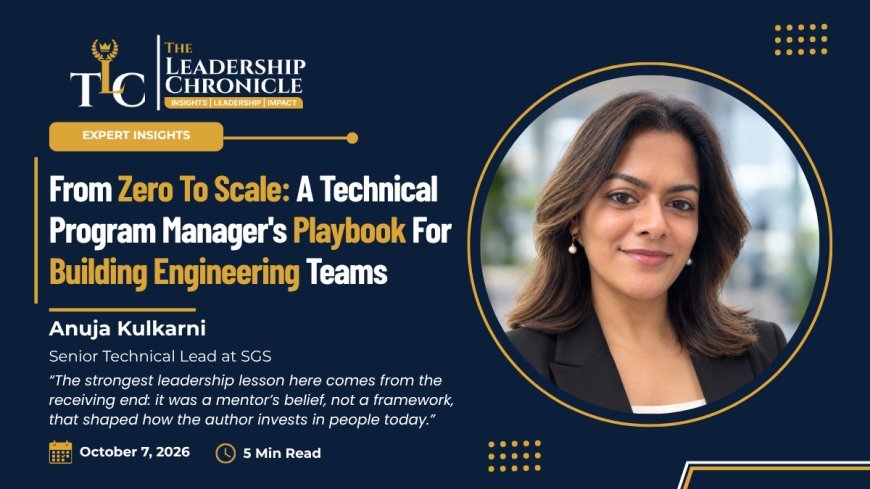
From Zero to Scale: A Technical Program Manager’s Playbook for Building Engineering Teams

Six principles for turning a handful of engineers into a high-performing organization, whatever industry you build in.
Every engineering team starts small, with a mandate, a deadline and a few people who aren’t yet sure what “done” looks like. Whether it’s a fintech startup’s first platform squad, a medical-device company standing up a validation lab or an automaker building its first software division, the challenge is the same. Growth either strengthens the team or quietly breaks it.
Technical program managers sit at the center of that transition. We rarely write the code or run the tests, but we shape the structures, rhythms and relationships that decide whether a team of five can become a team of fifty. Here is the playbook I have refined over more than a decade of building engineering teams.
1. Start with a purpose, not a headcount
When a new program lands, the first instinct is to ask for more people. Resist it. A small team with a sharp mission will outperform a larger one that is still debating what it’s for.
I once launched an AT&T 5G field certification program with just four engineers, during the pandemic in 2020, when test sites were scarce and the standard itself didn’t exist yet. What carried us wasn’t headcount; it was clarity. Everyone knew what we had to prove and for whom. The framework we built became the industry’s entry criterion for 5G handset certification.
The lesson: before you grow the team, make sure everyone on it can say, in their own words, why the work matters and who it helps.
“Most scaling advice begins with hiring. This piece begins with purpose — a sequencing choice that explains how a four-person team could carry a difficult certification program before the standard itself existed.”
2. Design roles around skills, not titles
In a relatively new team everyone does everything, which feels agile until the first hard deadline. As the work grows, the TPM’s job is to break it into streams that run in parallel and match them to people’s strengths. Give junior engineers well-defined work with clear quality gates. Let senior engineers own the architecture, templates and hardest problems. Bring analysts in early so data isn’t an afterthought.
Just as important is what the TPM doesn’t do. I don’t micromanage. Once the work is shaped, I let the leads take charge of their streams and hold them accountable for the outcome and for every step along the way. Spoon-feeding answers may feel faster, but it stops people from building the judgment a growing team depends on.
Do this well and it does more than speed up delivery. It creates a growth ladder where people are stretched without being overwhelmed, and today’s juniors become tomorrow’s leads.
3. Build the operating system before you need it
What works for a team of five rarely works for fifteen. When know-how lives only in a few people’s heads, those people become bottlenecks as the team grows.
Invest early in the unglamorous foundations such as onboarding guides, runbooks, a shared definition of “done,” standard templates and a decision log. None of it makes headlines, but it compounds. Each new hire becomes productive faster and strengthens the system instead of adding load to it.
4. Protect the team from moving targets
At Element, I stepped in mid-program when the original program manager left a vendor certification program for T-Mobile. We were coordinating twelve field engineers across six markets, with eight to ten test sites each. The acceptance criteria had never been formally documented, so new KPIs kept appearing and approved work kept being reopened. When the test markets changed mid-program, the team faced re-performing items that had already been signed off.
Rather than absorb the churn, we documented a baseline, gave every requirement a traceable ID and moved work through staged gates that couldn’t slip backwards. The client adopted the structure, certification followed, and a tense relationship became a lasting partnership.
The lesson: a TPM’s first duty to an engineering team is to absorb ambiguity so the engineers don’t have to.
“Scope creep is usually discussed as a schedule risk. The author treats it as a people risk, and the fix — a documented baseline, traceable requirement IDs and gates that cannot slip backwards — is one any program lead can borrow this week.”
5. Measure what matters, and make it visible
You cannot scale what you cannot see. Choose a few metrics that reflect how the team actually delivers, such as cycle time, milestone adherence and defect escape rate, or deployment frequency and recovery time for software teams. Put them where everyone, from engineers to executives, can see them.
Good metrics don’t police a team. They give it a shared version of the truth and let it fix problems before a customer finds them. This is where AI comes in these days. AI-assisted analytics can pull data from different tools, spot risks and trends early and turn raw results into clear reports in minutes rather than days. That frees the team to act on the numbers instead of spending hours compiling them.
6. Let trust do the scaling
Scale is earned, not planned. A team that delivers consistently builds a reputation, the reputation brings in new work, and that work funds the next hire.
The same logic applies inside the team. As it grows, the TPM has to shift from doing to enabling: delegating decisions, growing leads who own whole workstreams and stepping back from details that once needed them.
I learned this from the other side. As a lead engineer, no one asked me to take charge or come up with new projects. But my director, a mentor in every sense, kept showing me what I couldn’t yet see in myself: that I could lead teams and shape a vision for the whole business unit. He saw me going places long before I did. That belief changed how I worked, and it is the biggest reason I invest in the people around me today.
The lesson: great leaders don’t just delegate work; they help people see the leader they could become.
“The strongest leadership lesson here comes from the receiving end: it was a mentor’s belief, not a framework, that shaped how the author invests in people today.”
The TPM’s real job
When I look back, from mentoring my first junior engineers at BlackBerry to leading cross-regional teams today, the pattern is the same. Technical program managers don’t build teams by writing org charts. We build them by creating clarity, structure and trust, and then getting out of the way so talented engineers can do their best work.
The metrics, certifications and revenue matter. But the measure I care about most is how many of the engineers I’ve worked with have gone on to lead teams of their own.
As Albert Einstein put it: “Strive not to be a success, but rather to be of value.”
For a technical program manager, that is the whole playbook in one line.
For more details, visit: https://theleadershipchronicle.com/
If you would like to get featured or want to know more, connect with us at contact@theleadershipchronicle.com
LinkedInn : https://www.linkedin.com/company/the-leadership-chronicle/
Twitter : @TLChronicle
What's Your Reaction?
 Like
0
Like
0
 Dislike
0
Dislike
0
 Love
0
Love
0
 Funny
0
Funny
0
 Angry
0
Angry
0
 Sad
0
Sad
0
 Wow
0
Wow
0