






















How to Choose EEG Software for Your Clinic
How to choose EEG software for your clinic: what to evaluate, from waveform navigation and cloud security to compatibility, cost and pilots.

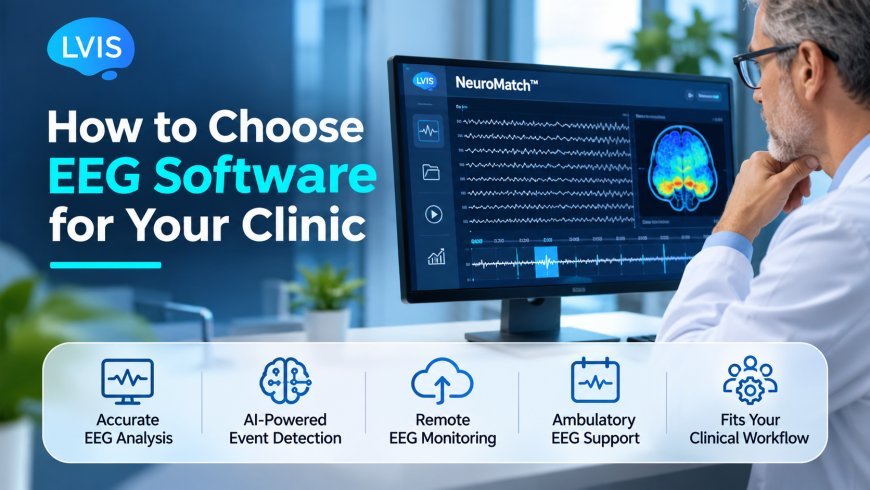
Choosing EEG software is a clinical and operational decision that affects how a practice handles recordings, communicates findings, and manages specialist resources. The most attractive demonstration may not reveal whether a product will work effectively with the clinic's existing equipment or review procedures. A thoughtful evaluation should begin with the problems that staff encounter during everyday work. It should then examine the clinical functions, infrastructure, security, and support needed to address those problems. This guide provides a practical framework for evaluating a platform before making a purchasing commitment.
What Should Clinics Look for in EEG Software?
A useful evaluation starts by mapping the entire journey of a study, from scheduling and acquisition through interpretation and report delivery. Ask technologists where information is entered more than once and ask physicians which steps interrupt their concentration during review. Identify whether delays originate in the reading process or in administrative activities such as case assignment. This exercise helps distinguish features that solve real problems from those that merely add complexity. A purchasing committee can then establish a shortlist based on requirements that are shared across the department.
Define Your Clinical Study Mix
An outpatient practice may primarily handle routine studies, while a larger neurology service might review extended recordings and studies acquired at multiple facilities. These environments place different demands on storage, navigation, staffing, and turnaround times. The clinic should estimate its current case volume and identify the types of studies it intends to support in the future. It should also consider the frequency of complex or technically limited recordings. These details provide a realistic foundation for evaluating system performance and capacity.
Evaluate the Quality of Waveform Navigation
A clinical reader needs to move efficiently through the original traces and examine activity in its surrounding context. During a demonstration, assess whether common viewing adjustments are straightforward and whether changes can be reversed easily. Ask readers to perform familiar tasks rather than relying entirely on a scripted presentation from the vendor. A suitable interface should provide enough flexibility for experienced reviewers without making basic navigation unnecessarily difficult for new users. Consistency across workstations and review sessions can also be important for staff who share responsibilities.
Assess Analytical Tools and Their Clinical Limits
EEG analysis software may offer multiple ways to display trends and identify portions of a recording that warrant closer examination. These tools should be evaluated according to their intended clinical use, not simply the number of features listed in promotional materials. A clinic should request appropriate regulatory documentation and discuss how each function has been evaluated. Staff should understand the kinds of recordings and patient populations for which specific functions are intended. A clear understanding of limitations can prevent unsuitable use after the system is introduced.
Test Automated Event Identification
When evaluating seizure detection software, include recordings with different degrees of complexity and examples of common artifacts. The purpose of the evaluation is to understand how candidate events appear and how easily clinicians can verify them. Ask how the platform handles uncertain findings and how reviewers document disagreements with an automated suggestion. Consider the practical consequences of both missed events and incorrect flags, including extra review time. Any assessment should preserve independent professional interpretation as the standard for clinical decisions.
Examine the Extended Study Workflow
If the clinic offers ambulatory EEG, review how the system handles studies that span many hours or several days. A useful demonstration should show how staff navigate a long timeline, find annotations, and return to the relevant surrounding signal. Consider how separate review sessions or handoffs affect documentation and whether readers can easily identify unfinished tasks. Ask how the workflow deals with missing data or a recording that arrives in multiple parts. Testing these situations is more informative than viewing only a short, technically clean example.
Compare Local and Cloud-Based Deployment
A locally installed platform and a browser-based service can introduce different operational requirements. Local installations may require dedicated workstations, internal server administration, and scheduled updates coordinated by the clinic. Cloud-based approaches may shift some infrastructure responsibilities to a service provider while increasing dependence on network connectivity. Neither model automatically satisfies every organization's security or availability needs. An informed decision should account for the clinic's existing infrastructure, geographical coverage, and approach to technical support.
Supporting Distributed Reading Teams
Practices that use remote EEG monitoring should establish how authorized readers obtain access and how studies are assigned across locations. A remote specialist needs sufficient clinical context as well as the recording itself to conduct a useful review. The organization should define how staff communicate urgent concerns and who is responsible for completing each report. An accessible interface does not, by itself, provide around-the-clock staffing or emergency response. Service commitments should therefore be evaluated separately from the ability to open a study remotely.
Reviewing Privacy and Security Arrangements
Patient recordings and associated reports can contain sensitive health information that requires appropriate protection. Ask the provider about identity management, access control, auditing, encryption arrangements, and the handling of backups. Review the relevant contractual responsibilities, including business associate arrangements where applicable under US privacy requirements. The clinic should also have procedures for removing access when staff leave and investigating suspected inappropriate access. Security is a shared operational responsibility rather than a feature that can be delegated completely to a vendor.
Check Compatibility and Data Portability
Before purchasing EEG software, identify the recording systems and file formats that the clinic currently uses. Ask the vendor to demonstrate a complete workflow using representative files rather than assuming that a stated compatibility claim covers every configuration. Determine how annotations, timestamps, and associated physiological channels are handled during transfer. Consider whether the clinic can retrieve its original recordings and completed reports in a usable form if it changes providers. Data portability is especially important because neurological records may need to remain available for future clinical comparisons.
Evaluate Reporting and Communication
The final report should communicate findings in a clear format that the referring clinician can use. During evaluation, ask reviewers to prepare sample reports that include both straightforward and complex observations. Examine how templates can be adapted and whether final approval remains under the appropriate physician's control. Confirm how completed documentation is transferred into the organization's recordkeeping system and whether any additional integration is necessary. An efficient review interface provides limited value if the reporting stage creates a new administrative bottleneck.
Understand the Total Cost of Ownership
A purchasing decision should include expenses beyond the initial subscription or licensing fee. Implementation, data migration, connectivity, training, and integration work can all affect the total investment. The clinic should ask which functions are included and which require a separate agreement or additional expenditure. Consider the operational cost of outages and whether support is available during the hours in which the department works. A comparison based on total cost and measurable workflow value is more informative than a simple comparison of advertised prices.
Run a Structured Pilot Before Committing
A list of EEG software options provides a starting point, but a controlled pilot can help determine which platform fits the practice. Select a representative collection of studies and agree on evaluation criteria before the demonstration begins. Include feedback from technologists, physicians, administrators, and the IT team because each group interacts with the system differently. Compare task completion and usability against the existing process without treating an isolated efficiency gain as proof of improved patient outcomes. Document any outstanding issues and request clarification before finalizing the purchase.
Frequently Asked Questions
What is the most important feature for a small clinic?
The answer depends on the clinic's particular bottlenecks and clinical services. For some practices, straightforward recording access and reporting may matter more than advanced analytics. Others may need support for distributed reading or lengthy studies. The clinic should define its essential tasks before comparing optional features. A focused evaluation makes it easier to avoid paying for functions that staff are unlikely to use.
Is cloud deployment always better than local installation?
No, the appropriate deployment model depends on infrastructure, staffing, and organizational requirements. Cloud access may support distributed teams, while local systems may fit established internal arrangements. Both approaches require appropriate security, availability, and continuity planning. Clinics should consider what happens when network connectivity or a component fails. The best choice is the one that meets documented clinical and operational needs.
Can automated analysis reduce the need for specialist readers?
Analytical tools can assist specialists by organizing data and drawing attention to possible findings. They do not remove the need for qualified clinicians to interpret the study. Automated suggestions may be incomplete or incorrect, especially in difficult recordings. Departments should define appropriate review procedures and provide training on limitations. Staffing plans must reflect the actual clinical responsibilities involved.
How should a clinic evaluate regulatory documentation?
Request the applicable device labeling and identify which functions are included in the intended use. Check relevant patient populations, recording configurations, and any stated limitations. Confirm that the version being purchased corresponds to the documentation supplied. A general marketing description should not substitute for this review. Clinical and regulatory specialists can help assess whether a product is appropriate for the planned application.
What should be included in a vendor demonstration?
The demonstration should cover acquisition handoff, navigation, analysis, annotations, reporting, and authorized access as appropriate. Ask to see how the system handles incomplete or technically difficult studies. Include realistic tasks performed by members of your own team. Discuss support, data export, and contingency procedures as well as visible features. Record the findings so the purchasing committee can compare providers consistently.
Conclusion
A successful EEG technology investment begins with a clear understanding of clinical requirements and operational priorities. Rather than selecting a platform according to feature count alone, clinics should examine compatibility, usability, governance, and total cost. LVIS Corporation offers a cloud-based approach to neurological review and analytical support through NeuroMatch. A demonstration can help prospective users determine how the platform aligns with their existing equipment and interpretation procedures. Contact LVIS to discuss your requirements and develop an evaluation plan for your clinic.
What's Your Reaction?
 Like
0
 Dislike
0
 Love
0
 Funny
0
 Angry
0
 Sad
0
 Wow
0