




















How to Stack a Cape Cod Bracelet with Other Bangles
Master the art of stacking! Explore creative ways to pair your Cape Cod bracelet with bangles for a fashionable statement.

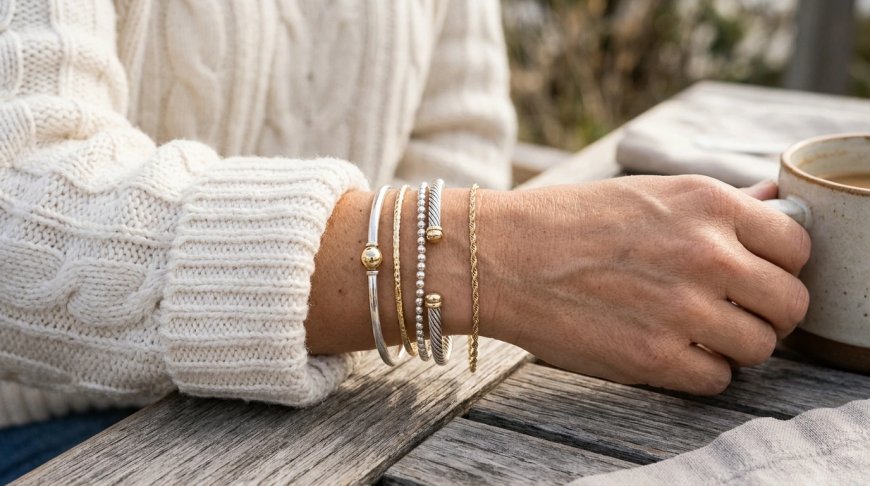
A good wrist stack looks effortless, but that's mostly a lie. The really good ones take a few tries, some second-guessing, and at least one failed experiment, with a bracelet that sounded like a clever choice until it was actually on your wrist. If you already own a Cape Cod bracelet, the sterling silver band with the gold screw ball closure that started in a small Dennis, Massachusetts, studio back in the 1960s—then you’re already in a good spot. That piece is clean; it mixes two metals, and it can stand its ground without needing much backup. What comes next is about picking that support carefully so the whole stack kind of earns its keep.
Why the Cape Cod Bracelet Earns the Anchor Spot
The Cape Cod bracelet is a rigid bangle, typically crafted from sterling silver. It features a gold ball closure that you unscrew to put it on and then screw back to secure it in place. It was first made by hand at Eden Hand Arts in Dennis, Massachusetts, starting way back in the 1960s, and honestly the design has stayed pretty close to how it was then. The design is not just a matter of luck; it’s intentionally crafted for simplicity. With one clean band and a single accent, there’s minimal surface noise. This restraint is precisely why it works well in a stack. It gives you something solid to build around, without forcing itself into the full conversation every second.
The ball closure sits slightly higher on the wrist, which naturally draws attention. As you choose additional pieces to add to your stack, keep this in mind. You want “companions” that can hold attention on their own but not pull directly against that main focal point.
Choose Your Metal Approach Before Adding Anything Else
Most advice about stacking tells you to pick one metal family for cohesion, and it does hold up in real life. All gold looks warm. All silver reads clean. But this Cape Cod piece already spans both, so you really get to decide. Either lean into one metal for your other bangles, or let the stack run mixed—no big rules.
If the closure on your bracelet is yellow gold, then a couple of slim yellow gold bangles nearby make everything feel warmer and more intentional. If you add a silver piece or two, it usually keeps the whole look from feeling like a mistake. Rose gold closures shift the math a little, but the idea stays basically the same: echo the piece, complement it, and stop before you start crowding it.
Build by Width, Not Just by Feel
One of the most common stacking mistakes is grabbing whatever is closest and sliding it on until the wrist feels full. But width is important, and it goes beyond simply creating a good vibe. It has a specific directional significance. Wider bangles tend to go closer to the hand, and the stack should taper as it climbs toward the forearm. That graduation basically guides the eye, so no single piece ends up collapsing the visual weight of the rest.
The Cape Cod bracelet sits right in the middle of the width spectrum. It is not a heavy cuff, nor is it a delicate thin-chain piece. So it’s naturally made to live in the center of the stack. You can place something slimmer near the hand like a cable chain or a simple beaded bangle. Then on the arm side, a hammered cuff or a slightly thicker open bangle usually works. The Cape Cod piece stays visible, and the proportions stay balanced.
Texture Does a Lot of the Work
Two smooth bangles placed side by side can look somewhat flat because they are too similar in style. In contrast, pairing one smooth bangle with one textured bangle typically adds more visual interest. Mixing textures is not about making everything look loud. It’s more about giving each piece its own job in the overall look.
Twisted wire bangles are a really natural partner here. And there are actually twisted-wire Cape Cod versions available already, so the aesthetic is friendly to that kind of surface. Hammered metal, rope-style bangles, and even slim herringbone chain bracelets all add surface variation without wrestling with the screwball closure energy. Just keep heavy stone pieces away from the Cape Cod band, because they compete where they should really be, complementing somewhere else.
Five Is Usually the Ceiling
Most stacks do fine with three to five pieces. Once you go past five, the individual bracelets start blending into each other, and then your nicest bracelet is basically disappearing in the pile. If you do fewer than three, you’re not really "stacking"; you’re just wearing multiple bracelets at once, which is a different thing.
With the Cape Cod bracelet in the middle, you do not need a lot to make it work. One thin chain bracelet, the Cape Cod piece, and one slim bangle already form a complete stack. A fourth piece is totally okay if the textures and proportions make sense. A fifth takes more thought. Past that point, you’re usually pulling attention away from the piece you started with, which was probably the best starting point anyway.
Odd Numbers Tend to Work Better
Three usually looks better than two or four. Five usually looks better than four or six. This is kind of jewelry-styling established science, and it tends to check out when you actually try it.
The odd number breaks symmetry just enough that it feels natural, not overly planned or too “posed for a magazine” either.
Three is the most practical starting point. Go with a twisted wire bangle, the Cape Cod bracelet, and one dainty gold chain. That combination handles width differences, mixed metals, and texture contrast, without requiring a ton of careful thinking. Start there, then adjust based on what you actually see on your wrist.
Let the Occasion Tell You How Far to Go
Part of why the Cape Cod bracelet is worth keeping is that it doesn’t trap you in one single situation. The rigid band plus the modest metalwork looks polished enough for dinner out, but it’s still relaxed enough for a Saturday at the beach, so it kind of moves with you.
For everyday wear, a braided cord bracelet or a simple beaded bangle keeps the whole thing light. If you want something more dressed up, a slim diamond tennis bracelet or one yellow gold bangle can move the stack toward quiet luxury without going overboard. For coastal vibes, a semi-precious stone bangle in aquamarine or chalcedony pulls the maritime origin into the color story in a way that feels cohesive, not too literal like “here’s the sea again.”
Bring the Rest of Your Jewelry Into the Same Thinking
A wrist stack doesn’t live in a bubble. It has to talk to your rings, your necklaces, and your earrings. If your wrist is the visual focus, then keep rings simple. A plain band or a single signet reads like a deliberate choice. If you do a bold ring plus a full bracelet stack on the same hand, they usually compete, and neither ends up really serving you.
Necklace-wise, the nautical character of the Cape Cod bracelet pairs well with a delicate anchor pendant, a shell motif, or a simple gold chain sitting around the collarbone. For earrings, keep them small. Small hoops or studs let the wrist do the talking without extra distraction.
Closing Thoughts on Building the Stack
Stacking is kind of personal, and there is no configuration that really works for everybody, which is half the point I guess. What tends to emerge in most successful stacks is this: begin with one piece that you already love, identify what makes it appealing, and then choose accompanying pieces that complement it rather than compete or clash with it. The Cape Cod bracelet is a decent place to anchor that whole process. Its proportions feel solid, the two-tone design gives you more pairing options than it might seem at first glance, and the way it’s structured provides a real center to build from. Get that part right, and the rest tends to fall into place after.
What's Your Reaction?
 Like
0
 Dislike
0
 Love
0
 Funny
0
 Angry
0
 Sad
0
 Wow
0