





















How Are Glycine Watches Different From Other Brands
Find out why Glycine watches are a cut above the rest, blending tradition with modern innovation for true watch enthusiasts.

Most people who get into watches go through a predictable phase. Rolex first, followed by Tudor and a few of the well-known Swiss brands. Then, around the second or third year of their watch journey, many collectors discover a brand that makes them feel a bit embarrassed about how long it took to find. The input contains a repetitive phrase that could be streamlined for clarity. Not heavily marketed. But once you understand what they actually built and when, the watches make a different kind of sense. For many collectors, Glycine Watches is that brand that evokes a sense of embarrassment over how long it took to discover it. The brand is not flashy.
The Swiss Heritage That Separates Glycine Watches From the Rest
Glycine has been producing watches continuously in its Bienne-based facilities in Switzerland since the brand was first founded in 1914 by Eugene Meylan. More than a century without moving the factory is rarer than it sounds. Many Swiss brands today manufacture in one country, assemble their products in another, and conduct quality control in yet another location. Glycine remained at its original location, consistently producing watches despite enduring two world wars, the Japanese quartz invasion of the 1970s, and undergoing eight changes in ownership.
Glycine Watches made their debut crafting unique mechanisms for women’s watches. Things began to change in 1930 with the invention of an automatic E.M.S.A. (Eugène Meylan Société Anonyme) module for watches. Glycine relied exclusively on its own movements until 1942, with some movements developed as late as 1966. The bulk of brands do not dedicate as much time or effort to internal movement development. This technique necessitates a high level of engineering expertise, is more costly, and takes longer to complete. Nonetheless, Glycine kept it going.
Glycine was one of the twenty-nine exhibitors at the very first Basel Watch Fair in 1939 and has not missed a year since. That is the kind of institutional consistency that tells you something about a company’s priorities. Basel is neither inexpensive nor informal. Showing up every single year for nearly ninety years says you take the craft seriously, whether or not anyone is paying attention.
Aviation DNA defines a specific identity for Glycine.
Most Swiss watch brands have some loose connection to sport or adventure that mostly shows up in marketing copy. Glycine went the other direction. Glycine was established as a watch brand dedicated to honoring pilots, aviation, and travel. It has consistently been an innovator in the industry and continues to push the boundaries with its watch designs.
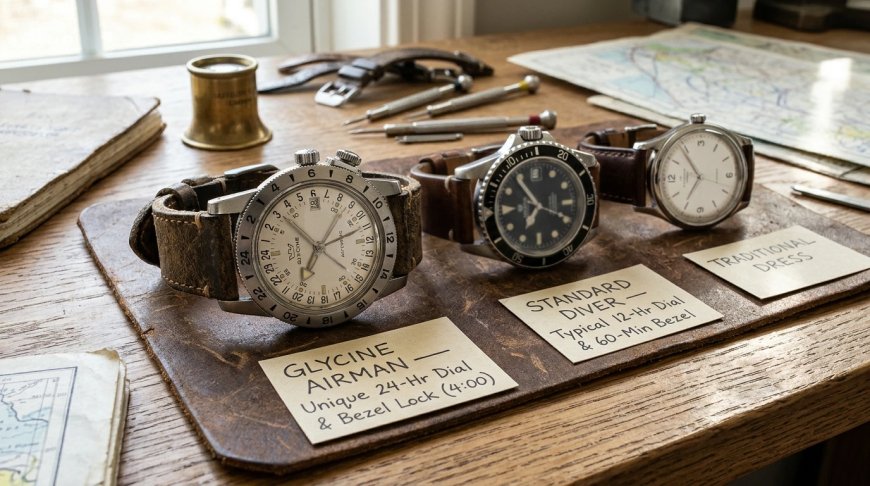
That focus produced something genuinely new. The Airman was developed in the mid-1950s and is reported to be the first wristwatch to incorporate a 24-hour dial and second time zone capabilities into the same timepiece. The 24-hour format meant the hour hand completed one full rotation per day instead of two. The Airman’s distinct 24-hour display was a direct nod to military time and pilot preferences, and it immediately set it apart from conventional 12-hour GMTs. The need for a watch that could simultaneously display different times on a 24-hour scale became critical for aviation and military operations, and Glycine rose to the challenge.
The Airman was designed around requests from international pilots themselves, featuring an automatic movement with a 24-hour dial, date function, centralized hands, and a rotating 24-hour bezel. This allowed pilots to accurately calculate unique time zones that fall between hourly intervals. The rotating bezel also included a thumbscrew to lock it in place once set, a practical detail that only someone thinking about cockpit use at altitude would bother adding.
One of the notable moments in Airman’s history is that it was worn by astronaut Charles Conrad on Gemini 5 and Apollo 12 missions in 1965 and 1969. Not every watch brand can point to a specific human being who wore their watch on a specific mission to space. Glycine can.
Military Credibility Through the Combat Collection
While the Airman anchors Glycine in aviation, the Combat collection connects the brand to ground-level military use, which has its own demanding set of requirements. The austere military dial and case finishing of the Combat SUBs are what make Glycine’s watch collection stand out in the overcrowded dive watch industry, with all watches priced below one thousand dollars.
There are plenty of brands selling watches with a military aesthetic. The combat line is different because the aesthetic came from actual functional requirements, not from a design brief written to attract customers who like the look of military gear. Glycine’s Swiss roots ensure precision and reliability in every timepiece, and models such as the Airman and Combat collections reflect the brand’s longstanding connection to aviation and military requirements, which makes them genuinely respected among serious watch buyers. That difference in origin shows in the details, which tend to prioritize legibility and durability over decoration.
Exceptional Value Without Compromising Quality
This is arguably the most crucial aspect of the brand to comprehend practically. Although less familiar to most watch buyers, Glycine is a strong option in the competitive under-$1,000 USD category. strapcode
In a market where prices for heritage models from major brands keep climbing, the Glycine Airman remains an outlier, offering genuine and documented military and aviation history at a fraction of the cost of its contemporaries. The history attached to these watches is not a reproduction or a tribute. It is the actual lineage, from the same brand that produced the originals. Collectors value Glycine for its heritage and for the opportunity to own historically significant designs such as the Airman 44 without breaking the bank.
That combination is genuinely uncommon. Heritage brands typically charge for their history, and newer affordable brands are still building theirs. Glycine sits in a position most watch companies would love to occupy, and few actually do.
Design Language That Stays True to Purpose
Models from Glycine feature large diameters and a masculine appeal, and most of the current watch designs have a vintage style inspired by the heritage pieces, updated to suit modern taste. The vintage references are not cosmetic choices invented by a marketing team. They trace back to designs that were built to solve specific problems in specific environments. vintage watch
The matte 24-hour dial, complete with luminous hour markers, paired with broad arrow luminous hands, is made for a dial readable at a glance in low light, under stress, and in a moving aircraft. The design was optimized for that context. Every element on the dial had to earn its place. That discipline is still visible in how current Glycine models are laid out, which gives them a clarity that purely fashion-driven watches tend to lack.
A Brand That Rewards the Curious Buyer
What sets Glycine watches apart in the end is not any single feature but a combination that is hard to find elsewhere: over a century of uninterrupted Swiss production, technical innovations that are documented and traceable rather than claimed, real-world use by pilots and military personnel who needed reliability over aesthetics, and price points that do not penalize you for discovering the brand late. Glycine continues to create wristwatches that stay true to the brand’s signature design codes, along with its heritage in creating timekeeping instruments for the military, sporting, and aviation industries. Most brands in this space are selling a version of heritage. Glycine built the thing the version is based on.
What's Your Reaction?
 Like
0
 Dislike
0
 Love
0
 Funny
0
 Angry
0
 Sad
0
 Wow
0