
























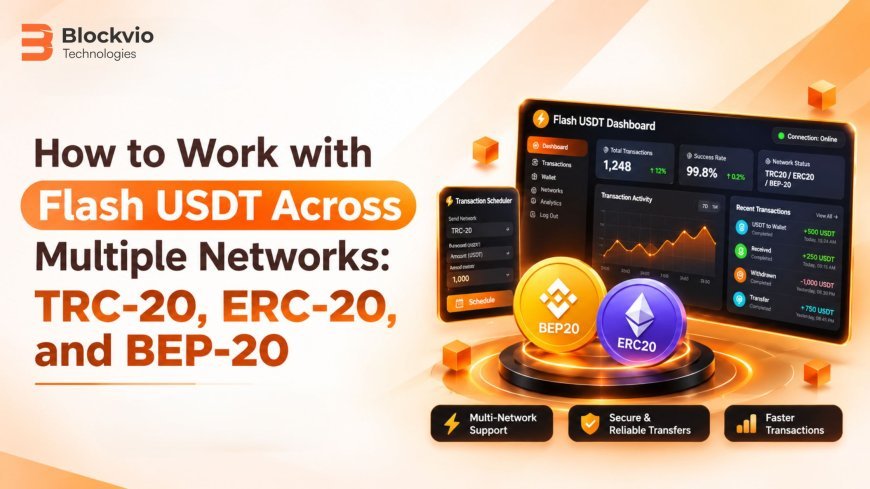
How to Work with Flash USDT Across Multiple Networks: TRC-20, ERC-20, and BEP-20
In this guide, we will explore the differences between these networks, how legitimate USDT transactions work, and how developers can safely test multi-network functionality.

It allows users and businesses to transfer digital value, support crypto payments, and interact with blockchain-based applications. However, USDT is not limited to a single blockchain. Different networks use different token standards, transaction processes, and wallet requirements.
This has created interest in working with USDT across networks such as TRC-20, ERC-20, and BEP-20. Understanding how these networks operate is important for anyone developing a crypto wallet, payment platform, or blockchain application. In this guide, we will explore the differences between these networks, how legitimate USDT transactions work, and how developers can safely test multi-network functionality.
1. Understanding USDT Across Different Networks
It is available on multiple blockchain networks, with each network using its own technical standards. Although these standards support similar token functions, they operate on different blockchain networks. A token on one network cannot automatically be transferred to an address on another network through an ordinary transaction.
Developers should also verify the issuer and official contract address of any token they integrate. Tether's current supported-protocol documentation lists TRC-20 USDT on TRON and ERC-20 USDT on Ethereum. Its BNB Smart Chain listing identifies XAU₮, not an official USD₮ deployment. Therefore, businesses should not assume that every token labelled BEP-20 USDT is issued by Tether.
2. How TRC-20 USDT Works
TRC-20 USDT operates on the TRON blockchain. It is commonly used for cryptocurrency transfers and payment-related applications. A wallet supporting TRC-20 can display token balances, generate receiving addresses, and send transactions through the TRON network. To complete a transaction, users need a compatible wallet and sufficient network resources. TRX may be required to cover transaction costs when available Energy and Bandwidth are insufficient. For businesses, integrating TRC-20 support can help customers use compatible wallets and transfer supported tokens through the TRON network.
3. How ERC-20 USDT Works
Ethereum provides a widely used environment for decentralised applications, smart contracts, and digital asset management. Businesses integrating ERC-20 support can use compatible wallet infrastructure and blockchain tools to manage token transactions. However, Ethereum transactions require ETH to pay network gas fees. For developers, testing ERC-20 integration includes checking token balances, transfer functions, transaction confirmations, and wallet compatibility.
4. Understanding BEP-20 Token Compatibility
It supports token transfers and smart contract interactions within that blockchain ecosystem. Businesses may encounter tokens described as BEP-20 USDT, but the token's name alone does not prove that it is issued by Tether. Its issuer, contract address, and backing arrangements must be independently verified. For wallet and payment platform developers, the important requirement is to verify the exact asset being supported rather than relying only on its displayed name or symbol.
5. How to Move USDT Between Different Networks
Moving USDT between networks requires a supported cross-chain process. A normal wallet transfer cannot directly convert TRC-20 USDT into ERC-20 USDT or another network's token. Users can explore supported cryptocurrency exchanges or cross-chain services that handle both networks.
A typical process involves:
-
Checking which network the receiving platform supports.
-
Selecting a service that supports the required network conversion.
-
Reviewing the conversion rate and transaction fees.
-
Confirming the destination network and wallet address.
-
Checking the completed transaction using the relevant blockchain explorer.
Always verify the network before sending funds. Selecting an incompatible network can result in lost or inaccessible assets.
6. How Developers Can Test Multi-Network USDT Features
Developers building cryptocurrency wallets or payment applications need to test their network functionality before launching. They can use blockchain testnets and clearly labelled mock tokens to simulate token-related activities without presenting them as genuine USDT.
Testing may include:
-
Wallet address generation and validation.
-
Simulated token balance displays.
-
Transaction submission and confirmation workflows.
-
Network selection and compatibility checks.
-
Transaction history and monitoring.
-
Error handling for failed or pending transactions.
These tests help development teams identify technical issues while keeping simulated assets separate from real cryptocurrency.
7. Important Security Checks for Multi-Network Integration
Supporting multiple blockchain networks requires careful security planning. Businesses should verify token contracts, use trusted blockchain infrastructure, and protect wallet credentials and private keys. They should also test transaction handling, implement appropriate access controls, and monitor suspicious activity. A displayed wallet balance should never be treated as proof that funds have been received. Users should verify actual transactions through the relevant blockchain explorer. Clear network labels and accurate transaction information can also help prevent user mistakes.
Conclusion
Working with Flash USDT Software across TRC-20, ERC-20, and BEP-20-related environments requires a clear understanding of blockchain standards, token issuers, wallet compatibility, and transaction procedures. For businesses, multi-network integration can support more flexible cryptocurrency payment and wallet applications. However, genuine USDT cannot be created through temporary balance generation or simulated transactions. Official issuance is controlled by Tether, while developers can use testnets and mock tokens for legitimate testing. Businesses planning to develop multi-network crypto applications can explore blockchain and wallet development solutions to build secure and properly tested digital asset platforms.
What's Your Reaction?
 Like
0
 Dislike
0
 Love
0
 Funny
0
 Angry
0
 Sad
0
 Wow
0