




















IB Global Politics SL vs HL: Which Level Should You Choose?
Compare IB Global Politics SL vs HL, including syllabus, exams, workload and assessment differences. Find out which level best suits your goals.

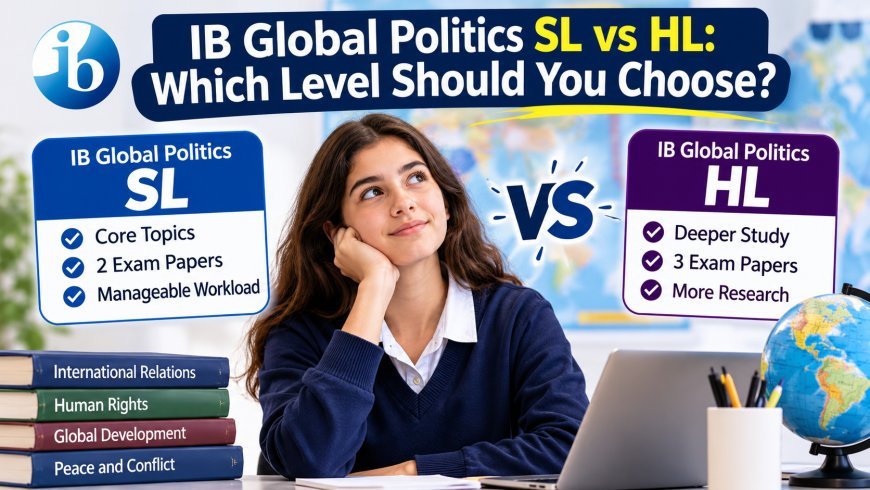
Choosing between IB Global Politics Standard Level (SL) and Higher Level (HL) can feel like a difficult decision. Both levels explore important political issues, international relations, human rights, development, and global conflicts. However, they differ in course depth, assessment requirements, study hours, and academic workload.
If you are interested in politics, international affairs, law, or social issues, Global Politics can be an exciting subject. But which level is right for you? Should you choose SL to maintain a balanced IB workload, or take HL to explore political challenges in greater depth?
Working with an experienced ib global politics tutor can help you understand the syllabus, prepare for assessments, and make a confident decision.
In this guide, we will explain the key differences between IB Global Politics SL and HL, compare their assessments, discuss workload expectations, and share practical tips to help you choose the right level.
1. What Is IB Global Politics?
IB Global Politics is a Diploma Programme subject that helps students understand how political decisions shape societies and influence people's lives.
Instead of simply memorising political facts, students learn to examine real-world situations, understand different perspectives, and evaluate how power operates at local, national, and international levels.
The course encourages students to think critically about questions such as:
- Why do countries experience conflicts?
- How do governments protect human rights?
- Why does economic development differ between countries?
- How do international organisations influence global decisions?
- What role do individuals and communities play in political change?
The course covers four major areas:
Power, Sovereignty and International Relations
Students explore how power works, why countries protect their independence, and how governments interact with one another.
Human Rights
This area examines individual freedoms, equality, justice, and the challenges of protecting human rights worldwide.
Development
Students investigate poverty, inequality, economic growth, and the different approaches countries use to improve living conditions.
Peace and Conflict
This unit explores the causes of conflict, international security, peacebuilding, and the role of different political actors.
Both SL and HL students study these common areas. The main difference is that HL students also explore additional global political challenges through more advanced research and case studies.
2. IB Global Politics SL vs HL: Key Differences
Before selecting a level, it is important to understand what each option involves.
Standard Level provides a strong foundation in political concepts and global issues. Higher Level builds on that foundation by introducing additional content, research requirements, and an extra examination paper.
| Comparison | IB Global Politics SL | IB Global Politics HL |
|---|---|---|
| Recommended teaching hours | 150 hours | 240 hours |
| Core syllabus | Same core content | Same core content |
| Global Political Challenges extension | Not required | Required |
| Paper 1 | Yes | Yes |
| Paper 2 | Yes | Yes |
| Paper 3 | No | Yes |
| Engagement Project | Yes | Yes |
| External assessment weighting | 70% | 80% |
| Internal assessment weighting | 30% | 20% |
The biggest difference is the additional HL extension, which requires students to study two global political challenges through a case-study approach.
HL students also complete Paper 3, which tests their ability to apply research and evidence to political questions.
Therefore, HL generally requires more independent research, preparation, and time management.
3. Understanding the IB Global Politics SL Assessment
If you prefer a more manageable workload while still studying important political topics, SL may be a suitable choice.
The SL assessment includes two examination papers and an internal assessment called the Engagement Project.
Paper 1: Source-Based Questions
Paper 1 is worth 30% of the final SL grade.
Students receive different sources, which may include written extracts, images, diagrams, or other information related to the core syllabus.
They must answer four compulsory structured questions.
To perform well, students need to develop skills such as:
- Identifying political arguments and viewpoints.
- Understanding information presented in different sources.
- Analysing political situations.
- Supporting answers with relevant knowledge.
- Comparing different perspectives where required.
For example, students may receive information about an international conflict and need to identify the political issues, explain the role of power, and analyse the perspectives of different stakeholders.
Simply describing what happened is not enough. Strong answers demonstrate an understanding of why something happened and what its political consequences might be.
Paper 2: Extended Response Questions
Paper 2 contributes 40% of the SL grade.
This examination tests students' ability to develop clear, well-supported arguments about the thematic studies.
Students answer two essay questions:
- One question from Section A, based on a particular thematic study.
- One question from Section B, involving connections across different thematic studies.
For example, a question about human rights might ask students to evaluate whether international organisations can effectively protect vulnerable communities.
A good response should include:
- A clear introduction and argument.
- Relevant political concepts.
- Specific real-world examples.
- Different viewpoints.
- Critical analysis and evaluation.
- A balanced conclusion.
Internal Assessment: Engagement Project
The Engagement Project is worth 30% of the SL grade.
Students investigate a political issue that interests them through research and practical engagement with relevant stakeholders.
For example, a student interested in environmental policy might investigate how local communities are affected by pollution.
The project involves:
- Selecting a relevant political issue.
- Conducting background research.
- Planning engagement activities.
- Exploring different stakeholder perspectives.
- Analysing findings.
- Reflecting on the research and engagement process.
Students produce a written report of up to 2,000 words.
This component is particularly useful for students who enjoy independent research and connecting classroom learning with real-world experiences.
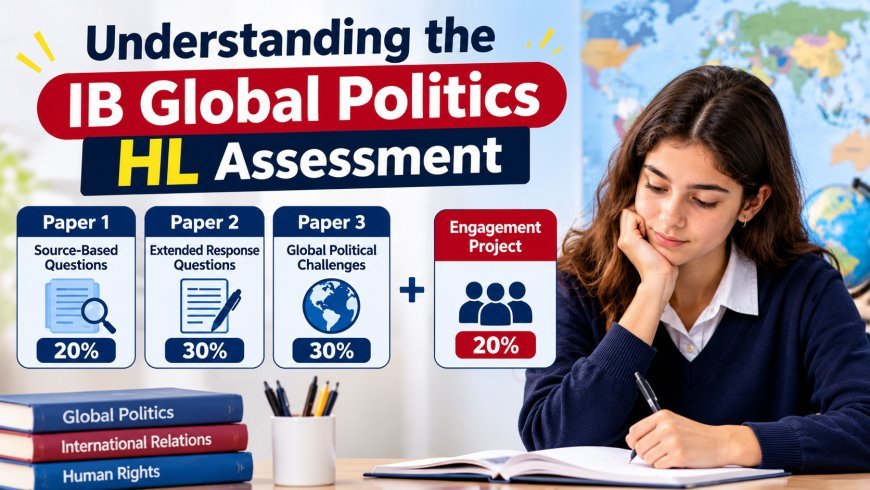
4. Understanding the IB Global Politics HL Assessment
Higher Level includes the same core topics and two common examination papers as SL. However, it introduces additional academic expectations.
HL students study two global political challenges in greater depth and develop a wider understanding of how political issues connect across countries and regions.
The HL assessment includes three examination papers and an Engagement Project.
Paper 1: Source-Based Questions
Paper 1 is worth 20% of the HL grade.
The examination is the same for SL and HL students. However, the weighting is lower at HL because students also complete an additional examination.
Students should practise analysing sources, identifying political arguments, and using relevant knowledge to support their responses.
Paper 2: Extended Response Questions
Paper 2 contributes 30% of the HL grade.
Like SL, students answer two extended-response questions based on the common thematic studies.
The examination requires strong essay-writing skills, clear arguments, relevant examples, and critical evaluation.
Paper 3: Global Political Challenges
Paper 3 is an additional examination that is only required for HL students.
It lasts 1 hour and 30 minutes and contributes 30% of the final HL grade.
This paper focuses on the additional global political challenges studied during the course.
Students research case studies and use the knowledge they have developed to answer three questions.
The six global political challenges are:
- Environment
- Poverty
- Health
- Identity
- Borders
- Security
HL students study two of these challenges in depth.
For example, a student researching security might explore international terrorism, cybersecurity, military conflict, or the role of international organisations in maintaining peace.
The examination tests students' ability to:
- Understand and analyse political issues.
- Apply knowledge to new situations.
- Use evidence from researched case studies.
- Develop practical recommendations.
- Evaluate different approaches to global challenges.
This paper makes HL more demanding, particularly for students who need additional practice with research and analytical writing.
Internal Assessment: Engagement Project
The Engagement Project is worth 20% of the HL grade.
Both SL and HL students complete this component, but HL students have additional requirements.
They conduct further research and develop a separate recommendation for addressing the political issue they investigated.
For example, a student studying access to education might examine inequalities in their local community and recommend practical policy changes to improve educational opportunities.
This requires more than describing a problem. Students must understand its causes, consider different stakeholder perspectives, and suggest a realistic way forward.
5. Which Level Has a Higher Workload?
Workload is one of the most important factors to consider when choosing between SL and HL.
The IB recommends approximately 150 teaching hours for Global Politics SL and 240 hours for HL.
This means HL includes around 90 additional recommended teaching hours.
However, the actual workload also depends on your research skills, writing ability, study habits, and familiarity with political issues.
SL Workload Generally Involves:
- Learning the four core syllabus areas.
- Preparing for two examination papers.
- Completing the Engagement Project.
- Practising source analysis and essay writing.
- Keeping up with relevant political developments.
HL Workload Generally Involves:
- Completing all SL syllabus requirements.
- Studying two additional global political challenges.
- Researching multiple real-world case studies.
- Preparing for an additional examination.
- Completing the extended Engagement Project requirements.
- Developing stronger independent research skills.
If you are already studying several demanding HL subjects, choosing Global Politics HL may require careful planning.
However, a higher workload does not automatically mean a better academic outcome. The right choice is the level where you can perform consistently while managing your other subjects.
6. Should You Choose IB Global Politics SL or HL?
The best level depends on your interests, academic goals, and ability to manage the workload.
Choose SL If:
SL may be the better choice if:
- You enjoy understanding international affairs but do not want an additional research-heavy extension.
- You prefer a more balanced IB Diploma workload.
- You want to focus on developing your political knowledge and essay-writing skills.
- You have several other demanding HL subjects.
- You are interested in Global Politics but do not necessarily plan to study politics at university.
For example, imagine a student interested in business, economics, or psychology who also enjoys following international news.
Global Politics SL can provide useful knowledge about governments, global markets, human rights, and international relationships without the additional HL extension.
Choose HL If:
HL may be a better fit if:
- You are genuinely interested in international relations and political affairs.
- You enjoy conducting independent research.
- You are comfortable writing detailed analytical essays.
- You want to explore global challenges in greater depth.
- You can manage additional coursework and examination preparation.
- You are considering university courses related to politics, international relations, or law.
For instance, a student who regularly follows international conflicts, government policies, environmental agreements, and human rights discussions may enjoy the additional depth offered by HL.
However, university admission requirements vary. Taking Global Politics HL does not automatically guarantee an advantage for every university or degree.
Always check the subject requirements of your preferred universities before making your final decision.
7. Does Your Choice of Other IB Subjects Matter?
Absolutely!
When selecting Global Politics SL or HL, you should consider your entire subject combination rather than looking at one subject in isolation.
For example, students taking subjects such as Economics HL, History HL, or ib english language and literature HL may already have significant reading, writing, and analytical work.
IB English Language and Literature is particularly relevant when considering your academic workload.
Both subjects require students to interpret information, develop arguments, and communicate ideas clearly.
Although their subject content is different, strong writing and critical-thinking skills can support your performance in both.
Consider these questions:
- How many HL subjects are you already taking?
- Are you comfortable writing analytical essays?
- Can you manage multiple research assignments?
- Do you have enough time for independent study?
- Does your preferred university course have specific subject requirements?
A balanced subject combination can help you maintain better academic performance throughout the Diploma Programme.
8. Practical Tips to Score Better in IB Global Politics
Whether you choose SL or HL, developing the right study habits can make a significant difference.
Here are some practical strategies to improve your preparation.
1. Follow Current International Affairs
Global Politics is closely connected to real-world events.
Read reliable news sources and follow developments involving international organisations, governments, conflicts, human rights, and economic policies.
Try to connect current events with the political concepts you learn in class.
2. Build a Case Study Collection
Do not depend on general examples when writing examination answers.
Maintain a collection of relevant case studies covering different political topics.
For each case study, record:
- The country or region involved.
- The main political issue.
- Important stakeholders.
- Relevant political concepts.
- Supporting facts and evidence.
- Different perspectives.
- The political consequences.
This will make essay preparation easier and help you develop stronger arguments.
3. Practise Analytical Writing
One common challenge students face is explaining an event without analysing it.
For example, instead of simply writing that an international organisation helped resolve a conflict, explain how it used diplomacy, negotiation, or economic pressure.
Always ask yourself:
- Why did this happen?
- Who benefited from the decision?
- Who was negatively affected?
- Was the approach successful?
- What alternative solutions were possible?
These questions encourage deeper political thinking.
4. Practise Past Papers
Past papers help you understand examination expectations and improve time management.
Practise both source-based questions and extended essays.
After completing an answer, compare your work with the relevant assessment criteria and identify areas for improvement.
5. Seek Support When Needed
If you struggle with political concepts, research methods, or essay writing, additional academic support can help.
An experienced ib global politics tutor can explain difficult topics, review your practice answers, guide your case-study preparation, and help you understand assessment expectations.
The goal should not be to memorise ready-made answers. Instead, focus on developing the skills needed to analyse unfamiliar political situations independently.
9. Frequently Asked Questions (FAQs)
Q1. Is IB Global Politics HL much harder than SL?
HL is generally more demanding because it includes additional global political challenges, a third examination paper, and extended research requirements. However, students who enjoy politics and independent research may find the additional content interesting and manageable.
Q2. Can I get a good IB score in Global Politics SL?
Yes. SL offers plenty of opportunities to achieve a strong grade. Success depends on your understanding of political concepts, quality of analysis, examination preparation, and performance in the Engagement Project.
Q3. Does IB Global Politics HL help with university admissions?
It can demonstrate your interest in politics, international affairs, and analytical research. However, its value depends on your intended degree and university admission requirements. Always review the specific subject prerequisites for your preferred programmes.
Q4. Do SL and HL students study the same topics?
Both levels study the same core content and thematic studies. However, HL students also study two additional global political challenges through an extended case-study approach.
Q5. Should I hire an IB Global Politics tutor?
A tutor can be helpful if you need support with political concepts, source analysis, essay writing, case-study research, or internal assessments. Personalised guidance can help you identify weaknesses and develop a more effective study strategy.
Conclusion: Make the Right Choice Between IB Global Politics SL and HL
Choosing between IB Global Politics SL and HL is not simply about selecting the more advanced option. It is about finding the level that matches your academic interests, university plans, and ability to manage the IB workload.
SL is a strong option if you want to understand global political issues while maintaining a balanced subject combination.
HL is worth considering if you enjoy deeper research, international affairs, and exploring complex global challenges.
Before deciding, review the syllabus, compare the assessment requirements, and consider your other IB subjects.
If you need additional guidance, working with an experienced ib global politics tutor can help you understand the course structure, strengthen your analytical skills, and prepare more confidently for examinations.
Make your IB subject choices with a clear plan, focus on consistent preparation, and choose the level that allows you to achieve your academic goals.
What's Your Reaction?
 Like
0
 Dislike
0
 Love
0
 Funny
0
 Angry
0
 Sad
0
 Wow
0