






















Why Does Your Breathing Change Before You Realize You're Stressed?
Discover why breathing changes during stress, how the nervous system responds, and how yoga and pranayama may support breath awareness and relaxation.

Understanding the Connection Between Breath, the Nervous System, and How Yoga Helps You Recognize Stress Earlier
You're sitting at your desk, answering emails, when an unexpected message appears.
There's a deadline you weren't expecting. You read the message twice, begin planning your response, and continue working.
A few minutes later, you notice something strange.
Your shoulders are tense. Your jaw is tight. And your breathing has become unusually shallow.
You hadn't consciously felt stressed until that moment.
Yet your body was already responding.
This experience is more common than many people realise. Stress doesn't always begin with an obvious feeling of worry or anxiety. Sometimes, physical changes happen before we consciously recognise what we're experiencing.
One of the earliest changes can involve breathing.
Understanding this connection can help us recognise stress patterns and develop a more thoughtful approach to managing them.
Your Body Responds to Stress Automatically
Breathing is unusual because it operates both automatically and voluntarily.
You don't need to remember to breathe while sleeping, reading, or working. Your brain continuously regulates breathing according to your body's needs.
But you can also deliberately change your breathing pattern.
This makes the breath an interesting connection between automatic bodily processes and conscious awareness.
When your brain detects a potential threat or demanding situation, it can activate the sympathetic nervous system.
This response prepares your body for action.
Your heart may beat faster, muscles may become tense, and breathing can become quicker or shallower.
These responses are part of the body's normal stress-response system.
The important detail is that they don't require conscious permission.
Your body can begin responding before you have clearly identified the situation as stressful.
Why Your Breathing Changes Before Your Thoughts Catch Up
Imagine walking across a road when a vehicle suddenly approaches faster than expected.
You react immediately.
Your muscles tighten, your attention sharpens, and your breathing may change.
You don't first sit down and decide whether the situation is dangerous.
The nervous system reacts rapidly.
Everyday psychological stress can activate some of these same physiological pathways, although usually less dramatically.
An uncomfortable conversation, approaching deadline, or unexpected responsibility may influence your breathing before you consciously acknowledge feeling anxious.
This doesn't mean breathing always changes before emotions.
Rather, physical responses and conscious emotional awareness don't always happen at exactly the same moment.
Recognising that distinction is important.
Students exploring authentic yoga teacher training Mysore India often encounter breathing awareness as part of traditional practice. Understanding the physiology behind breathing can add another dimension to that learning.
What Does Stress-Related Breathing Feel Like?
Stress doesn't affect everyone's breathing in the same way.
Some people begin taking faster breaths.
Others notice that breathing becomes concentrated in the upper chest.
Some unconsciously hold their breath during demanding tasks.
You may also notice frequent sighing, difficulty settling into a comfortable breathing rhythm, or tension around your shoulders and neck.
These experiences can occur during concentration as well as emotional stress.
For example, you might hold your breath briefly while writing an important message or trying to solve a difficult problem.
However, changes in breathing aren't always caused by stress.
Exercise, respiratory conditions, medications, pain, and other medical factors can also influence breathing patterns.
Persistent or unexplained breathlessness should not automatically be attributed to anxiety.
The Relationship Between Breathing and the Nervous System
The autonomic nervous system helps regulate essential bodily functions, including heart rate, digestion, and aspects of breathing.
Its sympathetic branch supports responses associated with heightened alertness and activity.
Parasympathetic activity contributes to rest, recovery, and regulation.
These systems work together rather than functioning as simple on-and-off switches.
Breathing interacts with this regulation.
When you're anxious or physically challenged, breathing patterns may change.
Deliberately practising comfortable, slower breathing can also influence physiological processes associated with relaxation.
Research suggests that certain breathing exercises may help reduce perceived stress.
However, breathing is not a universal switch that instantly turns off the stress response.
Its effects vary between individuals and situations.
Why Most People Don't Notice Their Breathing
One reason breathing changes go unnoticed is that attention is usually directed elsewhere.
During a stressful situation, you're probably concentrating on the problem itself.
You may be thinking about what to say, what to do next, or how to avoid making a mistake.
Your breathing is happening in the background.
Unless you deliberately observe it, subtle changes may pass unnoticed.
Regular yoga practice offers opportunities to develop that awareness.
In Hatha Ashtanga yoga teacher training Mysore, students may explore the relationship between movement, posture, and breathing through structured practice.
As familiar movements become easier to follow, they can begin paying closer attention to how breathing responds to physical effort.
This awareness may also become useful outside the yoga classroom.
Can Breathing Awareness Help You Recognise Stress Earlier?
Sometimes.
Imagine noticing that you're holding your breath while preparing for a difficult meeting.
Instead of continuing automatically, you pause.
You relax your shoulders, observe your breathing, and recognise that you're feeling tense.
The stressful situation hasn't disappeared.
But you've become aware of your response.
That awareness gives you an opportunity to make a more deliberate choice.
You might take a short break, change your posture, or approach the task with greater attention.
Breathing awareness isn't about preventing every stress response.
It's about noticing patterns that might otherwise remain automatic.
Why Forcing Deep Breaths Isn't Always Helpful
When people feel stressed, they're often told to take a deep breath.
For some, this feels calming.
For others, repeatedly taking very large breaths can create discomfort, dizziness, or a feeling of air hunger.
The goal of relaxation breathing shouldn't be to inhale as much air as possible.
Instead, it can involve allowing breathing to become gentle, comfortable, and unforced.
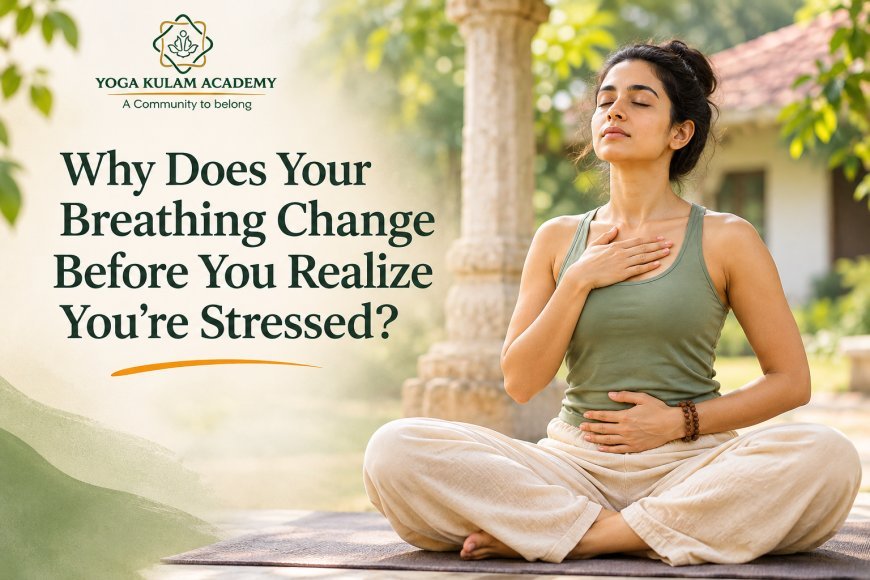
A simple practice is to sit in a supported position, notice your natural breathing, and gradually allow the rhythm to settle.
If comfortable, you may experiment with slightly slower breaths without holding your breath or straining.
Anyone who experiences dizziness, chest discomfort, or worsening breathlessness should stop.
Breathing exercises need to be adapted to individual circumstances.
What Yoga Teaches About Breath and Attention
Traditional yoga includes pranayama, commonly associated with the regulation and exploration of breathing.
Different pranayama techniques have different methods, purposes, and levels of intensity.
Some emphasise gentle awareness.
Others involve structured breathing patterns, alternate-nostril breathing, or breath retention.
These techniques shouldn't all be treated as interchangeable relaxation exercises.
Appropriate instruction is important, particularly for demanding techniques.
Students researching certified yoga teacher training India Mysore should look for programs that combine traditional pranayama education with clear explanations of technique, precautions, and individual suitability.
The objective is to understand breathing rather than assume every technique produces the same physiological effect.
Three Ways to Become More Aware of Your Breathing
Breathing awareness doesn't necessarily require a long meditation session.
You can begin with ordinary situations.
1. Notice your breath before starting work.
Sit comfortably for a moment and observe how you're breathing. There's no need to change anything immediately.
2. Check your breathing during demanding tasks.
After a difficult conversation or concentrated work session, notice whether you're holding tension in your jaw, shoulders, or chest.
3. Allow a comfortable breathing pause during the day.
Take a moment away from your screen. Let your posture settle and allow your breathing to return to a natural, comfortable rhythm.
These simple observations can help you become more familiar with your personal stress responses.
Why Yoga Teacher Training Includes Pranayama
For aspiring yoga teachers, breathing education is important because students respond differently to physical and mental demands.
A beginner may hold their breath while attempting a balancing posture.
Another student may breathe rapidly during a challenging sequence.
A teacher needs to recognise these possibilities without assuming that every breathing change indicates a problem.
When researching the top yoga schools in Mysore for teacher training, prospective students should consider how pranayama is taught alongside anatomy, philosophy, and practical instruction.
Does the curriculum explain precautions?
Are students encouraged to ask questions?
Do instructors distinguish gentle breathing awareness from more demanding techniques?
These details matter when preparing to guide others responsibly.
Can Yoga Reduce Stress Over Time?
Yoga may support stress management through a combination of physical activity, breathing practices, meditation, and relaxation.
Research suggests that some yoga and breathing interventions can reduce perceived stress, although results vary.
The benefits also depend on the type of practice, consistency, individual circumstances, and study quality.
Yoga shouldn't be presented as a guaranteed treatment for anxiety disorders or other medical conditions.
It can, however, form part of a broader wellbeing routine.
For someone considering the Best 200 hour yoga teacher training mysore, learning how movement, breath, and attention interact may be more valuable than simply memorising different postures.
A meaningful training experience should encourage understanding alongside regular practice.
Why the Learning Environment Matters
The environment in which students practise can influence how they engage with breathing exercises.
A calm, supportive classroom may make it easier to focus.
Clear instruction can help students understand unfamiliar techniques.
And opportunities for feedback allow learners to ask questions when a practice feels uncomfortable.
When comparing options for the best Yoga Teacher Training Mysore, students should look beyond course duration and certification alone.
An effective program should provide thoughtful instruction in pranayama, meditation, anatomy, and teaching methodology while respecting individual differences.
At Yogakulam Academy, residential yoga teacher training in Mysore includes pranayama alongside Hatha Yoga, Ashtanga, meditation, philosophy, and anatomy.
Students can explore these subjects through structured learning and regular practice.
More information is available at www.yogakulam.com.
When Breathing Changes Need Medical Attention
Although stress can affect breathing, not every breathing difficulty is stress-related.
New, persistent, or unexplained breathlessness deserves medical evaluation.
Sudden or severe difficulty breathing, especially with chest pain, fainting, or blue lips, requires emergency medical attention.
If anxiety or stress frequently interferes with everyday life, support from a qualified mental health professional may also be helpful.
Yoga can complement appropriate healthcare, but it should not replace diagnosis or treatment.
Final Thoughts
Your breathing can change before you consciously recognise stress because the body's stress response operates partly through automatic nervous-system processes.
These changes may appear as quicker breathing, shallow breaths, muscle tension, or temporary breath-holding.
Regular breathing awareness may help you recognise some of these patterns earlier.
You don't need to control every breath or eliminate every stressful feeling.
Sometimes, the most useful step is simply noticing what is happening.
Your breath doesn't always tell you exactly why you're stressed. But paying attention to it may help you recognise that something needs your attention.
What's Your Reaction?
 Like
0
 Dislike
0
 Love
0
 Funny
0
 Angry
0
 Sad
0
 Wow
0