






















Is Yoga About Becoming Better or Understanding Who You Already Are?
Explore whether yoga is about becoming better or understanding yourself through self-study, philosophy, mindful practice, and traditional yoga.

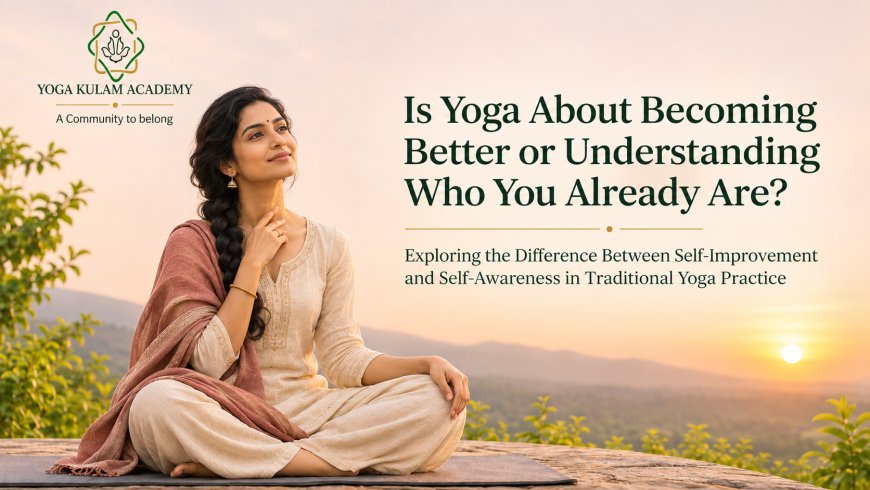
Exploring the Difference Between Self-Improvement and Self-Awareness in Traditional Yoga Practice
There is a familiar feeling that often brings people to yoga: the belief that something about themselves needs to improve.
Perhaps you want to become more flexible, feel calmer, develop better habits, or stop reacting so strongly to stressful situations.
You begin practising with a particular version of yourself in mind.
Someone healthier. More disciplined. More peaceful.
But after spending time on the mat, an unexpected question may arise.
What if yoga is not only about becoming a better version of yourself?
What if it is also about understanding the person you already are?
This distinction can change the way we approach yoga.
Self-improvement asks what we can change. Self-awareness asks what we can understand.
Traditional yoga includes elements of both, but its deeper philosophical purpose extends beyond physical achievement or personal productivity.
Why Most People Begin Yoga With the Desire to Improve
There is nothing wrong with wanting to improve.
Physical health, strength, flexibility, concentration, and emotional wellbeing are reasonable reasons to begin yoga.
Many students first attend classes because they want relief from everyday stiffness or a more consistent exercise routine.
Others are interested in meditation because they struggle to slow down after work.
These motivations can provide a useful starting point.
Problems arise when improvement becomes the only measure of a successful practice.
A student may become frustrated because they cannot perform a particular posture.
Another may believe they are failing because meditation does not make their mind completely quiet.
Someone else may constantly compare their progress with that of more experienced practitioners.
When yoga becomes another activity in which we must continually prove ourselves, we may overlook what the practice is revealing.
The Difference Between Progress and Self-Observation
Imagine practising a standing balance.
At first, your goal is simple: remain in the posture without falling.
You concentrate intensely, tighten your muscles, and become irritated whenever you lose stability.
Over time, you may begin noticing something beyond balance.
Perhaps you hold your breath when the posture becomes difficult.
Maybe you become frustrated when others appear more comfortable.
You might discover that your performance changes significantly depending on sleep, stress, or fatigue.
These observations tell you something about your physical and mental habits.
You are no longer learning only how to balance.
You are learning how you respond to difficulty.
Students exploring authentic yoga teacher training Mysore India may encounter this distinction through regular asana practice, meditation, and philosophical study.
The value of a posture can extend beyond its physical appearance.
What Does Self-Study Mean in Yoga?
Traditional yoga philosophy includes the concept of svadhyaya, often translated as self-study.
In the Yoga Sutras of Patanjali, svadhyaya is included among the niyamas, or personal observances.
Traditionally, the term also involves the study and recitation of sacred teachings. Its meaning is therefore broader than simply analysing your emotions.
For contemporary practitioners, self-observation can be one useful way to explore this principle.
You may begin noticing how you respond to discomfort, uncertainty, or success.
Do you become impatient when progress feels slow?
Do you constantly seek approval?
Can you remain attentive without judging every experience?
These questions do not require immediate answers.
Their value lies in encouraging curiosity about your habits.
Can Yoga Help You Become Better Without Rejecting Yourself?
Self-improvement and self-understanding do not have to compete.
You can work toward better strength or mobility while accepting your present abilities.
You can practise meditation to develop attention without treating every distracted moment as a failure.
You can aim to become a more knowledgeable yoga practitioner while recognising how much you still have to learn.
The difference is the attitude you bring to the process.
When improvement is driven entirely by dissatisfaction, every limitation may feel like a problem.
When improvement is supported by awareness, limitations can become useful information.
A thoughtful Hatha Ashtanga yoga teacher training Mysore program can help students explore this relationship through disciplined practice, breath awareness, and structured learning.
Progress becomes something to understand rather than constantly chase.
Why Yoga Is Not Just About Physical Transformation
Modern yoga is frequently presented through images of advanced postures.
Deep backbends, handstands, and impressive balancing positions can create the impression that physical ability determines progress.
But the ability to perform a difficult asana does not automatically indicate greater self-awareness.
Someone may be extremely flexible yet struggle with patience.
Another practitioner may use simple modifications while developing a thoughtful and consistent practice.
Neither physical appearance nor posture complexity can tell the whole story.
Traditional yoga encompasses philosophical inquiry, meditation, ethical principles, and practices intended to develop concentration and insight.
For students researching certified yoga teacher training India Mysore, this broader curriculum matters.
A certificate may recognise completion of an educational program, but it cannot measure every aspect of personal understanding.
What Happens When You Stop Comparing Yourself?
Comparison can quietly influence even a peaceful yoga class.
You notice someone holding a posture longer.
Another student seems more flexible.
Someone else appears completely comfortable during meditation.
Soon, you begin evaluating your own practice through their experiences.
But people have different bodies, backgrounds, physical abilities, and emotional circumstances.
A posture that feels easy for one person may be challenging for another.
When you stop using other students as your standard, your attention becomes available for more useful questions.
How does this movement feel?
Am I using unnecessary effort?
What can I learn from today's practice?
This shift does not mean abandoning ambition.
It means allowing your practice to develop according to your circumstances.
The Role of Discipline in Understanding Yourself
Yoga is sometimes associated with complete relaxation and acceptance.
But traditional yoga also places importance on sustained practice.
The concept of abhyasa refers to consistent effort or practice.
Developing awareness usually requires returning to the same activities repeatedly.
You practise familiar postures.
You observe your breathing.
You return to meditation even when concentration feels difficult.
Over time, repetition can reveal patterns that are easy to overlook during occasional practice.
Perhaps you notice that your shoulders tighten whenever you feel uncertain.
Maybe you recognise how quickly frustration appears when something does not go according to plan.
Discipline provides opportunities for observation.
It should not become an excuse to ignore pain, exhaustion, or individual needs.
Why Slower Practice Can Reveal More
Sometimes a challenging yoga sequence occupies so much attention that there is little opportunity to notice subtler experiences.
You are busy remembering movements, maintaining balance, and following instructions.
A slower practice may create more space for observation.
During a simple forward bend, you might notice how your breathing changes.
While holding a standing posture, you may recognise unnecessary tension.
In meditation, you might become aware of how frequently your attention moves from one thought to another.
These observations may appear ordinary, but they can influence how you understand your habits.
A yoga retreat in mysore may offer an opportunity to explore slower practice and reflection away from everyday routines.
However, awareness is not limited to retreat settings.
It can also develop through consistent practice at home.
Does Self-Awareness Mean You Should Stop Setting Goals?
Not at all.
Goals can provide direction and motivation.
You may want to develop a regular meditation practice, improve strength, or study yoga philosophy in greater depth.
These are worthwhile objectives.
The challenge is avoiding the belief that your value depends on achieving them.
Consider learning a difficult posture.
You can practise consistently, study appropriate technique, and gradually develop the necessary skills.
At the same time, you can recognise that not achieving the posture does not make your practice meaningless.
The process itself may teach patience, movement awareness, and adaptability.
Self-understanding allows goals to become part of learning rather than a measure of personal worth.
How Yoga Teacher Training Changes Your Perspective
Many students enter teacher training with the intention of developing better physical skills or becoming confident instructors.
During the course, they may encounter questions they had not considered before.
Why do different bodies require different modifications?
How can you guide someone without imposing your own expectations?
What happens when a student cannot perform the posture you demonstrate?
How should teachers respond when a practice causes discomfort?
These questions encourage a broader understanding of yoga.
When comparing the top yoga schools in Mysore for teacher training, prospective students should investigate whether the curriculum includes philosophy, anatomy, practical teaching, and opportunities for reflection.
A good educational environment should develop thoughtful instructors rather than simply reward impressive physical performance.
Can You Learn More About Yourself Through Teaching?
Teaching yoga can reveal habits that personal practice does not always expose.
You may discover that you become nervous when speaking in front of others.
Perhaps you tend to explain too much.
You might struggle when students ask unexpected questions.
Or you may realise that you expect others to understand movements as quickly as you do.
These experiences can become opportunities for reflection.
A responsible yoga teacher learns to recognise personal assumptions and remain open to feedback.
Students searching for the Best 200 hour yoga teacher training mysore should look for programs that provide practical teaching experience alongside theoretical education.
The purpose is not simply to complete a course.
It is to develop the knowledge and judgment required to guide others responsibly.
What Traditional Yoga Says About Who We Are
Many traditional yoga teachings explore questions of identity, consciousness, and the nature of the self.
Different philosophical traditions interpret these questions in different ways.
In classical Yoga philosophy, the distinction between purusha—often understood as pure awareness—and prakriti, the realm of nature and changing experience, is particularly important.
The tradition's ultimate aims extend far beyond becoming more flexible, productive, or emotionally comfortable.
This does not mean every modern yoga practitioner must adopt a particular metaphysical belief.
But studying these ideas can reveal why traditional yoga cannot be reduced to self-improvement alone.
It invites reflection on what changes through practice and what awareness itself means.
Finding a Yoga Learning Environment That Encourages Understanding
The right learning environment can influence how students approach their practice.
Some programs focus heavily on physical achievement.
Others combine asana with pranayama, meditation, anatomy, philosophy, and teaching methodology.
Students looking for the best Yoga Teacher Training Mysore experience should consider which approach matches their educational goals.
At Yogakulam Academy, yoga teacher training in Mysore includes structured study of Hatha Yoga, Ashtanga, pranayama, meditation, philosophy, and anatomy.
These subjects provide opportunities to explore yoga as a broader discipline rather than only a physical activity.
Students can learn more about the available programs at www.yogakulam.com.
Final Thoughts
So, is yoga about becoming better or understanding who you already are?
Perhaps the most meaningful answer is that these possibilities are connected.
Yoga can encourage physical development, concentration, discipline, and new skills.
But it can also reveal how you respond to difficulty, uncertainty, comparison, and change.
Improvement may be one outcome of practice.
Understanding can influence how you approach that improvement.
You do not need to abandon goals or stop challenging yourself.
You can continue learning while becoming less attached to proving that you are constantly progressing.
Yoga may help you develop new abilities, but one of its deeper possibilities is learning to observe yourself without always needing to become someone different.
What's Your Reaction?
 Like
0
 Dislike
0
 Love
0
 Funny
0
 Angry
0
 Sad
0
 Wow
0