


























KA02 Assessment: How to Structure Your Engineering Report Properly
A properly organized KA02 Assessment should present engineering knowledge in a clear, logical, and evidence-based manner.

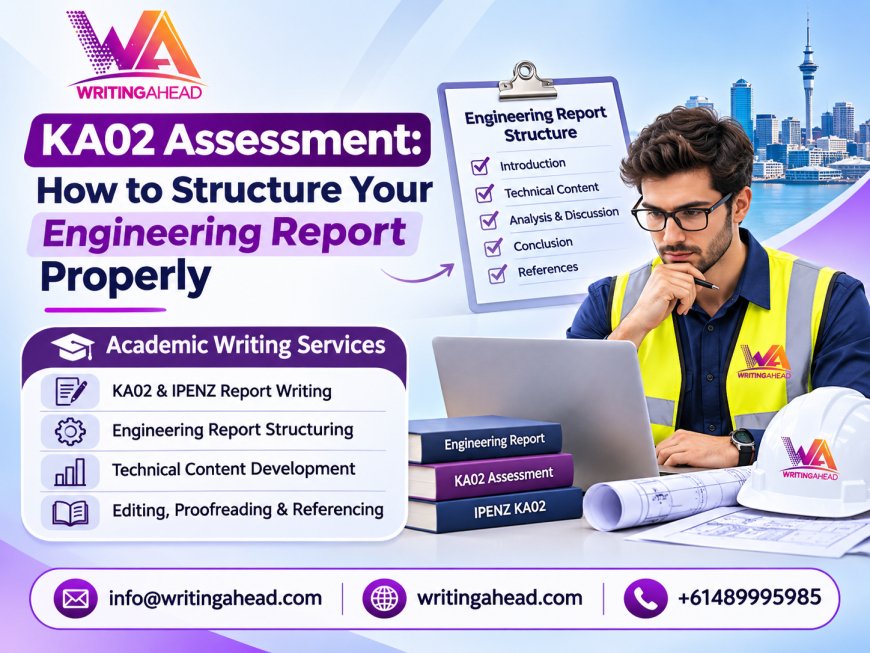
A well-structured engineering report is essential when preparing a KA02 Assessment, particularly for engineering graduates and professionals seeking recognition in New Zealand. The report should not simply describe your qualifications or professional activities; instead, it should clearly demonstrate how your engineering knowledge has been developed and applied through education, technical work, analysis, design, problem-solving, and relevant evidence. Engineering New Zealand provides specific guidance for knowledge assessments and recommends that applicants become familiar with the assessment criteria and present their information clearly.
For students and engineering professionals from New Zealand and Australia, the structure of the report can make technical information easier to understand and evaluate. A logical structure allows each section to connect naturally with the next while keeping the focus on engineering knowledge. Therefore, understanding how to organise an IPENZ KA02-style report is important when preparing an IPENZ KA02 Knowledge Assessment. The terminology "IPENZ" is commonly used historically, while Engineering New Zealand is the current organisation responsible for the assessment guidance.
KA02 Assessment: Understanding the Purpose of the Engineering Report
KA02 Assessment and Its Engineering Focus
The first step in structuring an engineering report is understanding what the document needs to demonstrate. A KA02 report is fundamentally about presenting evidence of engineering knowledge rather than creating a general professional biography. Your academic background, technical experience, engineering activities, and supporting evidence should work together to demonstrate the depth and application of your knowledge.
Consequently, every section should have a clear purpose. Instead of adding information simply to make the report longer, you should explain how particular academic learning, engineering activities, technical decisions, calculations, analysis, or project experiences demonstrate your knowledge.
For Australian and New Zealand engineering applicants, this distinction is particularly important because a strong technical report should show the relationship between engineering theory and its practical application. The report should therefore communicate not only what you did, but also the engineering reasoning behind what you did.
Creating a Clear Report Flow
A logical flow helps an assessor understand your engineering background without repeatedly searching for relevant information. Begin with your personal and academic background, then move into your professional development and engineering experience before presenting detailed knowledge evidence.
Afterward, the report can develop into technical explanations and supporting work samples. Each section should connect with the next so that the document reads as one coherent engineering assessment rather than a collection of unrelated descriptions.
KA02 Assessment: Building the Introduction Correctly
Introducing Your Engineering Background
The introduction should establish the context of your engineering education and experience. It should give the reader an immediate understanding of your engineering discipline, academic pathway, and professional direction.
However, the introduction should remain focused. Avoid filling it with unnecessary personal information. Instead, explain the engineering background that is relevant to the assessment and establish why the following sections provide useful evidence of your knowledge.
For example, an applicant from Australia with an overseas engineering qualification could briefly explain their engineering discipline, qualification, relevant professional experience, and the types of technical activities they have undertaken. Similarly, an applicant preparing for professional recognition in New Zealand can establish their engineering field before moving into detailed evidence.
Establishing the Report's Technical Context
The introduction should also prepare the reader for the technical content that follows. If your experience involves civil, mechanical, electrical, structural, telecommunications, or another engineering discipline, the terminology and examples used throughout the report should remain consistent with that field.
Furthermore, the introduction should establish a professional tone. Technical writing should be precise, direct, and evidence-based. Rather than making broad statements such as "I have excellent engineering knowledge," explain where that knowledge was obtained and how it has been applied.
KA02 Assessment: Structuring Your Academic Knowledge
Connecting Education With Engineering Knowledge
Academic information should not simply appear as a list of subjects, grades, or qualifications. The more useful approach is to explain how your education developed the engineering foundation required for later technical activities.
For instance, mathematics may have supported engineering calculations, physics may have helped you understand physical behaviour, and specialist engineering subjects may have provided the theoretical foundation for design or analysis.
Therefore, when describing academic knowledge, focus on the relationship between theory and engineering application. This makes the report more meaningful because the reader can understand how your academic background contributes to your technical capability.
Explaining Engineering Theory Clearly
Technical theory should be explained according to its relevance. If a mathematical principle, engineering model, scientific concept, or analytical method was important to a particular engineering activity, explain how you applied it.
At the same time, avoid unnecessarily complicated language. A technically strong report does not need to use difficult vocabulary simply to appear advanced. Instead, the explanation should demonstrate genuine understanding through accurate terminology, logical reasoning, and appropriate technical detail.
KA02 Assessment: Presenting Engineering Experience Effectively
Moving From General Experience to Specific Evidence
Your professional experience should provide context, but specific engineering activities should provide the deeper evidence. Engineering New Zealand's guidance emphasises clear assessment criteria and supporting documentation, making it important to organise your information so that your technical knowledge can be identified.
Instead of describing an entire project from beginning to end without a clear purpose, select relevant activities and explain the engineering knowledge demonstrated through them.
For example, you might describe how you investigated an engineering problem, evaluated possible approaches, performed calculations, developed a design, assessed constraints, or reviewed the technical outcome. The emphasis should remain on your engineering reasoning and contribution.
Highlighting Your Personal Contribution
A major structural consideration is distinguishing your own contribution from the work of a team. Engineering projects are frequently collaborative; nevertheless, the report needs to make your individual role understandable.
Using first-person language can help achieve this. Engineering New Zealand's assessment guidance specifically recommends writing in the first person, such as "I" or "me."
Consequently, statements such as "I analysed," "I calculated," "I designed," "I evaluated," or "I reviewed" can make your contribution clearer when they accurately describe your work. Avoid claiming responsibility for work you did not personally undertake.
KA02 Assessment: Organising Technical Knowledge and Evidence
Connecting Knowledge With Work Samples
Supporting evidence should not be added randomly at the end of a report. Instead, technical evidence should connect logically with the knowledge being discussed.
A calculation can demonstrate analytical knowledge, while a technical drawing may provide evidence of design activity. Similarly, a technical report, modelling output, testing record, or engineering analysis may help demonstrate how theoretical knowledge was applied in practice.
Therefore, when referencing supporting evidence, make the connection explicit. Explain what the evidence demonstrates and why it is relevant to the engineering knowledge being discussed.
Making Evidence Easy to Understand
Evidence becomes more useful when the reader can locate and understand it easily. Clear document names, section references, page references, figures, tables, or other appropriate identifiers can help establish this connection.
However, the evidence itself should remain authentic and relevant to your own engineering work. Engineering New Zealand provides supporting-document guidance for knowledge assessments, including work-sample-related documentation.
KA02 Assessment: Developing Strong Technical Sections
Explaining Engineering Problems
A strong engineering report should explain the problem before discussing the solution. This gives the technical discussion a clear context.
Begin by explaining the engineering situation, relevant constraints, technical requirements, and factors that influenced your approach. Then describe how you investigated the problem and developed an appropriate response.
This structure creates a natural progression from problem identification to technical reasoning and finally to the engineering outcome.
Demonstrating Analysis and Decision-Making
Engineering knowledge becomes clearer when the report explains why particular decisions were made. Rather than simply saying that you selected a particular method, explain the engineering factors that influenced that selection.
For example, technical decisions may have involved safety, performance, materials, environmental conditions, reliability, cost, constructability, maintainability, or regulatory considerations. The relevant factors will depend on your engineering discipline and project.
As a result, your report should demonstrate a chain of reasoning: the problem created a requirement, the requirement led to analysis, the analysis informed a decision, and the decision produced an engineering outcome.
KA02 Assessment: Creating Consistent Headings and Subheadings
Using a Logical Heading Hierarchy
A clear heading structure makes a long engineering report easier to navigate. Your main H2 sections should introduce major topics, while H3 headings should divide those topics into focused technical discussions.
For example, a section about engineering experience could contain separate subsections for technical responsibilities, problem-solving, engineering analysis, and personal contribution.
Consistency is equally important. Once you establish a heading style, maintain it throughout the document. Avoid changing terminology or heading formats unnecessarily because inconsistency can make the report appear disorganised.
Keeping Each Section Focused
Each section should answer a specific question. If a heading discusses engineering analysis, the content underneath it should primarily explain analysis rather than shifting into unrelated career history.
Similarly, an evidence section should explain the relevance of evidence rather than repeating the introduction. This approach reduces repetition and gives every part of the report a distinct function.
KA02 Assessment: Improving Technical Writing Quality
Using Precise Engineering Language
Technical writing should communicate complex information without creating unnecessary confusion. Therefore, use engineering terminology where it improves precision, but explain concepts sufficiently for the context.
Transitional words can also improve the flow. Words such as "however," "therefore," "furthermore," "consequently," "similarly," "in addition," and "as a result" help connect technical reasoning.
For example, an explanation can introduce a technical problem, discuss the analysis, and then use "therefore" to connect the analysis with the resulting engineering decision.
Maintaining Consistency Throughout the Report
Consistency should apply to terminology, project names, dates, engineering roles, technical descriptions, and evidence references. Information presented in one section should not contradict information presented elsewhere.
Before completing the report, review the entire document as one piece. This helps identify repeated explanations, missing connections, inconsistent terminology, and sections that require additional technical explanation.
KA02 Assessment: Reviewing the Complete Engineering Report
Checking Technical Completeness
The final review should examine whether the report demonstrates the required engineering knowledge clearly. Engineering New Zealand provides a Knowledge Assessment guide and checklist as part of its assessment guidance resources.
At this stage, consider whether every major technical explanation has appropriate context and whether your evidence actually supports the statements being made.
A report can contain extensive technical information and still be unclear if the information is poorly connected. Therefore, completeness should be considered together with organisation and relevance.
Checking Authenticity and Personal Ownership
Your final review should also confirm that the report accurately represents your own education, knowledge, engineering experience, and contribution. This is especially important because an assessment document should reflect the applicant's genuine knowledge and experience.
For applicants in Australia and New Zealand, maintaining accurate and original technical information is essential. Your report should never exaggerate your responsibilities or present another person's engineering work as your own.
KA02 Assessment: Final Structure for a Professional Engineering Report
Creating a Coherent Document
A properly structured engineering report should move naturally from background to academic knowledge, professional experience, technical evidence, engineering analysis, personal contribution, and supporting documentation.
The structure should allow the reader to understand not only your engineering history but also how your knowledge has developed and how you apply it in technical situations.
In this context, an IPENZ KA02 Knowledge Assessment should be approached as a technical and evidence-based document rather than a conventional employment report. Although applicants may still use the historical term IPENZ KA02, current Engineering New Zealand guidance should be followed when preparing the assessment.
Preparing the Report for New Zealand and Australian Applicants
Engineering professionals and graduates from Australia can benefit from presenting their qualifications and experience in a way that clearly explains the relationship between engineering education and professional practice. Likewise, applicants targeting engineering opportunities in New Zealand should ensure that their report reflects the relevant assessment requirements and technical expectations.
Ultimately, the goal of the structure is clarity. The reader should be able to understand your engineering knowledge, follow your reasoning, identify your personal contribution, and locate the evidence supporting your statements without unnecessary confusion.
Frequently Asked Questions About KA02 Assessment
What is the main purpose of a KA02 Assessment?
A KA02 Assessment is designed to assess an applicant's engineering knowledge against the applicable knowledge requirements. The report therefore needs to demonstrate knowledge through academic background, engineering experience, technical explanations, and relevant evidence rather than simply presenting a CV.
How should an engineering report begin?
An engineering report should begin by establishing the applicant's engineering background, qualification, discipline, and relevant context. After that, the report can move into academic knowledge, professional experience, technical examples, and supporting evidence.
Why is personal contribution important in a KA02 report?
Personal contribution helps distinguish your own engineering knowledge and activities from the work performed by a larger project team. Using accurate first-person explanations can make it easier to understand what you personally analysed, designed, calculated, reviewed, or decided. Engineering New Zealand also recommends first-person writing in its assessment guidance.
Should technical evidence be connected to specific sections?
Yes. Technical evidence is more meaningful when the report explains exactly what it demonstrates and how it relates to the engineering knowledge being discussed. Clear references can also make supporting material easier to locate and understand.
Can Australian engineering professionals use this structure?
Yes, the general principles of logical organisation, technical explanation, evidence connection, and clear personal contribution are useful for Australian applicants preparing documentation for New Zealand-related engineering assessment. However, applicants should always check the current requirements and guidance applicable to their specific assessment.
Conclusion
A properly organised KA02 Assessment should present engineering knowledge in a clear, logical, and evidence-based manner. The strongest structure connects academic learning with professional engineering activities, explains technical problems and decisions, identifies personal contributions, and links supporting evidence with the relevant discussion. For applicants targeting New Zealand or coming from an Australian engineering background, careful organisation can make complex technical information much easier to follow.
The key is to treat the report as a structured demonstration of engineering knowledge rather than a simple description of professional experience. By maintaining consistent headings, clear technical explanations, appropriate transitions, accurate evidence references, and authentic first-person descriptions, you can create a professional engineering report that communicates your knowledge effectively. Current Engineering New Zealand guidance should always be checked before submission because assessment requirements and documentation can change.
Frequently Asked Questions About KA02 Assessment
What is the main purpose of a KA02 Assessment?
A KA02 Assessment evaluates how effectively an engineering applicant can demonstrate relevant engineering knowledge through education, technical understanding, professional experience, and supporting evidence.
How should I structure an engineering report for KA02?
A clear report can begin with your engineering background and academic knowledge before moving into professional experience, technical examples, engineering analysis, personal contributions, and supporting evidence. Each section should connect logically with the next.
Why is personal contribution important in an IPENZ KA02 report?
Personal contribution helps explain what you personally completed during engineering projects. Therefore, clearly describing your own analysis, calculations, design decisions, problem-solving, and technical responsibilities can make the evidence easier to understand.
What is an IPENZ KA02 Knowledge Assessment?
An IPENZ KA02 Knowledge Assessment refers to the engineering knowledge assessment associated with the former IPENZ terminology. Applicants preparing current documentation should use the applicable current assessment requirements and terminology.
Can Australian engineering graduates prepare a KA02-style report?
Yes. Australian engineering graduates can organise their technical information around their academic knowledge, engineering experience, technical reasoning, and supporting evidence. However, the specific requirements applicable to their intended New Zealand assessment should be checked before submission.
What's Your Reaction?
 Like
0
 Dislike
0
 Love
0
 Funny
0
 Angry
0
 Sad
0
 Wow
0