





















Microsoft Azure AI Course: Complete Guide to Features, Skills, Benefits, and Career Opportunities
Explore the Microsoft Azure AI Course, covering key features, essential skills, learning benefits, certifications, and exciting career opportunities in artificial intelligence.

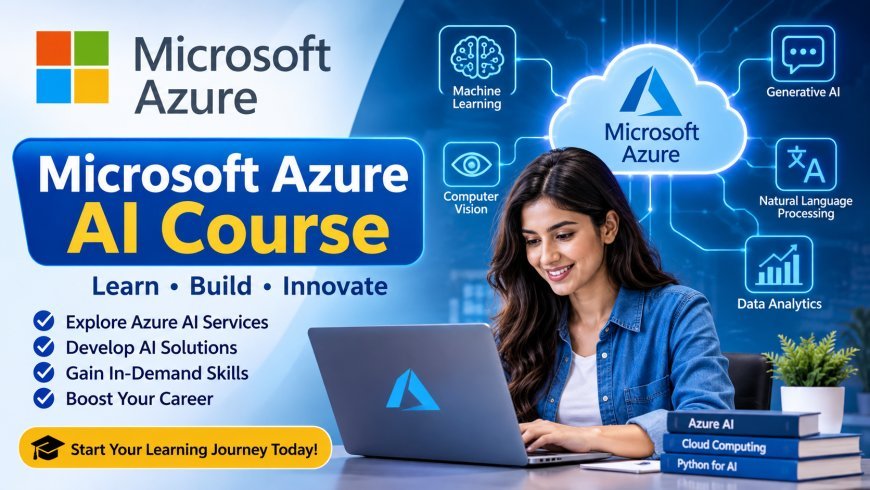
Artificial intelligence is transforming how businesses operate, make decisions, and deliver services. From intelligent chatbots and predictive analytics to automated business processes, AI has become an essential technology across industries. Microsoft Azure provides a comprehensive cloud-based environment that helps developers, data scientists, and IT professionals build, deploy, and manage AI-powered applications.
For individuals interested in developing expertise in artificial intelligence, a Microsoft Azure AI Course can provide a structured learning path covering essential AI concepts, Azure services, practical applications, and industry-relevant skills. Whether you are a beginner or an experienced IT professional, understanding Azure AI can open doors to exciting career opportunities.
What Is Microsoft Azure AI?
Microsoft Azure AI is a collection of artificial intelligence services and tools available through the Microsoft Azure cloud platform. These services enable organizations to integrate intelligent capabilities into applications without building every AI component from scratch.
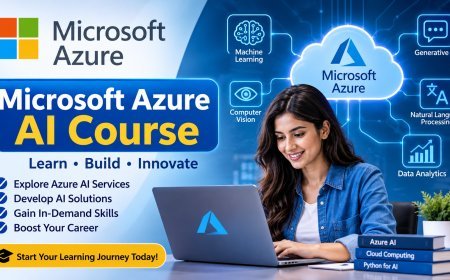
Azure AI supports several technologies, including machine learning, natural language processing, computer vision, speech recognition, and generative AI. Businesses use these capabilities to automate repetitive tasks, understand customer behavior, analyze large datasets, and improve operational efficiency.
The platform also provides development environments and prebuilt AI models that simplify the process of creating intelligent solutions. This makes Azure AI useful for startups, enterprises, developers, researchers, and technology professionals.
Key Features Covered in a Microsoft Azure AI Course
A comprehensive training program introduces learners to different Azure AI services and explains how to use them in real-world projects.
Here are some important features students can explore.
1. Azure AI Services
Azure AI Services offer ready-to-use APIs and tools for integrating artificial intelligence into applications. These services help developers implement intelligent features without requiring extensive knowledge of machine learning algorithms.
Important areas include:
-
Azure AI Vision: Helps applications analyze images, identify objects, and extract information from visual content.
-
Azure AI Language: Supports text analysis, sentiment detection, language understanding, and conversational applications.
-
Azure AI Speech: Provides speech-to-text, text-to-speech, and speech translation capabilities.
-
Azure AI Document Intelligence: Extracts useful information from documents, forms, and invoices.
-
Azure AI Search: Helps organizations retrieve relevant information from large collections of data.
Understanding these services allows learners to select suitable AI solutions for different business requirements.
2. Machine Learning with Azure
Machine learning is one of the most important areas of artificial intelligence. Microsoft Azure Machine Learning provides tools for developing, training, testing, and deploying machine learning models.
Learners can understand how to prepare datasets, select suitable algorithms, evaluate model performance, and deploy trained models.
An effective course also introduces automated machine learning, which helps identify suitable algorithms and parameters for specific datasets.
3. Generative AI and Azure OpenAI
Generative AI has become an important part of modern technology. It enables applications to generate text, summarize information, answer questions, and assist users with complex tasks.
Azure OpenAI provides access to supported generative AI models through Azure services. Learners can explore prompt engineering, conversational AI, retrieval-augmented generation (RAG), and responsible AI practices.
These concepts are particularly useful for developing AI-powered assistants, business applications, and intelligent knowledge management systems.
4. Responsible AI and Security
AI systems must be developed responsibly to ensure reliability, fairness, privacy, and transparency.
Training programs introduce learners to responsible AI principles, data protection, model monitoring, and security considerations. Understanding these practices helps professionals develop trustworthy AI solutions.
Essential Skills You Can Develop
Enrolling in a Microsoft Azure AI Course can help learners build technical and analytical skills required for working with artificial intelligence technologies.
Some important skills include:
1. Python Programming: Python is widely used in AI and machine learning development. Understanding Python helps learners work with datasets, develop models, and automate different processes.
2. Machine Learning Fundamentals: Knowledge of supervised learning, unsupervised learning, classification, regression, and model evaluation provides a strong foundation.
3. Cloud Computing: Understanding Azure resources, cloud deployment, storage, and computing services helps professionals manage AI applications effectively.
4. Data Preparation and Analysis: AI models depend on quality data. Learners should understand data cleaning, transformation, visualization, and feature engineering.
5. AI Model Development: Developing, testing, evaluating, and deploying AI models is an important practical skill.
6. Prompt Engineering: Generative AI applications require effective prompts to produce relevant and useful responses. Learning prompt design can improve application performance.
7. Problem-Solving: AI professionals must identify business challenges and select appropriate technologies to develop practical solutions.
Benefits of Learning Microsoft Azure AI
Artificial intelligence knowledge can provide several professional and technical advantages. Azure AI training combines cloud computing concepts with practical AI applications.
1. Industry-Relevant Knowledge
Azure AI is used across healthcare, finance, retail, manufacturing, education, and other sectors. Learning its services helps professionals understand how organizations implement artificial intelligence in different business environments.
2. Hands-On Learning Experience
Practical exercises allow students to work with Azure AI tools and understand how AI applications function. Building small projects can strengthen technical knowledge and improve problem-solving abilities.
3. Better Career Opportunities
Organizations increasingly require professionals who understand cloud-based AI technologies. Learning Azure AI can help candidates prepare for positions involving machine learning, data analysis, cloud development, and AI engineering.
4. Microsoft Certification Preparation
Structured training can help learners prepare for relevant Microsoft certification examinations. For example, the Azure AI Fundamentals certification (AI-900) introduces foundational AI concepts and Azure AI workloads.
Candidates interested in more advanced technical responsibilities can also explore role-based learning paths and relevant certification options. It is important to check Microsoft's current certification requirements before choosing an examination.
5. Flexible Learning Opportunities
Online training programs allow students and working professionals to learn at their own pace. They can combine theoretical lessons with practical exercises while managing their existing responsibilities.
Career Opportunities After Azure AI Training
Developing expertise in Azure AI can support career growth in several technology-related fields. The opportunities available depend on an individual's experience, programming knowledge, technical background, and practical project portfolio.
Some potential career paths include:
AI Engineer: AI engineers develop and integrate intelligent solutions into software applications. They work with AI services, machine learning models, and cloud technologies.
Machine Learning Engineer: These professionals build, train, test, and deploy machine learning models to solve business problems.
Data Scientist: Data scientists analyze complex datasets, identify patterns, and use statistical techniques and machine learning to support decision-making.
Cloud AI Developer: Cloud AI developers create applications that use Azure AI services, APIs, and cloud infrastructure.
AI Solutions Architect: These professionals design AI-based systems according to business requirements, focusing on scalability, security, and performance.
Data Analyst: Data analysts work with structured information, generate reports, and identify insights that support organizational decisions.
The demand for these roles varies by location, industry, and experience level. Combining Azure AI knowledge with programming, cloud computing, and data analysis skills can improve career prospects.
How to Choose the Right Azure AI Training Program
Selecting an appropriate training program is important for achieving learning goals. Before enrolling, consider the following factors:
-
Course Curriculum: Ensure the syllabus covers Azure AI services, machine learning, generative AI, and practical implementation.
-
Experienced Instructors: Choose trainers who have relevant industry experience and can explain technical concepts clearly.
-
Practical Projects: Look for programs that include hands-on exercises and real-world applications.
-
Learning Resources: Check whether the course provides study materials, assignments, demonstrations, and additional learning support.
-
Certification Preparation: If certification is your goal, select training that aligns with the relevant Microsoft examination objectives.
-
Flexible Schedule: Online and instructor-led options can help learners choose a format that suits their availability.
A well-structured learning experience should balance theoretical knowledge with practical implementation.
Conclusion
Artificial intelligence is creating new possibilities for businesses and technology professionals. Microsoft Azure offers a powerful collection of cloud-based tools that make it easier to develop, deploy, and manage intelligent applications.
A Microsoft Azure AI Course can help learners understand essential AI technologies, develop practical technical skills, and explore different career opportunities. From machine learning and computer vision to generative AI and natural language processing, the knowledge gained through structured training can support long-term professional development.
By combining consistent practice, hands-on projects, and relevant certifications, learners can build a strong foundation for working in the growing field of artificial intelligence.
Frequently Asked Questions (FAQs)
1. What is a Microsoft Azure AI Course?
A Microsoft Azure AI Engineer Training is a training program that teaches learners how to use Microsoft Azure's artificial intelligence services. It generally covers machine learning, computer vision, natural language processing, generative AI, and AI application development.
2. Is Azure AI suitable for beginners?
Yes. Beginners can start with foundational AI concepts and gradually learn about Azure AI services. Basic knowledge of computers and programming can be helpful, but many introductory courses are designed for learners without previous AI experience.
3. Do I need Python knowledge to learn Azure AI?
Python is useful for machine learning, data processing, and AI development. However, some Azure AI services offer prebuilt APIs that can be used with different programming languages. Learning basic Python can make advanced topics easier to understand.
4. Which certification is useful for Azure AI beginners?
Microsoft Azure AI Fundamentals (AI-900) is an introductory certification that covers basic AI concepts and related Azure services. Learners should review Microsoft's official certification information to confirm the current exam status and requirements.
5. What career opportunities are available after Azure AI training?
After completing Azure AI training, learners can explore roles such as AI engineer, machine learning engineer, data scientist, cloud AI developer, and data analyst. Practical experience, programming skills, and relevant certifications can help strengthen their professional profiles.
What's Your Reaction?
 Like
0
 Dislike
0
 Love
0
 Funny
0
 Angry
0
 Sad
0
 Wow
0