
























Mobile App Development in Kuwait: Key Features, Costs, and Trends Businesses Should Know in 2027
Mobile app development in Kuwait offers businesses an opportunity to improve customer experiences, simplify operations, and introduce new digital services.
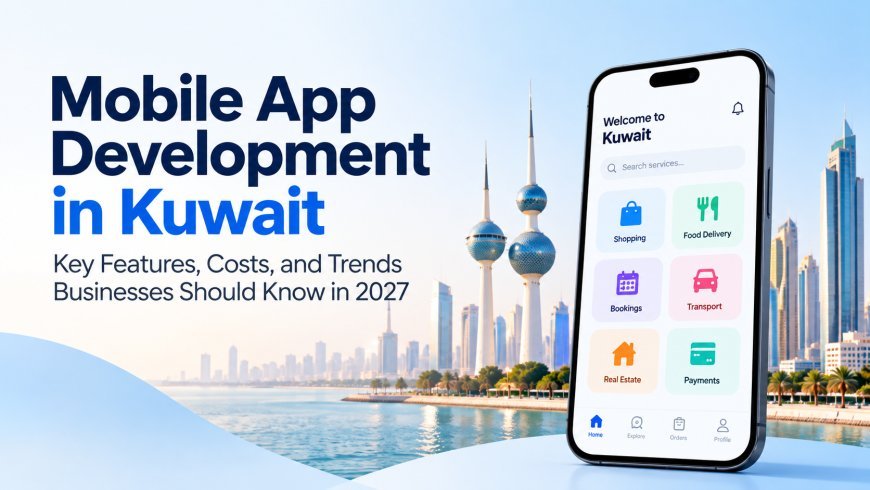
Businesses in Kuwait are increasingly exploring mobile applications to improve customer experiences, streamline daily operations, and create new digital revenue opportunities. From e-commerce and food delivery to fintech and healthcare, mobile apps can help companies serve customers more efficiently and compete in a digital-first market.
However, building a successful application requires more than an attractive interface. Businesses need to consider development costs, essential features, security requirements, platform selection, and future scalability before starting a project.
In 2027, choosing the right mobile app development company in Kuwait will be an important step for businesses planning to turn their ideas into reliable digital products.
This guide covers the estimated cost of mobile app development in Kuwait, the features businesses should prioritise, emerging technology trends, and how to select the right development partner.
1. How Much Does Mobile App Development Cost in Kuwait in 2027?
The cost of mobile app development in Kuwait depends on the application's complexity, required features, integrations, design, and development approach. A simple business application will generally require less investment than a platform supporting real-time transactions, multiple user roles, or AI-powered functionality.
For planning purposes, businesses can use an estimated budget of KWD 10,000 to KWD 40,000 for a custom mobile application. This is an indicative project range, not a fixed market rate or a verified quotation. The actual cost depends on the scope and requirements of the project.
Estimated mobile app development costs in Kuwait
|
App category |
Estimated cost |
Typical scope |
|---|---|---|
|
Business app with core features |
KWD 10,000–15,000 |
User accounts, profiles, notifications and basic admin tools |
|
Mid-level business application |
KWD 15,000–25,000 |
Custom UI/UX, payment integration, APIs and reporting |
|
Advanced mobile application |
KWD 25,000–35,000 |
Real-time features, multiple user roles and complex workflows |
|
Complex, scalable application |
KWD 35,000–40,000 |
Advanced integrations, enhanced security and scalable backend architecture |
These are indicative budgeting estimates for this article, not verified market averages. A project may fall outside these ranges depending on its scope.
The cost of mobile app development in Kuwait can increase when a project requires separate native iOS and Android applications, extensive third-party integrations, advanced artificial intelligence, or complex backend systems. Published Kuwait-focused pricing guides also highlight app complexity, payment integrations, and platform selection as important cost factors.
What affects the cost of mobile app development?
Several factors determine how much a business needs to invest.
-
App complexity: Applications with multiple workflows, dashboards, and user roles require more development and testing.
-
Platform selection: Building for iOS, Android, or both affects the development effort and maintenance requirements.
-
UI/UX design: Custom interfaces, accessibility, and Arabic right-to-left layouts require additional design and testing.
-
Third-party integrations: Payment gateways, maps, CRM platforms, inventory systems, and external APIs can increase project scope.
-
Security requirements: Authentication, encryption, access controls, and secure data handling must be considered during development.
-
Maintenance and updates: Operating system updates, bug fixes, infrastructure, and new features require a separate ongoing budget.
Businesses should request an itemised quotation from a mobile app development company in Kuwait so they can understand what is included in the proposed cost.
2. Essential Features Every Business App in Kuwait Should Consider
The right features depend on the business model and target audience. Rather than adding every available feature at launch, companies should prioritise functionality that solves a real customer problem.
Arabic and English language support
For businesses serving a multilingual audience, offering both Arabic and English can make an application easier to use. Arabic interfaces should support right-to-left (RTL) layouts, appropriate typography, and correct text alignment across screens.
Translation alone is not enough. Navigation, forms, notifications, dates, and payment screens should also be tested in both languages.
Secure user registration and authentication
Registration should be straightforward without compromising security. Depending on the application, businesses can consider phone or email verification, multi-factor authentication, secure password recovery, and role-based access controls.
Apps handling sensitive customer information should collect only the data they need and apply appropriate safeguards.
Local payment integration
Payment functionality is particularly important for e-commerce, delivery, booking, and subscription applications. Depending on the business and payment provider, integration options may include KNET, supported bank card payments, and eligible digital wallets.
Before choosing a provider, businesses should confirm its Kuwait availability, merchant requirements, transaction fees, refund support, and technical integration options.
Push notifications and customer engagement
Push notifications can help businesses share order updates, booking reminders, service announcements, and relevant offers. Notifications should be timely and useful rather than repetitive.
Segmentation and user preferences can help businesses send more relevant messages and improve the customer experience.
Admin dashboard and reporting
An admin dashboard allows authorised staff to manage customers, products, bookings, transactions, and application content. Reporting tools can help teams monitor user activity, identify operational issues, and understand which features are being used.
Scalable backend and API integrations
An application should be designed to accommodate expected business growth. A scalable backend can help support increasing users, transactions, and data volumes without requiring a complete rebuild.
APIs can also connect the application with existing business systems, reducing duplicate work and keeping information consistent across platforms.
3. Mobile App Development Trends Businesses Should Know in 2027
The following are emerging directions and likely priorities for 2027, rather than guaranteed predictions. Businesses should assess each trend according to their customers, budget, and operational needs.
AI-powered mobile applications
Artificial intelligence is becoming an important consideration for applications that need to personalise experiences or automate repetitive tasks. Depending on the use case, businesses can explore AI-powered search, customer support assistants, personalised recommendations, document processing, and predictive analytics.
For example, an e-commerce application could recommend relevant products based on customer preferences, while a service-booking app could help users find suitable appointments.
AI features should have a clear business purpose, with suitable privacy controls and human oversight where needed.
Cross-platform development with Flutter and React Native
Cross-platform frameworks allow developers to build applications for iOS and Android using a shared codebase. This can reduce duplicated development work and simplify maintenance for many business applications.
Flutter and React Native are worth evaluating for booking platforms, retail apps, customer portals, and other applications that do not depend heavily on platform-specific functionality.
However, cross-platform development is not automatically the best choice for every project. Applications requiring specialised hardware capabilities or highly platform-specific experiences may benefit from native development.
Personalised user experiences
Customers increasingly expect digital services to be relevant to their needs. Businesses can use preferences, previous interactions, and appropriate behavioural insights to personalise content, recommendations, and notifications.
Personalisation should be transparent and respect users' privacy choices.
Stronger security and privacy controls
Security should be part of the development process from the initial planning stage. In 2027, businesses should continue to prioritise secure authentication, encrypted communications, access controls, dependency updates, and regular security testing.
Applications operating in Kuwait should also assess applicable local data protection requirements and any sector-specific rules relevant to their services.
Integration with digital payment systems
Digital payments remain an important consideration for online retail, food delivery, service bookings, and subscription platforms. Businesses should choose payment integrations that support their target customers and commercial requirements.
The best approach is to evaluate supported payment methods, settlement processes, refunds, transaction security, and the provider's documentation before development begins.
Analytics-driven product improvements
Analytics can help businesses understand where users encounter difficulties, which features generate engagement, and where customers abandon important journeys.
By reviewing this information after launch, companies can prioritise improvements based on actual user behaviour rather than assumptions.
4. How to Choose the Right Mobile App Development Company in Kuwait
Selecting a development partner is an important decision because the quality of planning, implementation, and ongoing support can affect the application's long-term performance.
Businesses should evaluate potential partners using the following criteria.
Relevant portfolio and experience: Review previous applications, particularly projects with features or workflows similar to your requirements. If possible, test live applications rather than relying only on screenshots.
Technical expertise: Check the company's experience with native iOS and Android development, cross-platform frameworks, backend engineering, cloud infrastructure, and third-party integrations.
Understanding of the Kuwait market: Look for experience with Arabic and English interfaces, RTL layouts, local payment requirements, and the business processes relevant to your industry.
Transparent pricing: Request a detailed proposal covering design, development, testing, deployment, integrations, and ongoing maintenance. Clarify how additional features or changes will be charged.
Communication and project management: Establish how progress will be reported, who will manage the project, and how feedback and changes will be handled.
Post-launch support: Confirm whether the company provides bug fixes, security updates, performance monitoring, and future feature development.
Businesses can compare several providers before deciding which mobile app development company in Kuwait best matches their technical requirements, budget, and long-term objectives.
5. The Mobile App Development Process: From Idea to Launch
A structured development process helps businesses manage scope, budget, and expectations.
Step 1: Business analysis and planning
Define the target audience, business goals, essential features, competitors, and project requirements. Prepare a prioritised feature list before estimating costs.
Step 2: UI/UX design
Create user journeys, wireframes, and interface prototypes. Test Arabic and English layouts where bilingual support is required.
Step 3: App and backend development
Build the mobile interface, server-side functionality, database, APIs, and required integrations according to the agreed scope.
Step 4: Testing and quality assurance
Test performance, device compatibility, user journeys, payment flows, accessibility, and security before release.
Step 5: Deployment and ongoing improvement
Prepare the application for store submission, monitor its performance after launch, resolve issues, and introduce improvements based on user feedback.
6. How Businesses Can Manage Their App Development Budget
A well-planned budget helps businesses avoid unnecessary spending and prioritise features that deliver practical value.
-
Start with an MVP: Build the essential functionality first and add advanced features after validating customer demand.
-
Choose the right development approach: Compare native and cross-platform options based on performance, cost, and future requirements.
-
Define requirements early: Frequent changes to the agreed scope can increase development time and cost.
-
Prioritise essential integrations: Add payment systems, CRM tools, and other integrations according to actual business needs.
-
Budget for maintenance: Reserve funds for hosting, security updates, technical support, and future improvements.
-
Set measurable goals: Track relevant indicators such as completed transactions, repeat usage, customer retention, and conversion rates.
A lower initial quotation does not necessarily mean a lower total cost. Businesses should compare deliverables, code ownership, quality assurance, support, and future maintenance before making a decision.
Conclusion
Mobile app development in Kuwait offers businesses an opportunity to improve customer experiences, simplify operations, and introduce new digital services. However, a successful application requires careful planning, suitable technology, reliable security, and a clear understanding of customer needs.
Working with an experienced mobile app development company in Kuwait can help businesses define a realistic scope, choose suitable technologies, and develop an application that can evolve alongside their needs.
Apptunix UAE can be considered by businesses exploring custom mobile app development, from initial planning and UI/UX design to application development and ongoing improvements.
Planning to build a mobile application for your business? Define your core requirements, compare development proposals, and request a customised estimate before starting your project.
Frequently Asked Questions (FAQs)
1. How much does mobile app development cost in Kuwait in 2027?
For this guide, the indicative budget is KWD 10,000 to KWD 40,000. The actual cost depends on app complexity, platform selection, integrations, design, security, and ongoing support.
2. How long does it take to develop a mobile app in Kuwait?
A focused MVP may take around 2–4 months, while a more complex application can take 4–9 months or longer. These are general planning estimates, and actual timelines depend on the scope, team, and approval process.
3. Is Flutter suitable for mobile app development in Kuwait?
Flutter can be suitable for many business applications that need to run on iOS and Android. It can reduce duplicated development effort, although native development may be more appropriate for certain platform-specific requirements.
4. Which features should a business app include?
Common features include secure registration, user profiles, push notifications, analytics, and an admin dashboard. Depending on the business, Arabic and English support, local payment integration, booking functionality, and real-time tracking may also be useful.
5. How can I choose the best mobile app development company in Kuwait?
Compare portfolios, relevant experience, technical expertise, pricing transparency, project management, security practices, and post-launch support. Request a detailed proposal and confirm the deliverables before signing an agreement.
6. Should businesses build separate iOS and Android applications?
Not always. Cross-platform development can be an efficient option for many business applications, while native development can provide greater flexibility for specialised platform features. The decision should be based on requirements rather than cost alone.
7. What should businesses consider before launching an app in Kuwait?
Businesses should assess their target audience, Arabic localisation requirements, payment options, security needs, applicable data protection rules, hosting requirements, and ongoing maintenance budget.
What's Your Reaction?
 Like
0
Like
0
 Dislike
0
Dislike
0
 Love
0
Love
0
 Funny
0
Funny
0
 Angry
0
Angry
0
 Sad
0
Sad
0
 Wow
0
Wow
0