






















What Is a Data Pipeline? A Simple Guide to Data Pipeline Architecture
Learn what is a data pipeline, how data pipelines work, key data pipeline architecture, tools, automation, and their benefits for modern businesses.

Every business collects plenty of information from their websites, apps, customer databases, sales platforms, etc., each day. However, collecting data alone is not enough. Businesses need a way to transfer, process and structure it. And here comes the role of data pipelines.
What Is a Data Pipeline? If you want to know what is a data pipeline, then this is a system that transfers data automatically from one or several sources to the destination where the data will be stored or processed by applications.
What Is a Data Pipeline?
Data pipeline is a set of operations that collects data from different sources, transforms it when required, and transfers it to another system or a storage point. The pipeline process can be simple or very complicated depending on the needs of an organization.
For instance, e-commerce company can collect data from its website, payment system, inventory database and customer platform. The data pipeline can unify all that information and allow analyzing sales, inventories and customers behavior in one place.
In short, a pipeline consists of three main stages: Extract, Transform and Load (ETL). The modern pipelines use also ELT methodology where data is loaded first and then transformed.
Why Do Companies Use Data Pipelines?
Companies use data pipelines to transfer data from one system to another. Such transfers can be needed for business intelligence, reporting, machine learning, data analytics, data migration, and data application integration.
The main tasks data pipelines perform include:
Gathering data from several sources
Preprocessing raw data
Transferring data to databases or data warehouses
Updating dashboards and reports
Performing real-time analytics
Preparation of datasets for machine learning
Automation of routine data transferring enables companies to save time and effort while maintaining data consistency.
Data Pipeline Architecture
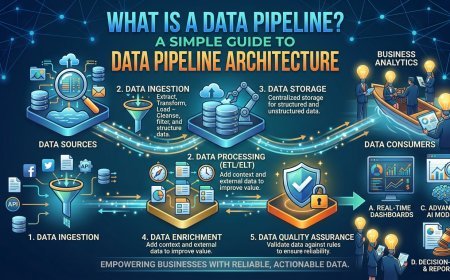
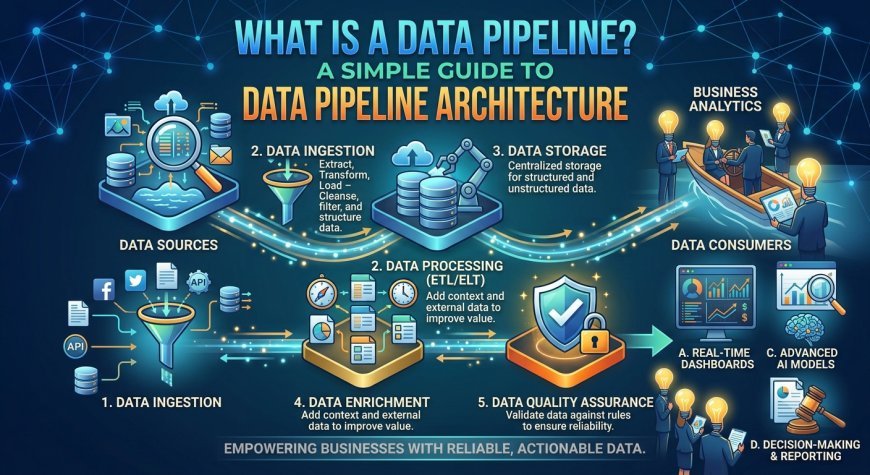
Data pipeline architecture implies the interaction of various components of the system that collect, process, and deliver data. Data pipeline architecture usually consists of the following elements: data sources, data ingestion, data processing, data storage, and analytics/application layer.
Example:
Data Sources → Data Ingestion → Data Processing → Data Storage → Analytics
There can be batch-based architecture when the data processing is performed regularly on a certain schedule, and there can also be a real-time data pipeline architecture where the data is processed as soon as it appears.
Moreover, a good architecture should also involve security and scalability aspects.
Data Pipeline Tools and Automation
There are many data pipelines tools that can be used to implement automated workflows. Organizations might choose specific tools based on their data volume, infrastructure, programming environment, and other considerations.
Main categories are workflow orchestration tools, cloud data integration tools, stream-processing solutions, and ETL/ELT solutions.
Automation of data pipelines can help schedule workflows, track data movement, detect failures, and launch processes automatically. It is particularly valuable in case organizations work with big amounts of data or have to perform regular updates.
Benefits of Data Pipelines
If designed correctly, a pipeline will allow you to optimize your data operation. The main advantages are increased data availability, decreased number of manual data processing steps, better data consistency, data integration capabilities, and scalability.
Also, you will be able to design a process that enables you to convert raw data into usable data.
Conclusion
Knowing what is a data pipeline is crucial for all organizations dealing with increasing amounts of digital data. Data pipelines enable companies to collect raw data, transform it and deliver to analysis.
With the right data pipeline architecture, suitable data pipelines tools, and effective automation, businesses can build a more efficient and dependable approach to managing data.
Visit us: https://dataqix.com/data-pipeline/
What's Your Reaction?
 Like
0
Like
0
 Dislike
0
Dislike
0
 Love
0
Love
0
 Funny
0
Funny
0
 Angry
0
Angry
0
 Sad
0
Sad
0
 Wow
0
Wow
0