




















Why Do Paid Campaigns Struggle When Customers Cannot Explain the Offer Clearly?
Learn why paid campaigns struggle when customers cannot clearly understand the offer and how stronger messaging, simple value propositions, clear benefits, and consistent landing pages can improve conversions.

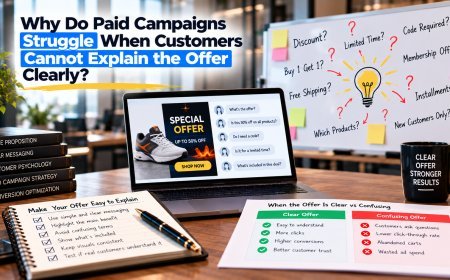
A paid advertisement can attract attention, generate clicks, and still fail to create enough customers. Sometimes the problem is not targeting, campaign structure, or even the appearance of the creative. The real weakness is that people cannot clearly explain what the business is offering.
If a potential customer watches an advertisement but cannot describe the product, main benefit, intended user, or reason to act, the message has created interest without understanding. That uncertainty becomes more damaging when the offer is expensive, unfamiliar, or requires the customer to compare several options.
Offer explainability in paid advertising helps marketers judge whether a campaign message is simple enough to remember, communicate, and use when making a decision.
What Does Offer Explainability Mean?
Offer explainability refers to how easily someone can understand and describe an offer after seeing an advertisement.
A clear offer normally helps the customer answer several basic questions:
· What is being offered?
· Who is it designed for?
· Which problem does it solve?
· What result or benefit can the customer expect?
· Why should the customer consider this option?
· What should the customer do next?
The audience does not need to remember every feature or condition. However, it should understand the central value clearly enough to continue the buying journey.
An experienced creative strategist considers this clarity when developing hooks, angles, scripts, offers, and creative direction. Attention matters, but attention without understanding rarely supports sustainable conversion performance.
Why Can an Offer Become Difficult to Explain?
Many offers become confusing because the marketing team tries to communicate too much at once.
An advertisement may contain several benefits, multiple price options, technical features, bonuses, guarantees, and calls to action. Each element may be useful by itself, but the complete message can become difficult to process.
Other common causes include industry terminology, vague benefit statements, unclear eligibility conditions, and visual designs that give every element the same importance.
Businesses may also understand their products so well that they forget what a first-time customer does not know. Internal teams use familiar terms and assume the audience understands how the product works. New customers may interpret those terms differently or fail to connect them with a practical outcome.
The problem becomes more serious when the customer must discuss the purchase with another person. A business buyer may need approval from a manager. A consumer may want to discuss an expensive purchase with a family member. If that person cannot explain the offer confidently, the decision may be delayed or rejected.
How Does Poor Explainability Affect Campaign Performance?
Confusing offers can weaken performance at several stages.
The advertisement may receive clicks because the hook creates curiosity. However, the landing page must then do additional work to explain the basic offer. Some visitors leave before reaching that understanding.
Other visitors may submit enquiries but remain poorly qualified. They want more information because the advertisement did not set clear expectations. The sales team then spends time explaining the offer instead of discussing fit, timing, and next steps.
Poor explainability can also reduce the quality of optimization data. Advertising platforms may record clicks, video views, leads, or add-to-cart events, but those actions do not prove that the customer understood the offer. A campaign may appear active while the business experiences low close rates, repeated objections, cancellations, or weak customer retention.
Professional paid advertising services should therefore connect campaign metrics with customer questions, sales feedback, conversion quality, and retained revenue.
How Can Businesses Test Whether an Offer Is Easy to Explain?
One useful test is to show an advertisement to someone who is similar to the intended customer but unfamiliar with the campaign. After viewing it, ask the person to explain the offer in their own words.
Do not ask whether the advertisement looks good. Ask specific questions:
· What do you think is being sold?
· Who would benefit from it?
· What is the main promised outcome?
· What makes this offer different?
· What information would you need before acting?
· What do you think will happen after clicking?
The answers reveal whether the advertisement communicates the intended message.
Customer comments, sales calls, support questions, and landing-page behavior can provide additional evidence. If many people ask the same basic question, the offer may not be sufficiently clear.
The team should also compare what customers believe with what the business can actually deliver. An offer is not truly clear if people understand it consistently but incorrectly.
A Practical Framework for Improving Offer Clarity
Businesses can improve explainability without reducing every advertisement to a generic statement.
1. Define the Core Offer in One Sentence
Write one sentence that explains the customer, problem, outcome, and offer. This sentence does not need to appear word for word in the advertisement, but it should guide the complete message.
2. Choose One Primary Benefit
A product may provide several benefits, but each advertisement should normally lead with one main outcome. Supporting advantages can appear later in the creative or on the landing page.
3. Make the Customer Context Visible
Show the situation in which the product or service becomes useful. Context can make an unfamiliar benefit easier to understand than a general claim.
4. Connect Claims With Proof
A claim becomes easier to believe when the advertisement provides suitable evidence. Proof may include a demonstration, specific customer experience, comparison, process explanation, or verified result.
5. Clarify Important Conditions
If the offer has eligibility rules, commitments, limitations, or pricing conditions, important details should not appear only after conversion. Transparency may reduce low-quality clicks while improving customer trust.
6. Use One Clear Next Step
The advertisement should tell the viewer what action makes sense next. Competing calls to action can make even a clear offer feel complicated.
How Can Creative Formats Improve Explainability?
Different formats can explain different parts of an offer.
A static advertisement can communicate one strong benefit quickly. A short video can demonstrate how the product works. UGC-style creative can show the offer in a relatable customer situation. A longer video may address objections or explain a process that requires more context.
The format should match the difficulty of the message. A complex product may need a sequence of advertisements instead of one creative carrying every detail.
Relevant campaign case studies can help marketers understand how creative, media buying, landing pages, and commercial outcomes should be evaluated together. The important lesson is that a strong format cannot rescue an unclear strategic message.
Which Metrics Should Be Reviewed?
Offer clarity should be measured through more than click-through rate.
Useful indicators may include:
· Qualified click rate
· Landing-page engagement
· Form completion rate
· Sales-accepted lead rate
· Repeated customer questions
· Call-to-sale conversion
· Cancellation or refund reasons
· Time required to close a sale
· Customer retention
If a clearer advertisement produces fewer clicks but more qualified customers, it may be creating a stronger business result.
Common Mistakes to Avoid
One mistake is assuming that shorter copy is automatically clearer. A short message can still be vague.
Another mistake is removing important information only to increase click volume. Hidden conditions may improve early metrics while reducing trust and conversion quality later.
Businesses should also avoid testing several offer changes at the same time. If the headline, price, guarantee, audience, creative format, and landing page all change together, the team cannot identify which improvement affected the result.
Finally, clarity should not remove meaningful differentiation. The objective is to make a distinctive offer easier to understand, not to make it sound like every competitor.
Final Thoughts
Paid campaigns struggle when customers notice the advertisement but cannot confidently explain the offer. Confusion creates friction across the landing page, sales process, purchase decision, and customer experience.
Offer explainability in paid advertising gives teams a practical way to evaluate message quality. By defining one central outcome, showing the customer context, supporting claims with proof, clarifying important conditions, and testing customer understanding, businesses can create campaigns that attract attention and guide better decisions.
Frequently Asked Questions
What is offer explainability in paid advertising?
It is the ability of an advertisement to help viewers understand and describe the offer, intended customer, primary benefit, important conditions, and next step.
Does a clear offer always need short advertising copy?
No. Clarity depends on structure and understanding, not only length. Some offers require more explanation, but every detail should support the main message.
How can a business test offer clarity?
Show the advertisement to suitable people who are unfamiliar with it and ask them to explain the offer in their own words. Compare their answers with the intended message.
Can a clearer advertisement reduce click volume?
Yes. Clear qualification may discourage unsuitable visitors. However, it can improve conversion quality, sales efficiency, and customer value.
Should the same offer explanation be used for every audience?
Not necessarily. Different audiences may have different awareness levels, objections, and priorities. The central offer should remain consistent while the explanation is adapted appropriately.
What's Your Reaction?
 Like
0
Like
0
 Dislike
0
Dislike
0
 Love
0
Love
0
 Funny
0
Funny
0
 Angry
0
Angry
0
 Sad
0
Sad
0
 Wow
0
Wow
0