



















Women and Weights: The Evidence Behind Strength and Longevity
For decades, the standard fitness advice aimed at women leaned heavily on cardio: walk more, run, join a spin class. Lifting weights was often treated as optional, or worse, as something that would make women "bulky."
For decades, the standard fitness advice aimed at women leaned heavily on cardio: walk more, run, join a spin class. Lifting weights was often treated as optional, or worse, as something that would make women "bulky." The research of the last few years tells a very different story. Muscle strength looks like one of the most useful assets a woman can build for a longer, more independent life, and some of the clearest evidence comes from a test as simple as squeezing a handle.
Here's what the major studies actually found, what they can't prove, and where a grip strengthener fits into a sensible strength routine.
The 2024 study that changed the conversation
In February 2024, the Journal of the American College of Cardiology published an analysis of more than 400,000 US adults followed for roughly two decades. The headline finding was that women got more benefit than men from the same amount of exercise. Women who exercised regularly were 24% less likely to die from any cause during the study than women who didn't, compared with a 15% reduction for men.
Strength training stood out. Women who did muscle-strengthening work two to three times a week had about a 30% lower risk of dying from cardiovascular disease than women who did none. Study author Dr. Martha Gulati, a preventive cardiologist at Cedars-Sinai, said the size of that effect surprised the team, because few interventions reduce mortality that much.
There was a catch, too: only about one in five women in the study did regular weight training. The other four were leaving a large potential benefit on the table.
Stronger women, longer lives: the 2026 grip strength study
The newest evidence goes further and looks at strength itself rather than just exercise habits. In February 2026, a University at Buffalo team published a study in JAMA Network Open that followed 5,472 women aged 63 to 99 for an average of about eight years. Researchers measured two things: grip strength in the dominant hand and how quickly each woman could rise from a chair five times without using her arms.
The results were striking:
- Women in the strongest grip group (over 24 kg) had a 33% lower risk of death than women in the weakest group (under 14 kg).
- Every additional 7 kg (about 15 lb) of grip strength was linked to roughly a 12% lower death rate.
- Faster chair stands were also tied to lower mortality.
What makes this study important is what the researchers controlled for. The link between strength and survival held even after accounting for how much the women moved and sat (measured with wearable devices, not self-reports), their walking speed and their level of inflammation. It also held when strength was adjusted for body weight and lean mass.
Perhaps most encouraging: women who fell short of the standard 150 minutes a week of moderate aerobic exercise still had lower mortality if they were stronger. Lead researcher Michael LaMonte noted that if you don't have the strength to get out of a chair easily, it becomes hard to do the walking and other aerobic activity that guidelines recommend. Strength, in other words, underpins everything else.
This isn't a one-off finding. An earlier study from the Women's Health and Aging Study in Baltimore found that, among older women already living with disability, handgrip strength was a powerful predictor of both total and cause-specific death over five years.
Strength and bones: busting the "too fragile to lift" myth
After menopause, falling estrogen speeds up bone loss, and many women are told to stick to gentle exercise to avoid fractures. The LIFTMOR trial in Australia challenged that assumption directly. Postmenopausal women with low bone mass were randomly assigned either to eight months of supervised, high-intensity resistance and impact training (twice a week, 30 minutes per session, using heavy loads for five sets of five) or to a low-intensity home program.
The heavy-lifting group improved bone density at both the spine and hip, and they did better on every functional test, from standing up out of a chair to reaching forward. A follow-up analysis found the supervised training did not cause vertebral fractures. The key word is supervised: these women were coached on technique and progressed carefully.
What the evidence can't tell you
It's important to read these studies honestly:
- Most are observational. The JACC and JAMA Network Open studies show strong associations, not proof that lifting weights directly causes longer life. Healthier women may simply be stronger and more active to begin with.
- Grip is a marker, not a magic switch. Grip strength likely reflects overall muscle strength, nutrition and resilience. Squeezing a device more won't, on its own, cancel out other risk factors.
- Individual numbers vary. Healthy grip strength depends on age, body size and hand dimensions, so compare yourself with your own past results rather than with someone else's.
How to put the evidence into practice
You don't need a gym membership or a bodybuilding program. LaMonte pointed out that free weights, machines and bodyweight exercises all work, and that even household items like soup cans or books provide resistance when nothing else is available.
A practical starting point for most women:
- Train the whole body two or three times a week. Squats or sit-to-stands, lunges, push-ups (wall or knee versions are fine), rows and carries cover the major muscle groups.
- Progress gradually. Muscles and bones respond to load that increases over time. Add weight, reps or sets slowly.
- Keep doing cardio. The researchers behind these studies recommend combining aerobic and muscle-strengthening activity, not choosing one over the other.
- Get advice if you need it. If you're older, new to exercise, or have osteoporosis, arthritis or another health condition, talk to your doctor and consider working with a physical therapist or qualified trainer.
Where a grip strengthener fits
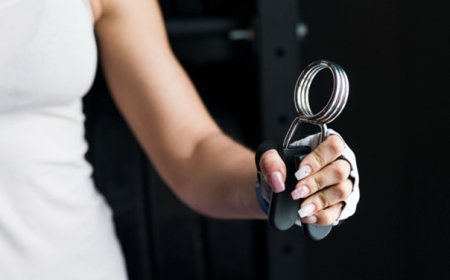
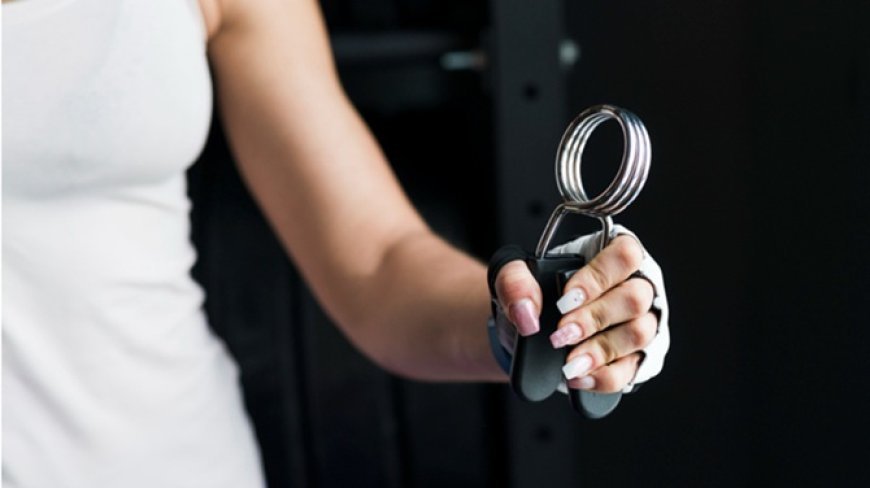
Because grip strength is so closely tied to healthy aging in women, it makes sense to train and track it directly. A grip strengthener is one of the simplest ways to do both. It's small, inexpensive, and easy to use while watching TV or between work tasks.
A good grip strengthener should have adjustable or graded resistance so you can keep progressing as your hands get stronger. Digital models that display or record squeeze force are especially useful, because they let you watch your trend over weeks and months rather than guessing.
Strong hands also make everyday life easier: opening jars, carrying shopping bags, holding a grab rail and lifting heavier weights in the gym. That practical carryover is a real benefit in itself.
Keep expectations realistic, though. A grip strengthener is a training and tracking tool, not a longevity treatment. Use it alongside full-body strength training, not instead of it. If you have hand pain, arthritis or a past wrist injury, check with a clinician before you start.
The bottom line
The evidence now points firmly in one direction: strength matters for women, and it matters more as they age. Large studies link regular strength training and stronger grip to lower risk of early death, particularly from heart disease, and well-designed trials show that properly supervised lifting can improve bone health after menopause. Pick up the weights, keep moving, and use a grip strengthener to build and measure one of the simplest signals of how strong you really are.
What's Your Reaction?
 Like
0
 Dislike
0
 Love
0
 Funny
0
 Angry
0
 Sad
0
 Wow
0