



















AI Healthcare App Development: Building Smarter Healthcare Solutions in 2026
AI healthcare app development helps hospitals and startups build smarter apps. Get insights on features, benefits and security with Web Nautical's guide today.
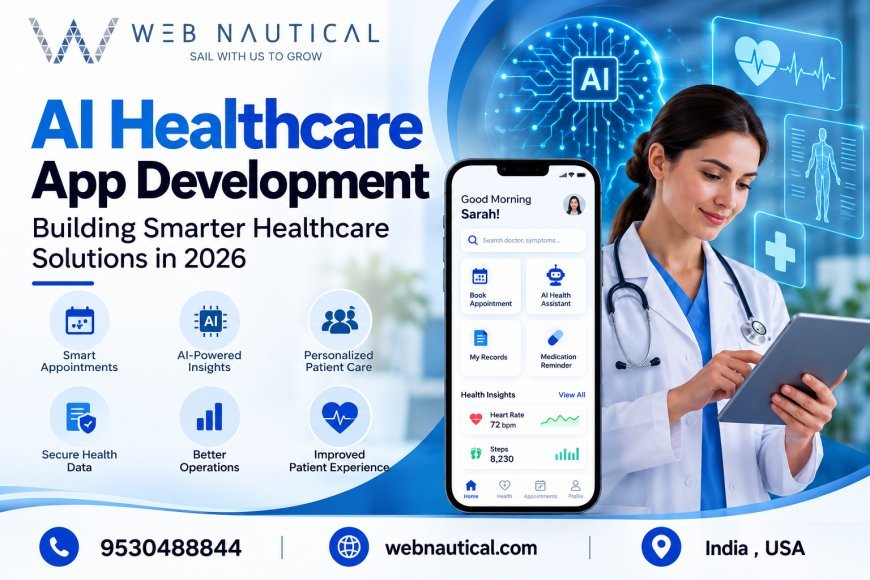
Healthcare is becoming more digital, and artificial intelligence is playing an important role in this change. From scheduling appointments to analyzing medical information, AI-powered applications are helping healthcare organizations improve everyday operations.
For hospitals, clinics, and healthcare startups, AI healthcare app development offers opportunities to create more accessible, efficient, and personalized digital experiences. However, building a successful healthcare application requires more than adding AI features. It involves understanding patient needs, protecting sensitive information, and developing technology that healthcare professionals can use confidently.
What Is AI Healthcare App Development?
AI healthcare app development is the process of creating healthcare applications that use artificial intelligence technologies to support medical and administrative tasks.
These applications may use machine learning, natural language processing, predictive analytics, or computer vision to analyze information and assist users.
For example, an AI-powered healthcare app might help patients book appointments, organize medical records, receive medication reminders, or communicate with healthcare providers.
More advanced applications can support clinical decision-making by identifying patterns in medical data. However, AI-generated recommendations should be appropriately validated and reviewed by qualified healthcare professionals.
Key Benefits of AI Healthcare App Development
1. Better Patient Experiences
Patients increasingly expect convenient access to healthcare services. AI-powered applications can simplify appointment scheduling, answer routine questions, and provide timely reminders.
These features can reduce administrative friction and make digital healthcare services easier to use.
2. Improved Healthcare Operations
Healthcare professionals often spend significant time handling documentation, scheduling, and administrative work.
AI applications can assist with repetitive processes, allowing healthcare teams to focus more attention on patient care. The actual benefits depend on how effectively the application integrates with existing workflows.
3. Data-Driven Healthcare Insights
Healthcare organizations generate large amounts of information through electronic health records, diagnostic systems, and patient interactions.
AI can help identify useful patterns within appropriately governed datasets. These insights may support resource planning, patient engagement, and clinical research.
4. Personalized Patient Engagement
AI-powered applications can deliver personalized educational content, wellness reminders, and follow-up notifications based on relevant patient information.
Such features should respect patient consent, privacy requirements, and appropriate clinical boundaries.
Essential Features of an AI Healthcare Application
The features of a healthcare app should match its intended users and business goals. Common capabilities include:
-
Secure patient registration and authentication
-
Appointment scheduling and reminders
-
AI-powered virtual assistance for administrative questions
-
Electronic health record integration
-
Remote patient monitoring integrations
-
Personalized notifications
-
Secure communication between patients and providers
-
Administrative dashboards and analytics
Not every healthcare application needs all these features. A focused minimum viable product can help businesses validate demand before investing in more advanced AI capabilities.
How to Develop an AI Healthcare App
Successful development begins with identifying a specific healthcare problem and understanding the people who will use the application.
The next step is defining functional requirements, selecting suitable AI technologies, and designing an accessible user experience.
Development teams must also consider secure data architecture, interoperability, model accuracy, and integration with existing healthcare systems.
For healthcare applications targeting the United States, relevant requirements may include HIPAA, FDA regulations, and other applicable privacy or security rules, depending on the product and its intended use.
Testing should cover functionality, cybersecurity, usability, and the performance of AI features before deployment. Continuous monitoring is equally important after launch.
Challenges Businesses Should Consider
Despite its potential, AI healthcare app development comes with important challenges.
Healthcare information is sensitive, making data security and privacy essential. Poor-quality training data can also produce inaccurate or biased AI outputs.
Additionally, integrating new applications with existing healthcare infrastructure may require significant technical planning.
Businesses should establish clear requirements, involve healthcare domain experts, validate AI performance, and maintain human oversight wherever patient safety could be affected.
Conclusion
AI healthcare app development creates opportunities for healthcare businesses to improve digital services, simplify operations, and support better patient engagement.
The most valuable applications are built around genuine healthcare needs rather than technology trends alone.
By prioritizing security, usability, interoperability, and responsible AI practices, organizations can develop solutions that provide long-term value.
Web Nautical helps businesses explore digital healthcare development opportunities through practical technology planning and application development expertise.
What's Your Reaction?
 Like
0
 Dislike
0
 Love
0
 Funny
0
 Angry
0
 Sad
0
 Wow
0