






















Advertising Profitability: How to Measure Campaign Results
Learn how to measure advertising profitability using ROAS, Marketing Analytics, and PPC metrics to evaluate campaign results, control ad costs, and improve returns.
Every business wants its advertising budget to generate measurable results. However, getting clicks, impressions, and website visits does not always mean a campaign is profitable. Businesses need to understand how much revenue their ads generate compared with how much they spend. By tracking sales, conversion rates, and advertising costs, marketers can identify which campaigns perform well and where improvements are needed. Understanding Advertising Profitability helps businesses make informed decisions, control spending, and build a marketing strategy focused on measurable returns.
What Is Advertising Profitability?
Advertising profitability refers to how effectively a business turns its advertising investment into revenue and, ultimately, profit. It helps marketers evaluate whether their campaigns contribute to business growth or simply consume the marketing budget.
For example, an online store might spend $1,000 on a paid advertising campaign and generate $4,000 in sales. This indicates that the campaign produced $4 in revenue for every $1 spent on advertising. However, the business must also consider product costs, shipping, platform fees, and other expenses before deciding how much profit it actually earned.
Advertising performance should therefore be evaluated using both revenue-based metrics and profit-related figures. A campaign that generates substantial sales may still lose money if its overall costs are too high.
Why Measuring Campaign Results Matters
Measuring campaign results gives businesses a clearer picture of how their marketing investments perform. Without reliable data, marketers may continue spending on campaigns that generate traffic but few sales.
Accurate measurement helps businesses:
-
Identify campaigns that generate the most revenue.
-
Understand customer behavior and conversion patterns.
-
Reduce spending on ineffective advertisements.
-
Compare different advertising platforms.
-
Improve targeting, messaging, and landing pages.
-
Allocate budgets according to campaign performance.
For example, a business running Google Ads and social media advertisements may discover that one channel generates more conversions at a lower cost. This information allows the marketing team to adjust its budget based on actual results rather than assumptions.
Understand the Difference Between ROAS and Profit
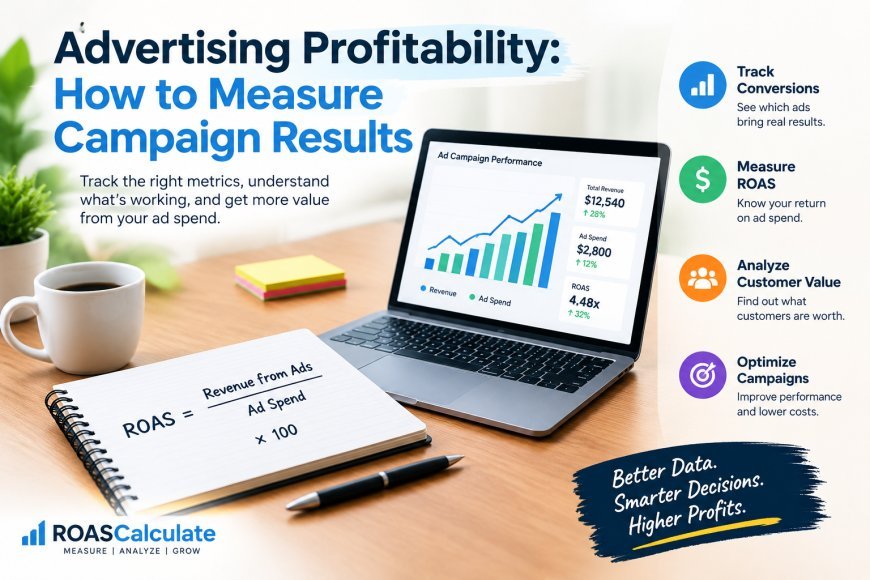
Return on ad spend (ROAS) is one of the most useful metrics for measuring advertising performance. It compares the revenue attributed to advertising with the amount spent on those advertisements.
The ROAS formula is:
ROAS = Revenue Attributed to Ads ÷ Advertising Cost
Suppose a company spends $2,000 on a campaign and generates $8,000 in attributed revenue.
ROAS = $8,000 ÷ $2,000 = 4
The campaign achieves a 4:1 ROAS, meaning it generates $4 in revenue for every $1 spent on advertising.
However, ROAS does not account for all business expenses. If the company has high product costs, shipping expenses, and operational overhead, its actual profit could be much lower than expected.
This distinction matters because a strong ROAS does not automatically mean a business is profitable. Companies should evaluate advertising returns alongside their profit margins and other operating costs.
How a ROAS Calculator Helps Measure Performance
A ROAS Calculator simplifies the process of measuring advertising returns. Instead of manually calculating campaign results, marketers can enter their advertising spend and attributed revenue to determine the return generated by their campaigns.
For example, a marketer can use a calculator to compare several campaigns:
|
Campaign |
Ad Spend |
Revenue |
ROAS |
|
Campaign A |
$500 |
$2,000 |
4.0x |
|
Campaign B |
$800 |
$2,400 |
3.0x |
|
Campaign C |
$600 |
$3,600 |
6.0x |
In this example, Campaign C delivers the highest revenue return relative to its advertising cost. Campaign B generates more total revenue than Campaign A, but its ROAS is lower.
Using roascalculate, marketers can make ROAS calculations more straightforward and compare campaign results when evaluating their advertising performance.
These calculations help teams identify opportunities for improvement. However, they should also consider conversion quality, profit margins, and the reliability of revenue attribution before deciding which campaign deserves additional investment.
Key Metrics for Measuring Advertising Profitability
ROAS is important, but it should not be the only metric used to evaluate advertising campaigns. Several additional measurements provide a more complete view of performance.
1. Return on Ad Spend (ROAS)
ROAS measures the revenue generated for every dollar spent on advertising. It is especially useful for comparing campaign performance and identifying which advertisements generate the strongest revenue returns.
A higher ROAS generally indicates better revenue efficiency, although profitability depends on the business's margins and other expenses.
2. Customer Acquisition Cost (CAC)
Customer acquisition cost measures how much a business spends to acquire a new customer.
CAC = Customer Acquisition Costs ÷ Number of New Customers
If a company spends $3,000 on customer acquisition and gains 150 new customers, its CAC is $20.
Businesses can compare CAC with customer value and profit margins to determine whether their acquisition strategy is sustainable.
3. Conversion Rate
Conversion rate measures the percentage of visitors who complete a desired action, such as making a purchase, submitting a form, or requesting a quotation.
Conversion Rate = (Conversions ÷ Total Visitors) × 100
If 1,000 people visit a landing page and 40 make a purchase, the conversion rate is 4%.
Improving the conversion rate can help businesses generate more sales from existing advertising traffic.
4. Cost Per Click (CPC)
CPC measures how much an advertiser pays for each click on an advertisement.
CPC = Total Advertising Cost ÷ Total Clicks
If a campaign costs $300 and receives 600 clicks, the average CPC is $0.50.
A low CPC can help stretch an advertising budget, but inexpensive clicks are not necessarily valuable if visitors do not convert.
5. Profit Margin
Profit margin shows how much revenue remains as profit after the relevant costs are deducted.
Businesses should examine product costs, fulfillment, payment processing, and other expenses when calculating the profitability of advertising-driven sales.
This measurement helps determine whether a campaign produces meaningful financial value rather than revenue alone.
The Role of Marketing Analytics in Campaign Evaluation
Marketing Analytics helps businesses collect, organize, and interpret campaign data. It connects advertising activity with customer actions and business outcomes.
Analytics platforms can reveal which keywords generate purchases, which landing pages convert visitors, and which audiences respond to specific offers.
For example, an online retailer might find that mobile visitors account for 65% of website traffic but only 35% of purchases. This pattern could indicate problems with mobile page speed, checkout design, or payment options.
The marketing team can investigate these issues, test improvements, and compare conversion rates before and after making changes.
Reliable analysis also requires consistent tracking. Businesses should check conversion tags, use appropriate campaign parameters, and ensure that revenue is attributed correctly. Otherwise, reporting errors can lead to poor budget decisions.
How Advertising & PPC Campaigns Can Become More Profitable
Advertising & PPC campaigns allow businesses to reach audiences through paid search and other advertising platforms. Their profitability depends on targeting the right customers, controlling costs, and providing an effective path from advertisement to purchase.
Businesses can improve performance by following several practical steps.
Set Clear Campaign Goals
Decide what each campaign should achieve before launching it. Goals might include online purchases, qualified leads, app installations, or product inquiries.
The selected goal determines which metrics matter most.
Improve Keyword Targeting
For search advertising, select keywords that match customer intent. Someone searching for a product to purchase may be closer to converting than someone looking for general information.
Review search-term reports and exclude irrelevant queries where appropriate.
Test Ad Copy and Landing Pages
Create variations of headlines, descriptions, offers, and calls to action. Test them systematically to identify which versions generate better results.
Landing pages should match the advertisement's promise and make the next step clear.
Monitor Budget Allocation
Review campaign performance regularly and identify where spending produces useful results. Increase budgets gradually when campaigns demonstrate sustainable performance, and investigate campaigns with rising costs or declining conversions.
Avoid making major decisions from very small samples because early results can be misleading.
A Practical Case Study: Evaluating an Advertising Campaign
Consider an online retailer that spends $5,000 on a monthly paid advertising campaign. The campaign generates $20,000 in attributed sales.
Its ROAS is:
$20,000 ÷ $5,000 = 4.0x
The retailer then reviews its product and operating costs. Suppose these additional costs total $12,000.
The estimated contribution after advertising and the specified additional costs is:
$20,000 − $5,000 − $12,000 = $3,000
The campaign produces $3,000 after the costs included in this example. This is not necessarily the company's final net profit because other overheads, taxes, and expenses may remain.
Now suppose the retailer improves its landing page and generates $24,000 in revenue while keeping advertising spend at $5,000. Its ROAS increases to 4.8x.
If other costs remain unchanged at $12,000, the amount remaining after the specified costs becomes $7,000.
This example shows how improved conversion performance can increase the financial value of an advertising campaign. Actual outcomes depend on customer demand, margins, tracking accuracy, and other business conditions.
Common Mistakes to Avoid When Measuring Results
Businesses can misjudge advertising profitability when they rely on incomplete data or unrealistic expectations.
Common mistakes include:
-
Treating revenue as net profit.
-
Ignoring product and fulfillment costs.
-
Comparing campaigns with different objectives.
-
Failing to track conversions accurately.
-
Increasing budgets before performance is stable.
-
Ignoring customer lifetime value.
-
Making decisions based on short-term fluctuations.
A consistent measurement process helps businesses avoid these problems. Teams should review campaign data at regular intervals and compare performance against clear targets.
Conclusion
Advertising success requires more than generating clicks and impressions. Businesses need to understand how advertising costs relate to revenue, customer acquisition, and profit. By using a ROAS Calculator, monitoring Marketing Analytics, and reviewing Advertising & PPC performance, marketers can make better decisions about their budgets.
The goal is not simply to generate more sales but to build campaigns that deliver sustainable financial results. Regular measurement, accurate tracking, and continuous testing make it easier to identify what works and improve future advertising performance.
Frequently Asked Questions
1. What is advertising profitability?
Advertising profitability measures how effectively advertising contributes to revenue and profit after relevant campaign and business costs are considered.
2. How do you calculate ROAS?
Divide the revenue attributed to advertising by the advertising cost. For example, $4,000 in revenue from $1,000 in ad spend produces a 4.0x ROAS.
3. Is a higher ROAS always better?
A higher ROAS generally means more revenue per advertising dollar, but it does not guarantee profit. Product costs and other expenses also matter.
4. How can a ROAS Calculator help marketers?
A ROAS Calculator helps marketers calculate returns quickly, compare campaign results, and assess revenue generated relative to advertising costs.
5. How often should businesses measure campaign performance?
Businesses should monitor key metrics regularly, often weekly, while allowing enough time and data for meaningful conclusions. Reporting frequency depends on campaign size and sales volume.
What's Your Reaction?
 Like
0
 Dislike
0
 Love
0
 Funny
0
 Angry
0
 Sad
0
 Wow
0