









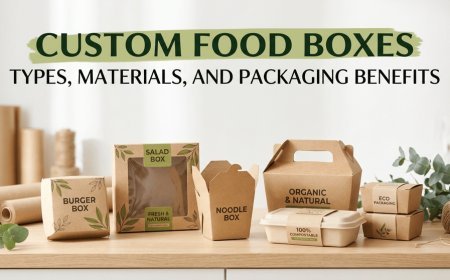







Custom Food Boxes: Types, Materials, and Packaging Benefits
Explore custom food boxes, their types, materials, and benefits. Learn how to choose food packaging that protects products and supports your brand.


Food packaging does more than hold a product. It protects food during handling, supports convenient transportation, and communicates important product information. For restaurants, bakeries, and food brands across the USA, custom food boxes provide packaging options tailored to different products and serving conditions. From pizza cartons to bakery containers, each box serves a specific purpose. Understanding available styles, materials, and benefits helps businesses select packaging that protects food while meeting practical requirements.
What Are Custom Food Boxes?
Custom food boxes are containers manufactured with specific dimensions, structures, materials, or printed designs to accommodate food products.
Unlike standard packaging, these boxes can be adapted for different portion sizes, food categories, and handling requirements. They may hold food directly or serve as secondary packaging around a separately sealed product.
Common applications include takeaway meals, bakery products, confectionery, snacks, and packaged retail foods.
Common Types of Custom Food Boxes
Different food products need different box structures. The following options are widely used across food businesses.
Bakery and Cake Boxes
Bakery boxes are designed for cakes, cookies, pastries, and cupcakes. They often feature folding lids, transparent windows, or internal inserts.
Cupcake inserts help keep individual products upright, while taller cake boxes provide clearance for frosting and decorations.
Takeout Food Boxes
Takeout containers are commonly used for burgers, sandwiches, rice dishes, and prepared meals.
Depending on the food, these boxes may require secure closures, ventilation, or grease-resistant surfaces. Their design should support convenient carrying and serving.
Pizza Boxes
Pizza boxes typically use corrugated cardboard for structural support. Their flat shape accommodates pizza while allowing multiple boxes to be stacked.
Ventilation openings can help manage trapped steam, although the effectiveness depends on the overall packaging design.
Window Food Boxes
Window boxes include a transparent section that displays the contents without opening the package.
They are commonly used for cookies, chocolates, pastries, and other products where appearance influences purchasing decisions.
Retail Food Cartons
Retail cartons package products such as cereals, tea, candy, and dry snacks.
A printed food packaging box may contain an additional sealed pouch that provides the primary moisture or oxygen barrier.
Materials Used in Custom Food Packaging
Choosing the correct material depends on product weight, moisture, temperature, and required protection.
|
Material |
Common Uses |
Main Property |
|
Kraft paperboard |
Bakery and dry-food cartons |
Lightweight and printable |
|
SBS paperboard |
Retail food packaging |
Smooth surface for detailed printing |
|
Corrugated cardboard |
Pizza and transport boxes |
Structural strength and cushioning |
|
Coated paperboard |
Selected takeaway applications |
Improved grease or moisture resistance |
|
Recycled paperboard |
Suitable secondary packaging |
Can incorporate recovered fiber |
Not every material is suitable for direct food contact. Businesses should confirm the intended use, temperature conditions, coatings, and relevant food-contact documentation before selecting a material.
We Print Boxes: Custom Food Packaging and Branding Options
Businesses exploring packaging suppliers can consider We Print Boxes when comparing box structures, printing options, and packaging specifications.
Custom Boxes allow businesses to select dimensions that match their products. Custom Packaging can also accommodate different closures, materials, and presentation requirements.
For businesses developing branded packaging, Custom Boxes with Logo provide space for recognizable visual elements. Custom Boxes Wholesale may be worth considering when larger quantities are needed, although minimum orders and pricing should be confirmed directly with the supplier.
The most suitable option should meet the food product's handling and protection requirements before decorative features are added.
Key Benefits of Custom Food Boxes
Better Product Protection
Properly sized Food Boxes can reduce movement during handling and delivery. Suitable closures and inserts also help prevent crushing or accidental opening.
However, packaging cannot replace appropriate food storage temperatures or safe handling practices.
Easier Handling and Transportation
Well-designed boxes can improve stacking, carrying, and serving. Features such as handles, locking tabs, and secure lids are particularly useful for takeaway and catering businesses.
Clear Brand Identification
Custom printed food packaging provides space for logos, brand colors, and product information.
Businesses using custom food boxes with logo designs can maintain a consistent appearance across takeaway orders, retail displays, and promotional packaging.
Improved Product Presentation
Personalized food boxes can be designed around product shape and serving style. For example, a bakery may use a window carton to display pastries, while a restaurant may choose a compact clamshell box for burgers.
Space for Important Information
Custom food packaging boxes with logo printing can also accommodate ingredient details, allergen information, and other required labeling.
The information displayed must follow the applicable rules for the specific food product and market.
Food Safety Considerations in the USA
Food packaging used in the United States must be appropriate for its intended food-contact application.
The FDA regulates substances used in food-contact materials under applicable federal requirements. Businesses should request relevant supplier documentation, particularly for boxes that directly contact hot, oily, or moist foods.
Printed surfaces, adhesives, and coatings should also be evaluated as part of the complete packaging construction.
Are Custom Food Boxes Environmentally Friendly?
Some paper-based boxes can be recyclable, but recyclability depends on coatings, food contamination, and local recycling facilities.
Businesses can reduce unnecessary packaging by selecting suitable box dimensions and avoiding excessive material layers.
Environmental claims should be supported by evidence rather than based only on the appearance of kraft or recycled paper.
How to Select the Right Food Box
Start by identifying whether the food is hot, cold, dry, greasy, or moisture-sensitive. Then determine whether the box will contact the food directly.
Compare box strength, closure style, storage conditions, and transportation needs. Before ordering wholesale food boxes, request samples and test them with the actual product.
A practical packaging choice should protect the contents and remain convenient for employees and customers.
Conclusion
Custom food boxes are available in different styles and materials to meet the needs of restaurants, bakeries, and packaged food businesses. Each option offers specific advantages for product protection, transportation, branding, or presentation.
Choosing suitable materials, confirming food-contact requirements, and testing box performance can help US businesses make informed packaging decisions.
Frequently Asked Questions (FAQs)
What are custom food boxes used for?
They are used to package, protect, transport, and present food products in restaurants, bakeries, and retail businesses.
What materials are used for food boxes?
Common materials include kraft paperboard, SBS paperboard, corrugated cardboard, and coated paperboard.
Are custom food boxes safe for direct food contact?
They can be, provided the complete packaging materials are suitable for the intended food and conditions.
Can food boxes be printed with a business logo?
Yes. Many suppliers offer logo printing, brand colors, and customized packaging artwork.
Are cardboard food boxes recyclable?
Some are recyclable, depending on coatings, food residue, and local recycling guidelines.
What's Your Reaction?
 Like
0
 Dislike
0
 Love
0
 Funny
0
 Angry
0
 Sad
0
 Wow
0