



























Custom Tofu Boxes: Dimensions, Materials, and Labeling Guide
Learn how to choose custom tofu boxes with the right dimensions, food-safe materials, and labeling options to protect tofu and meet packaging needs.

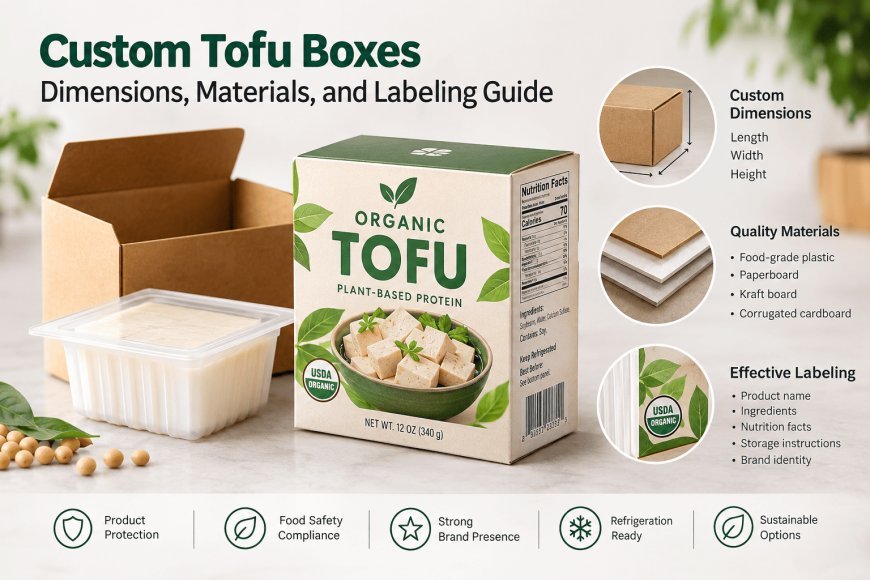
Tofu packaging requires more than an attractive box. Food businesses need packaging that supports product protection, maintains hygiene, communicates essential information, and fits the product properly. Whether a brand sells firm tofu, silken tofu, organic tofu, or seasoned tofu, the right packaging choices can improve handling, storage, and shelf presentation.
When selecting custom tofu boxes, manufacturers should consider package dimensions, food-contact materials, moisture resistance, labeling requirements, and the conditions under which the product will be refrigerated or transported. Each detail contributes to a better packaging solution for retailers, food distributors, and consumers.
This guide explains how to choose suitable box sizes, compare packaging materials, and design informative labels for tofu products.
1. Understanding Custom Tofu Boxes
Custom tofu boxes are packaging solutions designed around the dimensions, weight, storage requirements, and branding needs of tofu products. Depending on the product format, packaging may consist of a food-grade inner tray or sealed container combined with a printed outer carton or sleeve.
Unlike packaging for dry goods, tofu packaging must account for moisture, leakage risks, refrigeration, and food-contact safety. The outer box can provide space for branding and product information, but it should not automatically be treated as the primary barrier protecting the tofu.
Common applications include:
-
Retail tofu: Packaging for supermarket shelves and refrigerated display cases.
-
Organic tofu: Cartons or sleeves that communicate organic positioning while protecting the inner package.
-
Food-service tofu: Packaging designed for bulk handling by restaurants, caterers, and commercial kitchens.
-
Flavored tofu: Boxes that distinguish marinated, smoked, seasoned, or ready-to-cook varieties.
-
Private-label tofu: Packaging customized with a retailer's logo, product identity, and required information.
The most appropriate design depends on the tofu's moisture content, serving size, storage conditions, and distribution method. A well-designed package balances product protection with convenient handling and a recognizable brand identity.
2. How to Choose the Right Tofu Box Dimensions
Accurate sizing is essential for preventing movement, reducing wasted packaging space, and ensuring that the package fits neatly into storage and shipping systems. The required dimensions depend on the tofu container rather than the product name alone.
When planning tofu box dimensions, measure the length, width, and height of the filled primary container, including its lid, seal, and any projecting edges.

Key measurements to consider
-
Length: The longest horizontal measurement of the filled container.
-
Width: The distance across the shorter side.
-
Height: The total height, including the lid or seal.
-
Internal clearance: A small allowance for easy insertion and removal without making the package excessively loose.
-
Structural tolerance: Extra consideration for carton thickness, folding tabs, and closure construction.
For a custom carton, the manufacturer should distinguish between internal dimensions and external dimensions. The latter include the thickness of the packaging material, which affects how boxes fit into shipping cases and refrigerated display arrangements.
Illustrative tofu packaging sizes
The following measurements are examples for planning and prototyping, not universal tofu industry standards.
|
Packaging application |
Illustrative internal dimensions (L × W × H) |
|
Small tofu container |
4 × 3 × 2 inches |
|
Standard retail container |
5 × 4 × 2.5 inches |
|
Large retail container |
6 × 4.5 × 3 inches |
|
Multipack or food-service pack |
8 × 6 × 3 inches |
Actual sizing should be confirmed using the finished container and a physical sample. The dimensions also depend on whether the package is a close-fitting sleeve, a folding carton, or a secondary shipping box.
Expert tip: Before ordering food packaging in bulk, test a prototype with the actual filled container. Check the fit, closure, stacking stability, label placement, and performance under the intended refrigerated conditions.
3. Choosing Suitable Tofu Packaging Materials
The best material depends on whether the packaging directly contacts tofu or serves as an outer branding layer. These two functions should be evaluated separately.

Food-grade plastic containers
Rigid plastic trays and sealed containers can hold moist tofu while helping prevent leakage when properly designed. Select a material and closure suitable for the product's temperature, processing method, and expected shelf life. Confirm food-contact compliance with the supplier.

Paperboard and kraft cartons
Paperboard offers a printable surface for product names, brand colors, preparation instructions, and other information. Kraft board creates a natural visual appearance, making it useful for brands that emphasize a simple or environmentally conscious identity. It generally works best as secondary packaging unless specifically engineered and validated for direct food contact.

Corrugated cardboard
Corrugated board is useful for transporting multiple tofu units from manufacturers to distributors and retailers. Its fluted structure provides cushioning and stacking strength, depending on the board grade and box design. It is usually selected for outer shipping cartons rather than direct contact with wet tofu.

Multilayer barrier packaging
Certain tofu products use specialized packaging combining materials such as paperboard, polymers, and sometimes aluminum foil. These structures can provide barriers against moisture, oxygen, and light when properly engineered. Aseptic packaging is a specialized system that requires suitable processing and sealing equipment; it is not interchangeable with an ordinary printed carton.
What makes a packaging material suitable?
Consider the following criteria before selecting a substrate:
-
Moisture resistance: The package must withstand the conditions it will encounter without losing its intended performance.
-
Food-contact suitability: Materials, coatings, adhesives, and other components intended to contact food must be appropriate for the intended use.
-
Temperature performance: Confirm that the package remains functional during refrigeration, distribution, and any specified processing conditions.
-
Print quality: The outer surface should support clear graphics and readable product information.
-
Environmental considerations: Evaluate recyclability, material separation, recycled content, and local disposal infrastructure rather than relying on broad sustainability claims.
In the United States, the FDA regulates food-contact substances according to their intended use and applicable authorizations. A supplier's general claim that a material is food-grade should not replace verification that the particular material is suitable for the planned application.
4. Designing Effective Tofu Box Labels
A label helps consumers identify the product, understand its ingredients, and determine how to store and use it. For food brands, label design must balance visual appeal with accuracy and readability.


Essential information to plan for
For tofu sold in the United States, the applicable labeling rules may require information such as:
-
Statement of identity: The common or appropriate name of the food, such as tofu.
-
Net quantity: The amount of product contained in the package, declared in the required format.
-
Ingredient statement: Ingredients listed according to applicable requirements.
-
Allergen declaration: Soy is a major food allergen under U.S. federal law, and the applicable requirements must be followed.
-
Nutrition Facts: Nutrition information when required, subject to applicable exemptions.
-
Business information: The required name and address of the manufacturer, packer, or distributor.
-
Storage and handling instructions: Appropriate directions, such as keeping refrigerated, when needed for safe handling.
-
Date or lot information: Useful for inventory rotation and traceability, with applicable legal and customer requirements determining what must be provided.
FDA food-labeling guidance covers the placement and presentation of required information, while the agency's allergen guidance explains the declaration of major food allergens, including soybeans. Requirements can vary with the product and applicable exemptions, so review the current rules before printing a production run.
Label design practices that improve usability
Use a clear visual hierarchy to separate the product name, brand identity, and supporting details. Keep small text legible, provide sufficient contrast, and avoid placing essential information over busy graphics.
A well-organized label can use the front panel for the product name, variety, and brand logo, while side or back panels carry the ingredient list, nutrition information, barcode, and storage directions as appropriate.
Also consider the conditions in which the label will be used. Adhesives and label stock should be tested for condensation, cold storage, and the surface of the actual container. A label that peels away in a refrigerator can undermine both presentation and product identification.
5. Printing and Customization Options for Tofu Packaging
Once the dimensions and materials have been selected, customization helps a product stand out in a competitive refrigerated food section. The design should reinforce the brand without making required product information difficult to read.
Useful customization options include:
-
Logo printing: Place the brand mark prominently to improve recognition across different product varieties.
-
Brand colors: Use a consistent palette to distinguish firm, extra-firm, silken, or flavored tofu.
-
Product photography: Include a relevant serving suggestion or food image when it accurately represents the product.
-
Matte or gloss finishes: Choose a finish that complements the visual identity and works with the intended material.
-
Custom die-cut sleeves: Create a fitted outer sleeve around the primary food container, leaving necessary seals and closures accessible.
-
Barcode placement: Reserve an unobstructed area for scanning and retail inventory systems.
Finishes and coatings should be compatible with the substrate and intended packaging conditions. For refrigerated products, test printed samples for scuffing, condensation, and handling before approving a large order.
A practical design does not need excessive decoration. Clear typography, a recognizable logo, accurate product details, and a consistent appearance can create a professional retail presentation.
6. Common Mistakes to Avoid When Ordering Tofu Boxes
Packaging problems often begin during the specification and sampling stages. Addressing them before production can reduce waste and avoid costly reprints.
|
Common mistake |
Better approach |
|
Using the wrong dimensions |
Measure the actual filled container and confirm internal carton measurements. |
|
Treating a paper carton as a liquid barrier |
Use a suitable primary container or a validated barrier system. |
|
Ignoring refrigerated conditions |
Test the complete package under realistic storage and handling conditions. |
|
Printing labels before checking requirements |
Verify ingredients, allergen statements, net quantity, and other applicable information. |
|
Using unreadable small text |
Check contrast, type size, and legibility on a printed proof. |
|
Ordering large quantities without testing |
Approve a prototype and confirm the final artwork before bulk production. |
|
Making unsupported sustainability claims |
Verify material composition and the availability of appropriate recycling facilities. |
One particularly important distinction is between packaging that looks suitable and packaging that has been validated for its intended function. A visually appealing carton cannot compensate for an unsuitable food-contact material, an unreliable seal, or incorrect labeling.
7. A Practical Checklist Before Placing Your Packaging Order
Use this checklist when discussing a new packaging project with a supplier.
Packaging order checklist
Confirm the tofu variety, net weight, and filled container dimensions.
Choose the primary package and secondary carton or sleeve.
Verify food-contact suitability and refrigerated-use requirements.
Approve the carton structure, material thickness, and closure.
Check label content, allergen declarations, and nutrition information.
Review the artwork, print colors, barcode, and readable text.
Test a physical sample under realistic storage and distribution conditions.
Confirm order quantity, production schedule, and delivery requirements.
Reset checklistCopy checklist
8. Where Custom Tofu Packaging Fits into Your Brand Strategy
For a food business, packaging should be considered part of the product experience rather than simply an outer covering. A suitable combination of primary packaging, a printed carton, and informative labeling can help establish brand consistency from manufacturing through retail display.
Businesses developing a new tofu range should first establish the product's storage and protection requirements. They can then select appropriate materials, determine accurate dimensions, and develop a label that communicates essential information clearly.
At Fast Custom Boxes, businesses can explore custom printed packaging solutions designed around their branding and presentation needs. When planning tofu packaging, confirm that the proposed carton structure and printing specifications suit the intended food container and distribution conditions.
Conclusion
Choosing the right tofu packaging involves balancing dimensions, material performance, labeling accuracy, and visual presentation. Accurate measurements help create a better fit, appropriate food-contact materials support product safety, and well-designed labels make important information easier to understand.
Before committing to a production run, test the complete package, verify applicable labeling requirements, and confirm that the materials are suitable for the intended use. With careful planning, custom tofu boxes can support a consistent brand identity while meeting the practical demands of food packaging.
What's Your Reaction?
 Like
0
Like
0
 Dislike
0
Dislike
0
 Love
0
Love
0
 Funny
0
Funny
0
 Angry
0
Angry
0
 Sad
0
Sad
0
 Wow
0
Wow
0