






















Deepfake Fraud in Fintech: How AI-Powered Security Protects Fintech Apps
Discover how AI-powered security, deepfake detection, and authentication help fintech apps prevent identity theft, financial fraud, and cyber threats soon.

Why Deepfake Fraud Is Becoming a Serious Threat to Fintech Apps
A convincing video call or a cloned voice can make a fraudulent financial request look completely legitimate. For that reason, fintech platforms can no longer verify only what users see and hear.
Deepfake fraud in fintech is the use of AI-generated or AI-manipulated video, audio, images or documents to impersonate a real person, or to invent a believable fake one, in order to open accounts, take over existing ones or authorise payments.
Generative AI has made this type of attack cheaper, faster and more convincing. At the same time, financial services have moved online. Mobile banking, digital wallets, online lending and remote customer onboarding now depend on a screen, a camera and a microphone to confirm who is on the other side. Fraudsters know this, and they target exactly those points.
Deepfakes are also no longer limited to social media impersonation. They can now directly influence financial transactions, from a fake selfie during KYC to a cloned executive voice approving a transfer. Strong fintech app security therefore needs two things: robust identity verification and real-time fraud prevention. Businesses planning a secure product often begin by working with an experienced fintech application development company that treats security as part of the architecture rather than an add-on.
How Deepfake Technology Is Changing the Fintech Fraud Landscape
Fraudsters use generative AI to manipulate digital identities and exploit the trust built into financial applications. The main techniques are described below.
AI-Generated Videos and Facial Impersonation
Face-swapping tools and synthetic videos can imitate a genuine customer closely enough to pass a casual review. Manipulated selfies can be submitted during remote KYC, where an application relies on a photo or short video to match a person with their identity document. If the system only compares faces and does not check whether the input is live, a convincing fake may be accepted.
Voice Cloning and Banking Impersonation
A few seconds of recorded speech can be enough to clone a voice. Attackers use cloned voices to imitate customers, bank representatives and company executives. This creates risk wherever voice is trusted, including voice-based authentication, call-centre verification and verbal payment approvals.
Synthetic Identities and Fake Digital Documents
Synthetic identity fraud combines real and fabricated data to create a person who does not exist. AI-generated identity documents and profile images make these identities look credible. Weak onboarding procedures allow them to open accounts, build a transaction history and later be used for loan fraud or money laundering.
Real-Time Deepfake Attacks During Financial Transactions
Attackers can also manipulate live video verification, using real-time face and voice filters during a call. Combined with social engineering, this can push a victim or an employee to authorise a transaction.
Consider a practical example. A lending app asks applicants to complete a live selfie check. An attacker uses stolen identity details and feeds a synthetic video into the camera stream rather than a real camera feed. If the app only compares the face to the document photo, the check passes and a fraudulent loan account is created. Strong digital identity verification and deepfake detection in banking are designed to stop precisely this kind of attack.
Why Traditional Fintech Security Measures Are No Longer Enough
Conventional controls were designed for stolen passwords and simple forgeries, not for realistic AI-generated content. Several of them now show clear gaps.
Weaknesses in Password-Based Authentication
Passwords can be stolen through phishing, data breaches and malware, which leads to account takeover. A correct password proves only that someone knows a secret. It does not prove that the person is the genuine account holder.
Limitations of Basic Facial Recognition
Facial matching without effective liveness checks can be fooled by static photographs, recorded videos and manipulated selfies. Recognising a face is not the same as confirming that a real person is present at that moment.
How Fraudsters Exploit OTP and Multi-Factor Authentication
One-time passwords add a layer of protection, but attackers work around them through SIM swapping and social engineering. Customers are often manipulated into sharing verification codes themselves. Multi-factor authentication remains valuable, yet it is not sufficient when the person being deceived is the user.
Gaps in Conventional Fraud Monitoring Systems
Rule-based systems detect patterns they already know. Unfamiliar attack patterns, especially AI-driven ones, can pass unnoticed. Effective fintech cybersecurity solutions therefore need continuous monitoring and contextual risk assessment, rather than a single check at login.
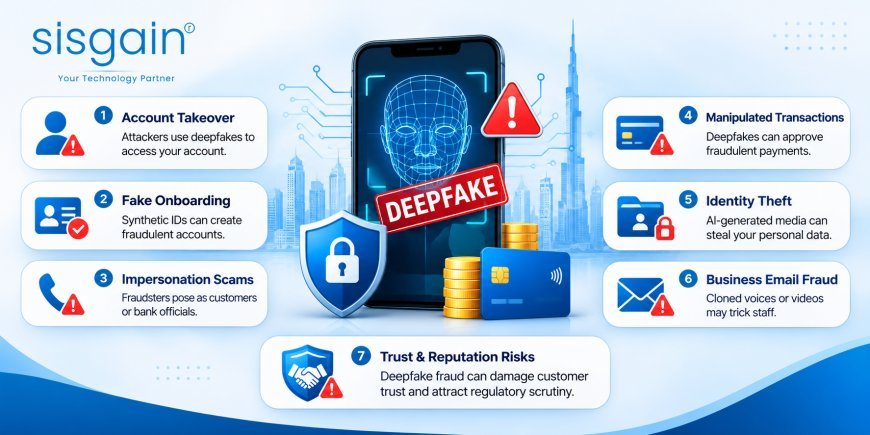
7 Major Risks Deepfake Fraud Creates for Fintech Applications
The following seven risks show how deepfake-enabled attacks can affect fintech operations.
1. Account Takeover and Unauthorised Access
How it happens: Attackers use cloned voices or manipulated video to pass recovery or verification steps. Affected operations: Login, account recovery, device changes. Consequences: Stolen funds and compromised customer data. Prevention: Risk-based authentication, liveness checks and device intelligence.
2. Fraudulent Customer Onboarding and Fake Accounts
How it happens: Synthetic identities and fake documents pass weak KYC. Affected operations: Digital onboarding and lending. Consequences: Mule accounts, loan fraud and compliance exposure. Prevention: Document authenticity checks, liveness detection and multi-signal identity verification.
3. Financial Loss Through Impersonation Scams
How it happens: Fraudsters pose as a customer, a bank officer or a relative using a cloned voice or video. Affected operations: Customer support and payment requests. Consequences: Direct losses and disputes. Prevention: Call-back verification, transaction warnings and behavioural analysis.
4. Manipulated Payment and Transaction Authorisation
How it happens: A deepfake is used to approve a payment or confirm a change of beneficiary. Affected operations: Payment approvals and high-value transfers. Consequences: Irreversible transfers. Prevention: Transaction risk monitoring and step-up authentication for unusual payments.
5. Identity Theft and Personal Data Exposure
How it happens: Stolen personal data is combined with AI-generated media to impersonate victims. Affected operations: Profile management and data access. Consequences: Privacy breaches and long-term harm to customers. Prevention: Encryption, strict access controls and secure data handling.
6. Business Email and Executive Impersonation
How it happens: A cloned executive voice or video instructs staff to make an urgent payment. Affected operations: Treasury, finance and corporate payments. Consequences: Large fraudulent transfers. Prevention: Dual approval, out-of-band verification of high-risk requests and staff training.
7. Customer Trust and Regulatory Reputational Risks
How it happens: Repeated fraud incidents weaken confidence in a platform. Affected operations: Customer retention, partnerships and regulatory relationships. Consequences: Customer churn, scrutiny and reputational damage. Prevention: A visible, layered security strategy and prompt incident reporting.
Together, these risks show why deepfake fraud in fintech must be treated as a core product and fintech app security concern, not only a compliance issue.
How AI-Powered Fraud Detection Can Protect Fintech Apps Against Deepfakes
AI-powered fraud detection allows financial platforms to identify suspicious activity before it becomes a financial loss. Providers of specialised ai solutions in dubai and other markets increasingly combine the following capabilities rather than relying on a single control.
Real-Time Deepfake Detection and Media Analysis
Detection models analyse images, video and audio for manipulated facial features, audio inconsistencies and other signs of synthetic media. During identity verification, suspicious media can be flagged for stricter checks or manual review.
AI-Based Behavioural Biometrics
Behavioural biometrics study typing patterns, device usage and interaction behaviour. When a user acts very differently from their normal pattern during a sensitive operation, the system can request extra verification.
Machine Learning for Transaction Monitoring
Machine learning models identify unusual transaction patterns, suspicious payment behaviour and abnormal account activity. Risk scoring helps flag potentially fraudulent transactions in real time, while lower-risk activity continues without friction.
Liveness Detection and Biometric Verification
Liveness detection confirms that a real person is present. Active liveness asks the user to perform an action, while passive liveness analyses the input without extra steps. Good systems also address replay attacks and injected video feeds, and combine facial recognition with additional identity checks.
Predictive Fraud Analytics and Continuous Monitoring
Predictive analytics use historical and real-time signals to recognise emerging fraud patterns. This supports continuous security assessment instead of one-time verification at login or onboarding.
No system can promise complete prevention. A layered approach reduces risk, and models must be updated as attackers adapt.
Essential Security Features Every Modern Fintech App Should Include
When planning a product, a capable fintech application development company will usually recommend the following features from the start.
Multi-Factor and Risk-Based Authentication
Authentication strength should change with context, such as a new device, an unusual location or a high-value payment.
Advanced Digital Identity Verification
Combine document checks, biometrics, device signals and contextual data instead of relying on one input.
AI-Based Deepfake and Spoofing Detection
Detect manipulated media, presentation attacks and injected video streams during onboarding and sensitive actions.
End-to-End Data Encryption
Protect sensitive financial and personal data in transit and at rest.
Secure API Integration and Access Management
Secure third-party integrations with authentication, least-privilege access and regular reviews.
Real-Time Transaction Risk Monitoring
Score payments as they happen and apply step-up verification where risk is high.
Automated Fraud Alerts and Incident Reporting
Notify customers and security teams quickly, and keep clear records to support investigation and reporting.
|
Security feature |
Main purpose |
Business benefit |
|---|---|---|
|
Liveness detection |
Identify fake biometric inputs |
Stronger identity checks |
|
AI fraud detection |
Recognise suspicious patterns |
Faster fraud response |
|
MFA |
Add authentication layers |
Reduced unauthorised access |
|
Behavioural biometrics |
Analyse user behaviour |
Additional identity signals |
|
API security |
Protect application communication |
Reduced integration risks |
|
Transaction monitoring |
Flag unusual payments |
Better financial protection |
How Fintech Companies Can Build a Stronger Deepfake Fraud Prevention Strategy
Technology works best when it follows a clear implementation plan. The five steps below can guide that process.
Step 1: Assess Existing Security Vulnerabilities
Review onboarding, login, payment and account recovery processes. Identify weaknesses in biometric verification, such as missing liveness checks or reliance on a single signal.
Step 2: Integrate AI-Powered Identity Verification
Introduce deepfake detection and liveness checks, and combine several identity signals, including document data, biometrics and device intelligence.
Step 3: Implement Intelligent Fraud Monitoring
Monitor transactions and unusual account activity. Establish risk-based verification workflows so that higher-risk actions trigger stronger checks.
Step 4: Strengthen API and Data Security
Secure third-party integrations, and apply encryption, access controls and secure data handling across the platform.
Step 5: Conduct Regular Security Testing
Perform penetration testing and vulnerability assessments. Simulate deepfake and social engineering scenarios, and update detection models as threats evolve. These fintech cybersecurity solutions and AI-powered fraud detection practices should be repeated, not treated as one-time projects.
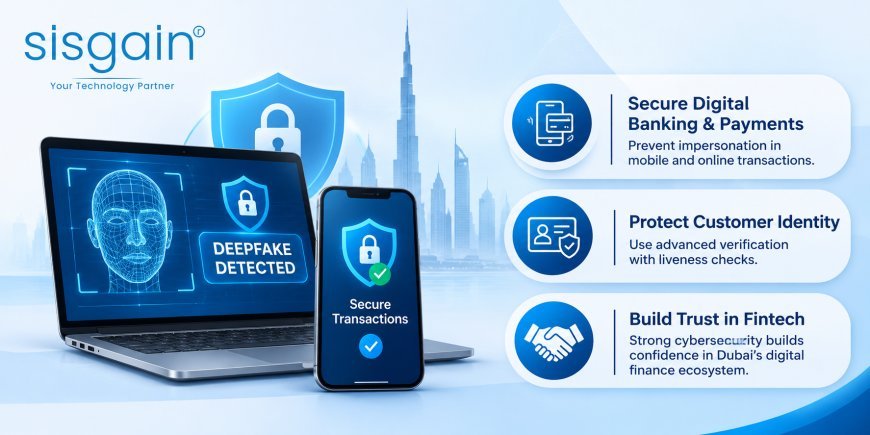
Why Deepfake Protection Matters for Dubai's Growing Fintech Ecosystem
The UAE continues to expand its digital financial services, and with growth comes a larger attack surface. Businesses exploring unlocking new opportunities in dubais fintech market should treat security as a foundation for that growth.
Increasing Adoption of Digital Banking and Mobile Payments
Digital-first services raise the importance of secure customer authentication. Mobile wallets, payment applications and digital lending platforms each require protection against impersonation and account takeover.
Protecting Customer Identity Across Digital Financial Services
Secure onboarding and digital identity verification are essential. Stronger authentication reduces impersonation risks, particularly where national digital identity tools such as UAE Pass can be combined with liveness and behavioural checks.
Building Trust in UAE's Digital Financial Ecosystem
Cybersecurity, customer confidence and fintech adoption are closely connected. Privacy, secure data handling and regulatory alignment, including the UAE's data protection law and Central Bank of the UAE requirements, help build lasting trust. Companies should confirm current obligations with qualified legal and compliance advisers.
Preparing Fintech Applications for Emerging AI-Driven Threats
Scalable security architectures and continuous fraud monitoring support long-term resilience as attack methods change.
Business Benefits of Investing in Advanced Fintech App Security
Security investment has commercial value beyond loss prevention.
Reduced Financial Fraud and Operational Losses
Earlier detection limits direct losses and lowers the cost of investigations and chargebacks.
Improved Customer Confidence and Retention
Customers stay with platforms they trust to protect their money and identity.
More Secure Digital Onboarding Experiences
Risk-based checks can block fraud while keeping genuine onboarding smooth.
Better Protection of Sensitive Financial Information
Encryption and access controls reduce the chance and impact of data exposure.
Stronger Business Scalability and Security Readiness
A secure foundation lets a business add products and enter new markets with confidence.
To measure results, track indicators such as fraud detection rate, false-positive rate, account takeover rate, average fraud investigation time, customer onboarding completion rate and security incident response time. Compare them before and after implementation, and use your own verified data rather than generic claims.
How to Choose the Right Technology Partner for Secure Fintech App Development
Choosing a development partner is a security decision as much as a technical one. When evaluating options, including sisgain, consider the following.
Experience in Fintech Application Development
Look for experience with digital banking, payment and financial applications, and a clear understanding of secure financial workflows.
Expertise in AI and Fraud Detection Technologies
Check for capability in AI-based identity verification, machine learning, behavioural analytics, biometric authentication and deepfake detection integrations.
Security-First Application Architecture
The partner should design secure APIs, data encryption, scalable infrastructure and strong authentication and access management from the beginning.
Ongoing Security Maintenance and Improvements
Security does not end at launch. Ask about regular vulnerability assessments, security updates, performance monitoring and continuous improvement against emerging threats.
Why SISGAIN Is Important for Secure, AI-Ready Fintech Development
Deepfake-resistant fintech products require more than a single tool. They need engineering teams that understand financial workflows, AI-driven fraud detection and secure architecture together. This is where SISGAIN adds value.
- Security built into design: Fraud prevention, identity verification and data protection are planned during product architecture instead of added after launch.
- AI and fintech expertise in one team: Combining application development with AI capabilities helps connect detection models directly to onboarding, login and payment flows.
- Layered protection: Liveness checks, behavioural signals, transaction monitoring and secure APIs can work together as one system.
- Scalable, maintainable solutions: Regular testing and updates help products keep pace with new threats.
- Business-focused delivery: Security decisions are linked to measurable goals such as lower fraud losses and smoother onboarding.
Conclusion: Strengthening Fintech Apps Against the Next Generation of Fraud
Deepfake technology is creating new challenges for digital financial security, and deepfake fraud in fintech will continue to evolve. Traditional authentication alone cannot address every impersonation technique. AI-powered fraud detection, behavioural biometrics, liveness detection and multi-layered authentication together provide a far stronger defence. Fintech businesses should prioritise security during planning, development and ongoing maintenance, and should test their defences regularly.
Build a more secure fintech application with AI-powered fraud protection. Speak with a qualified technology partner today to design a scalable, security-first product.
Frequently Asked Questions About Deepfake Fraud in Fintech
What Is Deepfake Fraud in Fintech?
Deepfake fraud in fintech is the use of AI-generated video, audio, images or documents to impersonate real customers or create fake identities. Criminals use it to pass identity checks, take over accounts, open fraudulent accounts or authorise payments on financial platforms.
How Do Deepfakes Affect Mobile Banking Applications?
Deepfakes can fool selfie-based onboarding, voice authentication and live video checks in mobile banking apps. This can lead to fake accounts, account takeover and fraudulent transfers, especially when an app relies only on facial matching or voice recognition without liveness verification.
Can AI Detect Deepfake Fraud in Financial Transactions?
Yes, AI can help detect deepfake fraud by analysing media for manipulation, monitoring behaviour and scoring transaction risk. However, no tool is perfect. The best results come from combining AI detection with liveness checks, device intelligence and human review for high-risk cases.
How Does Deepfake Detection Work in Banking?
Deepfake detection in banking analyses images, video and audio for artefacts, inconsistencies and signs of injected or replayed media. It is combined with liveness detection, device signals and behavioural data, so that suspicious sessions can be challenged, blocked or sent for review.
What Security Features Can Prevent Deepfake Attacks?
Useful features include liveness detection, AI-based deepfake and spoofing detection, risk-based multi-factor authentication, behavioural biometrics, transaction monitoring, secure APIs and encryption. No single feature is enough, so layering them provides stronger protection against impersonation.
Is Facial Recognition Enough to Protect Fintech Applications?
No. Facial recognition alone can be deceived by photos, recorded videos and synthetic faces. It should be combined with liveness detection, document verification, device intelligence and behavioural analysis to confirm that a real, genuine user is present.
How Can Fintech Companies Verify Customer Identities Securely?
Fintech companies should use multi-layered digital identity verification: document authentication, biometric matching with liveness checks, device and location signals, and risk-based step-up authentication. Continuous monitoring after onboarding helps detect suspicious changes in behaviour or account activity.
Why Is AI-Powered Fraud Detection Important for Fintech Apps?
AI-powered fraud detection can recognise new and complex fraud patterns that fixed rules miss. It analyses behaviour and transactions in real time, helping fintech apps respond faster, reduce losses and protect customers as attack techniques evolve.
What's Your Reaction?
 Like
0
 Dislike
0
 Love
0
 Funny
0
 Angry
0
 Sad
0
 Wow
0