
























How Businesses Can Improve Inventory Accuracy Through Smarter Stock Management

Inventory accuracy plays a major role in the smooth operation of a business. Companies need dependable stock records to manage purchasing, fulfil customer orders, plan production, and understand the value of the products they hold. When recorded quantities do not match physical stock, even routine business decisions can become difficult.
A company might believe that a product is available when it has already been dispatched, misplaced, damaged, or reserved for another customer. In other situations, products may be sitting in a warehouse without being reflected correctly in the inventory system. These discrepancies can lead to delayed orders, unnecessary purchases, wasted employee time, and unreliable financial reports.
Improving inventory accuracy requires more than conducting occasional stock counts. Businesses need consistent processes, clear employee responsibilities, reliable transaction records, and suitable technology to maintain accurate information throughout the inventory lifecycle.
Understanding the Causes of Inventory Discrepancies
Inventory discrepancies can develop at different stages of a product's journey. Errors during receiving, picking, packing, transfers, returns, and stock adjustments can gradually create differences between recorded and physical quantities.
For example, a warehouse may receive 100 units from a supplier but record only 95 units in the system. If the remaining five units are placed on a shelf without being recorded, employees may assume that the warehouse has less stock than it actually holds.
Similar problems can occur when products are moved between storage locations without updating their records. In businesses with multiple warehouses, inconsistent procedures can make these errors more difficult to identify.
The first step towards improvement is understanding where discrepancies originate. Rather than correcting stock figures without investigation, managers should identify the underlying process failure and introduce controls to prevent the same problem from recurring.
Establishing Standardised Receiving Procedures
Receiving is one of the most important stages of inventory control because it determines how incoming products enter the company's records.
Businesses should establish a consistent process for checking deliveries against purchase orders and supplier documentation. Employees should verify the product description, quantity, condition, and any additional identification details required for the goods.
Where applicable, batch numbers, serial numbers, expiry dates, or lot information should also be recorded according to the company's requirements.
Damaged, missing, or incorrect items should be documented and reported to the appropriate team. This prevents inaccurate quantities from being treated as available stock and provides useful information for resolving supplier discrepancies.
Businesses should also define when a received product becomes available for sale or production. Some goods may require inspection or approval before they can be used.
A clear receiving process creates a stronger foundation for every inventory activity that follows.
Making Stock Movements Easier to Track
Inventory rarely remains in one location. Products may move between warehouse shelves, storage areas, production departments, dispatch zones, and different business locations.
Each movement should follow a defined procedure so that the system reflects the product's current location and status.
For example, when goods move from one warehouse to another, the business should record the transfer, the quantity dispatched, the goods in transit where applicable, and the quantity confirmed at the receiving location.
This information helps prevent products from appearing in the wrong warehouse or being counted twice.
Businesses can also benefit from consistent product identification. Standard item codes, barcode labels, and clearly defined storage locations make it easier for employees to identify the correct products during picking, counting, and replenishment.
The appropriate level of tracking depends on the business's product range, operational complexity, and traceability requirements.
Using Cycle Counting to Maintain Accuracy
Physical stocktaking is essential, but counting every item at the same time may interrupt normal warehouse operations. Cycle counting provides an alternative by allowing businesses to verify selected inventory items regularly throughout the year.
A company may count fast-moving products more frequently than slow-moving items. High-value products or items with a history of discrepancies may also receive additional attention.
When a difference is discovered, the team should investigate the reason before making an adjustment. Possible causes include receiving errors, incorrect picking, unrecorded transfers, damaged goods, or transaction timing issues.
Recording the findings helps managers recognise recurring problems and determine whether additional training or process changes are required.
Cycle counting works best when it follows a documented schedule and clear rules for approving adjustments. This approach helps businesses maintain better visibility without relying entirely on a single annual stocktake.
Improving Employee Accountability
Inventory accuracy is a shared responsibility across several departments. Purchasing employees record orders, warehouse teams handle physical goods, sales teams create customer commitments, and finance personnel use inventory information for reporting.
If responsibilities are unclear, employees may assume that someone else has already updated the system.
Businesses should define who is responsible for recording receipts, confirming dispatches, approving adjustments, processing returns, and investigating discrepancies. These responsibilities should be communicated clearly and supported by appropriate training.
Access permissions can also help ensure that employees can perform the tasks required for their roles while sensitive adjustments remain subject to suitable controls.
The objective is not to create unnecessary administrative work. It is to make each transaction traceable and ensure that inventory records are updated consistently.
Connecting Inventory Records with Daily Business Operations
Inventory information becomes more useful when it is accessible to the employees who need it. Purchasing teams need to understand current stock and incoming deliveries, while sales representatives need to know whether products are available for new orders.
Warehouse supervisors may need to investigate discrepancies, and managers may require reports that show stock movements, slow-moving products, and replenishment requirements.
When these activities rely on disconnected records, employees can spend considerable time checking spreadsheets, sending messages, and reconciling conflicting information.
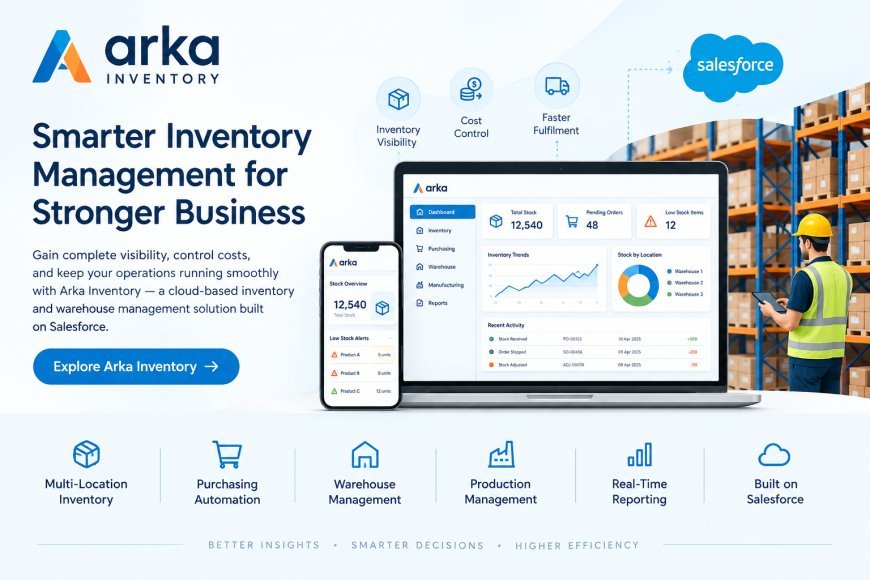
A connected inventory system can help bring stock information and operational workflows together. Businesses evaluating Arka Inventory's Salesforce-based inventory management solution can explore its approach and determine whether its available capabilities fit their stock control and reporting requirements.
Before implementing any platform, businesses should confirm its specific features, integration needs, reporting options, and support for their existing processes.
Monitoring the Right Inventory Accuracy Measures
Businesses need meaningful indicators to determine whether their stock management procedures are improving.
One useful measure is inventory record accuracy, which compares recorded stock information with verified physical quantities according to a defined calculation method.
Other useful indicators include the number of discrepancies discovered during cycle counts, the frequency of inventory adjustments, receiving error rates, and the time required to investigate stock differences.
These measurements should be interpreted in context. A higher number of adjustments may indicate that employees are identifying previously hidden problems, rather than necessarily showing that the process has become worse.
Managers should review the reasons behind the figures and focus on reducing the underlying causes of errors.
Regular performance reviews can help identify which products, locations, or transaction types require additional controls.
Preventing Excess Stock and Unexpected Shortages
Inventory accuracy also supports better purchasing decisions. If recorded quantities are incorrect, replenishment calculations may be unreliable.
A business might place a new order even though sufficient stock is already available, increasing storage requirements and tying up working capital. Conversely, overstated inventory may prevent a necessary purchase, resulting in a stockout.
To reduce these risks, businesses should review available stock alongside reserved quantities, open purchase orders, expected deliveries, and actual demand.
Reorder points should reflect the item's consumption pattern, supplier lead time, and operational importance. They should also be reviewed when demand or supplier performance changes.
Accurate inventory records provide the information needed to make these decisions, while regular forecasting and purchasing reviews help translate that information into practical action.
Creating a Continuous Improvement Process
Inventory accuracy should be treated as an ongoing operational priority rather than a one-time project.
Businesses can begin by identifying their most frequent discrepancies and selecting a small number of processes to improve. They might standardise receiving procedures, introduce scheduled cycle counts, improve storage labels, or establish clearer approval rules for stock adjustments.
After introducing a change, managers should review the results and gather feedback from employees who perform the work. If discrepancies continue, the process may require further investigation or modification.
Regular reviews help businesses adapt their procedures as product ranges, order volumes, and warehouse operations change.
Conclusion
Accurate inventory records support reliable purchasing, efficient warehouse operations, timely order fulfilment, and better financial decision-making. However, accuracy depends on the consistent recording of stock movements, standardised receiving and dispatch procedures, regular physical verification, and clear employee responsibilities.
Technology can strengthen these processes by improving access to information and supporting connected workflows, but dependable results also require sound operational practices.
Businesses looking to improve their stock control can evaluate their current procedures, identify recurring discrepancies, and introduce measurable improvements over time. With the right combination of disciplined processes and suitable inventory management tools, organisations can build a more reliable foundation for daily operations and future growth.
What's Your Reaction?
 Like
0
 Dislike
0
 Love
0
 Funny
0
 Angry
0
 Sad
0
 Wow
0