





















MSME Funding in India: Government Schemes vs NBFC Loans vs Alternative Finance
Compare MSME funding options in India, including MUDRA, CGTMSE, NBFC loans, TReDS, and P2P lending. Learn which option fits your business cash flow and growth stage.

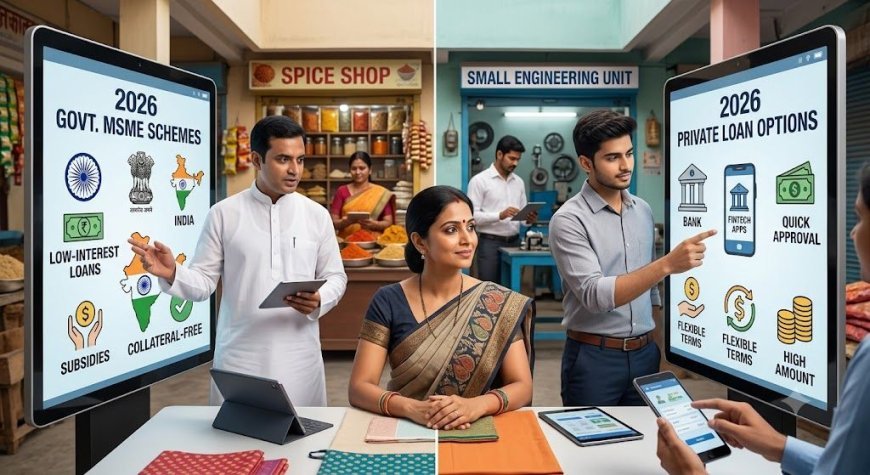
Small businesses need funding for varying reasons, from managing short-term cash flow and purchasing inventory to acquiring heavy equipment or executing large commercial orders.
The right choice depends on the loan size, urgency, business vintage, credit score, available collateral, and total borrowing cost. Below is how government-backed schemes, bank/NBFC business loans, and alternative financing structures compare.
.
Government Schemes for MSME Funding
Government-backed credit schemes facilitate institutional borrowing by providing subsidised rates or credit risk guarantees to participating banks and NBFCs.
Pradhan Mantri MUDRA Yojana
The Pradhan Mantri MUDRA Yojana (PMMY) provides institutional credit to micro-enterprises. The loan categories are:
-
Shishu: Up to ₹50,000
-
Kishore: Above ₹50,000 and up to ₹5 lakh
-
Tarun: Above ₹5 lakh and up to ₹10 lakh
-
Tarun Plus: Above ₹10 lakh and up to ₹20 lakh (for borrowers with a clean track record of repaying previous Tarun loans)
Tarun Plus is intended for entrepreneurs who have successfully repaid previous Tarun loans. The scheme can help eligible micro-enterprises seeking smaller amounts of business funding. Loan terms, including interest rates, are determined by the lending institution under the applicable framework.
CGTMSE Credit Guarantee Scheme
The Credit Guarantee Fund Trust for Micro and Small Enterprises (CGTMSE) supports eligible lending to micro and small enterprises by providing guarantee cover to participating lending institutions. Key details include:
-
Guarantee Ceiling: Up to ₹10 crore per eligible borrower.
-
Guarantee Coverage: Ranges between 75% and 85% of the sanctioned loan depending on unit location, enterprise category (e.g., women-owned units), and loan size.
-
Cost Factor: Lenders pay an Annual Guarantee Fee (AGF) to CGTMSE (revised framework effective April 1, 2025), which is typically passed on to the borrower as part of the overall cost of capital.
NBFC Business Loans
Non-Banking Financial Companies (NBFCs) offer secured and unsecured NBFC business loans for needs such as working capital, expansion, and equipment purchases. Terms vary by lender, including interest rates, loan amounts, tenure, fees, and approval timelines.
What to Compare Before Choosing an NBFC Loan:
-
Annual Percentage Rate (APR): Factor in processing fees, documentation costs, and penal charges alongside the nominal interest rate.
-
Key Facts Statement (KFS): Regulated entities must provide a KFS detailing the total cost of credit before agreement execution.
-
Foreclosure & Prepayment Terms: Verify whether prepayment penalties apply if you clear the debt ahead of schedule.
Alternative Finance for MSMEs
Businesses can also explore financing options beyond conventional term loans, such as invoice financing, TReDS, and regulated P2P lending.
TReDS
The Trade Receivables Discounting System (TReDS) is an electronic platform framework that facilitates the financing or discounting of eligible MSME trade receivables through multiple financiers. It can help eligible suppliers access funds against qualifying receivables before their invoices mature.
Peer-to-Peer Lending
Peer-to-peer (P2P) lending platforms facilitate borrowing and lending online. In India, these platforms operate under an RBI regulatory framework and must comply with applicable directions. Businesses should compare the costs, risks, and repayment obligations before considering P2P lending.
Which MSME Funding Option Should You Choose?
|
Funding Option |
Primary Advantage |
Maximum Coverage / Cap |
Best Suited For |
|
MUDRA (PMMY) |
Collateral-free; sub-market interest rates |
Up to ₹20 lakh |
Micro-enterprises and small retail businesses |
|
CGTMSE Cover |
Institutional credit without collateral assets |
Up to ₹10 crore |
Micro and Small Enterprises undertaking expansion |
|
NBFC Business Loans |
Rapid processing and flexible credit evaluation |
Depends on lender assessment |
Urgent capital needs or businesses with short vintage |
|
TReDS Invoice Discounting |
Off-balance-sheet liquidity; no collateral |
Depends on corporate buyer credit line |
MSMEs selling to large corporates or CPSEs |
|
P2P Lending |
Digital borrowing platform |
Restricted to ₹10 lakh limit |
Unsecured, short-term micro-funding needs |
Your choice should depend on the amount you need, how quickly you need the funds, your business and credit profile, available documentation, repayment capacity and the total cost of financing.
Final Takeaway
Choosing the right MSME funding option involves balancing speed versus cost of capital. If you have time for underwriting, government-backed schemes like PMMY or CGTMSE-supported bank loans provide lower interest rates. If liquidity is tied up in unpaid corporate bills, TReDS offers immediate collateral-free cash flows. Always review your Key Facts Statement (KFS) to compare the Annual Percentage Rate (APR) across lenders before borrowing.
What's Your Reaction?
 Like
0
Like
0
 Dislike
0
Dislike
0
 Love
0
Love
0
 Funny
0
Funny
0
 Angry
0
Angry
0
 Sad
0
Sad
0
 Wow
0
Wow
0