















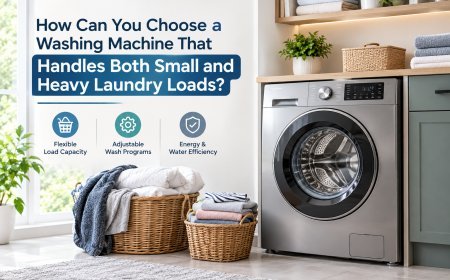







How Can You Choose a Washing Machine That Handles Both Small and Heavy Laundry Loads?
Learn how to choose a washing machine that handles both small and heavy laundry loads by considering capacity, load-sensing features, wash programs, efficiency, and spin speed.
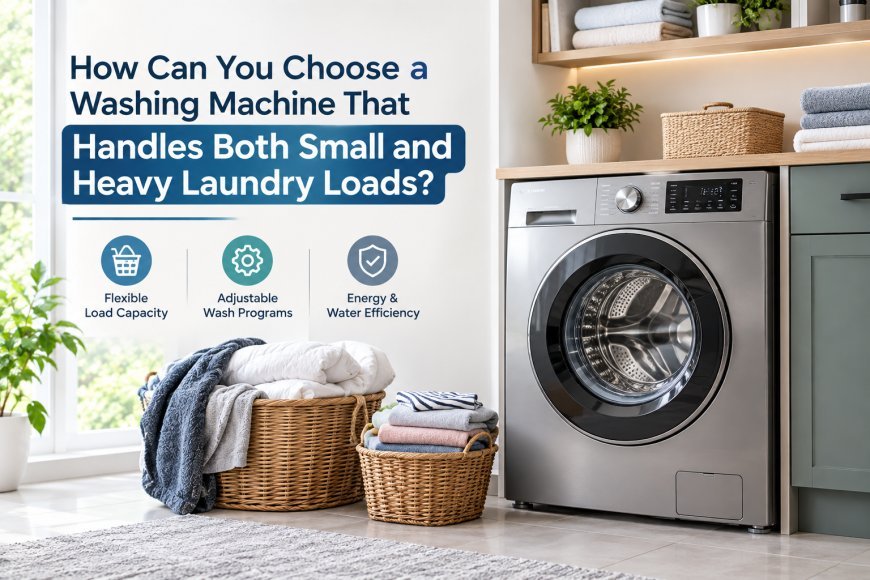
Laundry is rarely the same every day. One wash may contain only a few shirts and trousers, while another may include towels, bedsheets, children's clothes, or other bulky fabrics. Because of these changing requirements, choosing a washing machine should involve more than simply looking at the maximum capacity written on the specification sheet.
A practical appliance should be able to handle regular household loads comfortably while also providing enough flexibility for heavier washing days. Capacity, loading style, programs, water requirements, installation space, and ease of use all influence how useful a machine feels after purchase.
Understanding these factors can help you choose a model that works well throughout the week rather than only for one type of laundry.
Why Should You Think About Different Load Sizes?
Many households do not wash the same amount of clothing in every cycle.
During the week, you may need to wash a small number of everyday clothes. On weekends, the load may become much larger because of towels, bedding, uniforms, or several days of accumulated laundry.
If the drum is too small, large loads may need to be divided into multiple cycles. If the appliance is much larger than your normal requirements, much of its capacity may remain unused during everyday washing.
The better approach is to estimate your average load while also considering the heaviest laundry you regularly handle.
This gives you a more realistic idea of the capacity you actually need.
How Should Family Size Influence Capacity?
Household size is useful when estimating laundry requirements, but it should not be the only factor.
Two families with four members can have completely different routines.
One may wash clothes almost every day, keeping individual loads relatively small. Another may save laundry for the weekend and wash much larger quantities at once.
Young children, school uniforms, sports clothing, towels, and bedding can also increase washing frequency.
Instead of selecting capacity purely according to the number of people in the home, consider how quickly laundry normally builds up.
Your weekly routine often provides a better guide than family size alone.
What Happens When a Machine Is Regularly Overloaded?
Trying to place too much laundry into the drum can reduce the space available for clothes to move during the cycle.
This may affect how effectively water and detergent reach different fabrics.
Bulky items can be particularly demanding because they occupy more drum space than ordinary clothing.
Rather than forcing a large load into a smaller machine, it is usually more practical to divide it or select a capacity that matches your regular needs.
At the same time, capacity should not be treated as a reason to fill the drum completely during every wash.
Follow the manufacturer's guidance for different fabrics and programs because appropriate load sizes may vary by cycle.
Does Automatic Operation Help With Changing Loads?
Automatic models can simplify the laundry process by managing multiple stages within one selected cycle.
Depending on the appliance and program, users may not need to manually handle every washing, rinsing, draining, and spinning step.
This can be especially useful when laundry is done frequently.
However, convenience should still be balanced with installation requirements, water availability, available space, and the controls you prefer.
A model with many automatic functions may be useful for one household but unnecessary for another that prefers straightforward operation.
Choose according to how you actually want to manage laundry.
What Should You Compare in a Haier Washing Machine?
When considering a Haier washing machine, compare models according to capacity and configuration rather than assuming every option from the brand is designed for the same user.
Start with how much laundry you normally wash.
Then look at loading style, available programs, motor technology, controls, dimensions, and the amount of space required for installation.
A larger model can be practical for families dealing with heavy weekly loads, while a more moderate capacity may be better suited to couples or smaller households.
The most useful comparison is between products that serve similar laundry requirements.
When Can a Super Asia Washing Machine Be Suitable?
A Super Asia washing machine may appeal to buyers comparing different machine types and capacities.
The important step is to check whether the individual model matches your preferred level of automation and normal load size.
For example, an automatic top-loading machine and a semi-automatic single-tub washer provide different laundry experiences even when both come from the same manufacturer.
Instead of beginning with brand alone, first decide what type of machine fits your routine.
Then compare models within that category according to capacity, controls, construction, available washing functions, and dimensions.
This helps keep the comparison relevant.
How Useful Are Different Wash Programs?
Wash programs are most useful when they match fabrics you actually clean regularly.
A normal cycle may handle much of the everyday laundry in many homes. Quick cycles can help with smaller or lightly used clothing, while heavier modes may be useful for more demanding loads.
Gentler settings may suit fabrics that require additional care.
Some machines also include dedicated rinse, spin, bedding, or tub-cleaning functions.
Rather than choosing the appliance with the highest number of programs, identify the few settings you are likely to use every week.
A simple control panel with useful cycles can often be more practical than numerous functions that are rarely selected.
Why Does Loading Style Matter?
Top-loading and front-loading designs affect how the appliance fits into your laundry area.
A top-loader requires enough space above the machine for the lid to open properly.
A front-loading model needs clearance in front of the appliance.
Think about nearby cabinets, shelves, walls, doors, and walking space before choosing.
Loading preference matters as well. Some people find top-loading more comfortable, while others prefer the design and features commonly associated with front-loading models.
Neither arrangement is automatically suitable for every home.
Available space should be part of the decision from the beginning.
Should You Consider Heavy Items Before Buying?
Yes. Families often think about clothing but forget items such as bedsheets, blankets, curtains, and towels.
These fabrics occupy much more space once placed inside the drum.
If you wash heavy items regularly, consider whether the appliance has enough practical capacity to handle them according to manufacturer guidance.
For households that rarely wash such items at home, paying for much larger capacity may not be necessary.
Think about what you realistically wash rather than what you might wash only once or twice a year.
How Important Are Water Supply and Drainage?
Fully automatic machines generally depend on suitable water and drainage arrangements.
Before buying, inspect the installation area.
Check that water connections are accessible, drainage can be arranged properly, and a suitable electrical supply is available.
Also measure the machine's intended space carefully.
Do not rely only on width. Height, depth, lid or door movement, and surrounding clearance matter too.
Planning installation before purchase can prevent situations where a suitable appliance becomes inconvenient because the laundry area was not prepared for it.
What Does “Best” Actually Mean for a Household?
People searching for the best washing machine in Pakistan may expect one model to be ideal for everyone, but household requirements are too different for that approach.
For one buyer, the priority may be large capacity for weekly family laundry.
For another, compact dimensions may matter more.
Some households may value automatic operation, while others prefer simpler controls and greater manual involvement.
The better question is not “Which machine is best overall?” but “Which features are most useful for the way my household handles laundry?”
That shift makes comparisons much more practical.
How Can Good Laundry Habits Improve Everyday Use?
Even a suitable appliance performs better when it is used properly.
Avoid repeatedly overloading the drum and select programs that match the type of fabrics being washed.
Use detergent according to appliance and detergent guidance rather than assuming that more detergent always produces better results.
Accessible filters, detergent areas, and other parts should also be maintained as recommended by the manufacturer.
These habits can help keep regular laundry more manageable and prevent small maintenance issues from building up over time.
FAQs
1. Should I choose capacity according to family size?
Family size is helpful, but washing frequency and typical load size should also be considered.
2. Is a larger drum always better?
No. Additional capacity is valuable only when your household regularly needs it.
3. Can one machine handle both small and large loads?
Many machines can handle different load sizes, but users should follow the capacity and cycle guidance provided for the individual model.
4. Should I compare brands before deciding machine type?
It is usually more useful to decide the required type and capacity first, then compare brands and models within that category.
5. What should I measure before buying?
Measure width, height, depth, lid or door clearance, and the available space for water, drainage, and electrical connections.
Final Thought
Choosing the right laundry appliance is easier when you consider both ordinary washing days and the heavier loads that appear during the week.
Start by estimating how much clothing your household normally washes, how frequently laundry is done, and whether bulky fabrics are cleaned regularly. Then compare capacity, machine type, useful programs, installation needs, and ease of operation.
The most practical choice is not necessarily the largest or most advanced model. It is the one that comfortably manages your real laundry routine without adding unnecessary capacity or features that remain unused.
What's Your Reaction?
 Like
0
Like
0
 Dislike
0
Dislike
0
 Love
0
Love
0
 Funny
0
Funny
0
 Angry
0
Angry
0
 Sad
0
Sad
0
 Wow
0
Wow
0