












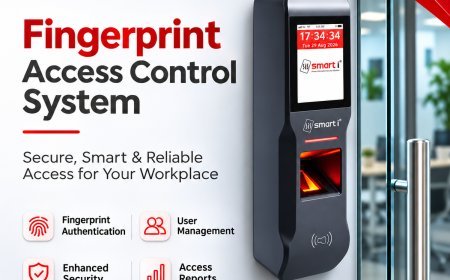








Fingerprint Access Control System: A Smarter Way to Secure Your Business and Workplace
A fingerprint access control system offers a more convenient approach to workplace security by using an individual's unique fingerprint for identity verification.


Security is one of the most important responsibilities for any organisation. Whether you manage a corporate office, manufacturing facility, bank, pharmaceutical company, data centre, or commercial building, controlling who can enter your premises is essential. Traditional keys and access cards may offer basic protection, but they can also create challenges when keys are lost, cards are shared, or employee access permissions need to be changed.
A fingerprint access control system offers a more convenient approach to workplace security by using an individual's unique fingerprint for identity verification. Instead of depending entirely on physical keys or cards, employees can gain access through biometric authentication. This makes it easier for organisations to manage entry permissions, monitor access activities, and maintain better control over restricted areas.
Smart-i Systems provides biometric fingerprint devices designed for access management and attendance applications. Its range includes BIOtrak, BIOslim, and BIOplus, offering different features and configurations for organisations with varying security requirements.
From individual office entrances to multi-location business environments, choosing the right fingerprint access control system can help businesses establish a more organised and dependable security arrangement.
What Is a Fingerprint Access Control System?
A fingerprint access control system is a biometric security solution that identifies individuals by examining the unique patterns present in their fingerprints. It uses a fingerprint sensor to capture biometric information and compare it with an enrolled fingerprint template.
When an authorised employee places their finger on the scanner, the device verifies the identity against its registered records. If the authentication is successful and the person has the required access permission, the system allows the door to unlock.
If the fingerprint does not match an authorised record or the user does not have permission to enter, access can be denied.
A typical fingerprint access control system includes:
-
Fingerprint reader: Captures and reads fingerprint information.
-
Access controller: Processes authentication and access permissions.
-
Electric door lock: Controls the physical opening and closing of the door.
-
Access management software: Helps administrators configure users and permissions.
-
Communication interface: Connects compatible devices with management systems.
-
Exit switch and door sensors: Support controlled exit and door-status monitoring.
Depending on the installation, these components can operate as a standalone arrangement or as part of a larger networked security infrastructure.
Why Businesses Are Choosing Biometric Fingerprint Access Control
Modern workplaces need security arrangements that are practical for employees and manageable for administrators. A biometric fingerprint access control system addresses several common problems associated with traditional entry methods.
1. Better Control Over Employee Entry
Physical keys can be duplicated, while access cards may be borrowed or shared. Fingerprint authentication connects entry permissions with an enrolled biometric identity.
This allows organisations to manage access according to individual employees rather than relying entirely on transferable credentials.
2. Reduced Dependence on Physical Cards
Employees do not need to carry a separate access card every time they enter the workplace when fingerprint authentication is used.
This can be particularly convenient in busy environments where employees regularly move between departments or controlled areas.
3. Individual Access Permissions
Not every employee should have access to every area of a building. Server rooms, laboratories, administrative offices, financial departments, and restricted storage areas may require different permission levels.
A properly configured access control system helps administrators assign permissions according to employee roles and organisational requirements.
4. Improved Access Monitoring
Recording entry events helps organisations understand when authorised users access controlled areas.
Depending on the device and connected software, administrators can review access transactions and use the information for security monitoring and internal reporting.
5. Convenient Workplace Management
Managing employee access becomes easier when biometric devices are connected to centralised access management software.
Administrators can manage enrolled users, review permissions, and handle access-related changes through the configured system.
Important Features of a Fingerprint Access Control System
Before selecting a biometric device, businesses should understand the features that influence everyday performance, security, and installation requirements.
Advanced Fingerprint Recognition
The fingerprint sensor is one of the most important components of any biometric access device. It captures fingerprint information and supports identity verification.
Smart-i Systems offers fingerprint-based terminals with optical fingerprint sensor technology. Its BIOSlim and BIOplus devices include a rugged optical sensor with an automatic template update facility designed to reduce the need for repeated fingerprint registration over time.
A suitable fingerprint access control system should provide reliable recognition while being practical for regular workplace use.
Fingerprint and RFID Card Authentication
Some organisations prefer having more than one authentication option. Combining fingerprint verification with RFID card technology provides additional flexibility.
Smart-i Systems' BIOslim and BIOplus terminals support fingerprint and card-based authentication. Multiple RFID technology options are available across the relevant device configurations.
This allows organisations to select authentication arrangements according to their security policies and existing infrastructure.
Multiple Communication Options
Connectivity is important when access devices need to communicate with centralised software or other security systems.
Depending on the model and configuration, Smart-i fingerprint devices support communication options such as TCP/IP, Wi-Fi, GPRS, and other available interfaces.
A network-connected fingerprint access control system can help organisations manage access information across different locations, subject to the installed hardware and software configuration.
Centralised Access Management
Organisations with several doors or branches need a convenient way to manage access permissions.
Smart-i provides centralised access management capabilities through its integrated hardware and software solutions. Depending on the selected configuration, businesses can manage multiple locations, access policies, and relevant security information through a common management environment.
CCTV Integration
Access control becomes more useful when it can work alongside other building security systems.
BIOslim and BIOplus offer CCTV integration capabilities. Depending on the installation, this can help organisations coordinate access-related monitoring with their existing surveillance infrastructure.
Businesses should confirm the required interfaces and compatibility before planning an integrated installation.
Power over Ethernet (PoE)
Power and communication arrangements can influence installation costs and infrastructure planning.
Certain Smart-i device configurations support Power over Ethernet, allowing compatible network infrastructure to provide both power and data connectivity through a single Ethernet cable.
This can simplify cabling in suitable installations. Actual requirements depend on the selected model, PoE equipment, and connected door hardware.
Explore Smart-i Systems Fingerprint Devices
Different organisations have different access management requirements. Smart-i Systems offers three fingerprint-based product options worth considering.
BIOtrak – Standalone Biometric Fingerprint Terminal
BIOtrak is a fingerprint and card-based biometric terminal designed for access control and attendance applications.
Its compact design and standalone biometric functionality make it an option for organisations looking for a biometric terminal with practical access management capabilities.
Key features include:
-
Standalone biometric functionality.
-
Capacitive touch keypad.
-
32-bit processor.
-
Fingerprint and card-based terminal functionality.
A BIOtrak fingerprint access control system configuration can be considered for business environments that require individual authentication and controlled entry.
BIOslim – Fingerprint and Card-Based Access Management
BIOslim combines fingerprint authentication with RFID card-based access functionality.
Its sleek design makes it suitable for installations where appearance and device functionality both matter. The rugged optical sensor and automatic template update facility are designed to support convenient long-term usage.
Important features include:
-
Fingerprint and multiple RFID technologies.
-
Rugged optical fingerprint sensor.
-
Automatic template update facility.
-
CCTV integration.
-
Multiple communication options.
-
Wi-Fi and optional GPRS configurations.
-
PoE support in applicable configurations.
-
BIS and CE certifications as stated for the product.
BIOSlim can be considered by businesses looking for a fingerprint access control system that supports both attendance tracking and controlled entry.
BIOplus – Fingerprint Terminal for Multi-Location Management
BIOplus is designed for organisations that require fingerprint and card-based access management across multiple locations.
It features a 2.4-inch colour TFT display, capacitive touch keypad, and 32-bit high-speed processor. Its rugged optical fingerprint sensor includes an automatic template update facility.
The device supports multiple RFID technology options, with different configurations available for specific card requirements.
Key specifications include:
-
Up to 50,000 user records.
-
Up to 100,000 event records.
-
Up to 19,000 fingerprint templates.
-
TCP/IP connectivity.
-
Optional Wi-Fi and GPRS configurations.
-
PoE availability in applicable models.
-
CCTV integration.
-
Multiple card reader configurations.
BIOplus can be suitable for businesses looking for a fingerprint access control system with greater user capacity and multi-location management capabilities.
The final device selection should be based on the number of users, doors, communication requirements, and access policies.
Industries That Benefit from Fingerprint Access Control
Biometric security is useful across different industries because each organisation needs to protect its people, equipment, information, and physical infrastructure.
Corporate Offices
Corporate offices often have different departments with different security requirements. General employees, management teams, visitors, and IT administrators may require separate access permissions.
A fingerprint access control system helps businesses manage authorised entry and monitor access to restricted office areas.
Banking and Financial Institutions
Banks and financial organisations handle confidential information, valuable assets, and sensitive records. Restricted areas may require additional identity verification.
Biometric access management can help control entry to selected rooms, administrative areas, and other protected spaces.
Manufacturing Facilities
Manufacturing units may have production areas, warehouses, laboratories, and equipment rooms that require controlled access.
Fingerprint devices can help businesses manage employee entry permissions and support a more structured security process across different departments.
Pharmaceutical Companies
Pharmaceutical facilities often handle sensitive research, regulated processes, and valuable materials.
A suitable biometric access control arrangement can help restrict entry to authorised personnel and support internal security procedures.
Data Centres and Server Rooms
Data centres contain important IT infrastructure and business information. Unauthorised entry into server rooms can create serious operational and security risks.
A fingerprint access control system can help restrict entry to approved personnel and provide an additional layer of physical security.
How to Choose the Right Fingerprint Access Control System
Selecting the right biometric device requires more than comparing prices or technical specifications. Businesses should consider their actual security requirements before making a decision.
Identify the number of users: Check how many employees, contractors, and authorised visitors may need access. Select a device with sufficient user and fingerprint template capacity.
Consider the number of doors: A single-door installation may require a different arrangement from a building with several controlled entry points.
Review authentication options: Decide whether fingerprint-only authentication is sufficient or whether RFID cards and additional authentication methods are required.
Check connectivity: Consider whether the installation needs TCP/IP, Wi-Fi, GPRS, PoE, or integration with existing network infrastructure.
Evaluate software compatibility: Confirm that the fingerprint device works with the access management software and other systems your organisation uses.
Consider future expansion: If your organisation plans to add branches or restricted areas, choose a solution that can accommodate future requirements.
Review security and maintenance: Ask about administrator permissions, biometric data protection, backup arrangements, device maintenance, and technical support.
Taking these factors into account helps businesses choose a fingerprint access control system that fits their security objectives and daily operations.
Why Consider Smart-i Systems for Fingerprint Access Control?
Smart-i Systems develops biometric and electronic security solutions for different business environments.
Its fingerprint device range includes BIOtrak, BIOslim, and BIOplus, each offering different capabilities for fingerprint authentication, card-based access, and attendance applications.
The company also provides access management solutions, door controllers, and supporting security products. This broader product range can be useful for organisations planning a connected security infrastructure rather than installing individual devices without considering the complete system.
From standalone biometric terminals to multi-location access management arrangements, Smart-i offers configurations that businesses can evaluate according to their requirements.
When choosing a fingerprint access control system, organisations should review the available specifications, confirm device compatibility, and discuss their installation requirements with the Smart-i team.
Frequently Asked Questions
1. What is a fingerprint access control system?
A fingerprint access control system is a biometric security solution that verifies an individual's identity using fingerprint information. It allows authorised users to enter controlled areas after successful authentication and permission verification.
2. Is a fingerprint access control system suitable for offices?
Yes. It can be used in corporate offices, IT departments, server rooms, administrative areas, and other restricted spaces. The system helps businesses manage employee access and monitor entry transactions.
3. Can fingerprint access devices support RFID cards?
Yes. Certain biometric terminals support both fingerprint and RFID card authentication. Smart-i's BIOtrak, BIOSlim, and BIOplus product range includes fingerprint and card-based device options, with available configurations varying by model.
4. What is the difference between BIOtrak, BIOslim, and BIOplus?
BIOtrak offers standalone biometric functionality with a capacitive touch keypad and 32-bit processor. BIOslim combines fingerprint and RFID card authentication with multiple communication options. BIOplus is designed for multi-location access management and offers higher user and event capacities.
5. Can a fingerprint access control system integrate with CCTV?
Certain fingerprint access devices support CCTV integration. Smart-i's BIOSlim and BIOplus include this capability. The integration method and available functions depend on the selected equipment and installation configuration.
Conclusion
Protecting a workplace requires more than installing a lock on the entrance. Businesses need a reliable way to identify authorised individuals, manage entry permissions, and maintain better control over restricted areas.
A fingerprint access control system provides a practical biometric approach to workplace security by using fingerprint authentication instead of relying entirely on traditional keys or access cards.
Smart-i Systems offers fingerprint-based solutions through its BIOtrak, BIOSlim, and BIOplus devices. With features such as fingerprint recognition, RFID compatibility, multiple communication options, and centralised access management capabilities, these products provide different options for organisations with varying security requirements.
Whether you manage a corporate office, manufacturing facility, bank, pharmaceutical company, or data centre, evaluating the right biometric access solution can help strengthen your physical security arrangements.
Choose a system based on your user capacity, access requirements, infrastructure, and future expansion plans. A properly selected and configured fingerprint access control system can become an important part of a well-managed workplace security environment.
What's Your Reaction?
 Like
0
 Dislike
0
 Love
0
 Funny
0
 Angry
0
 Sad
0
 Wow
0