




















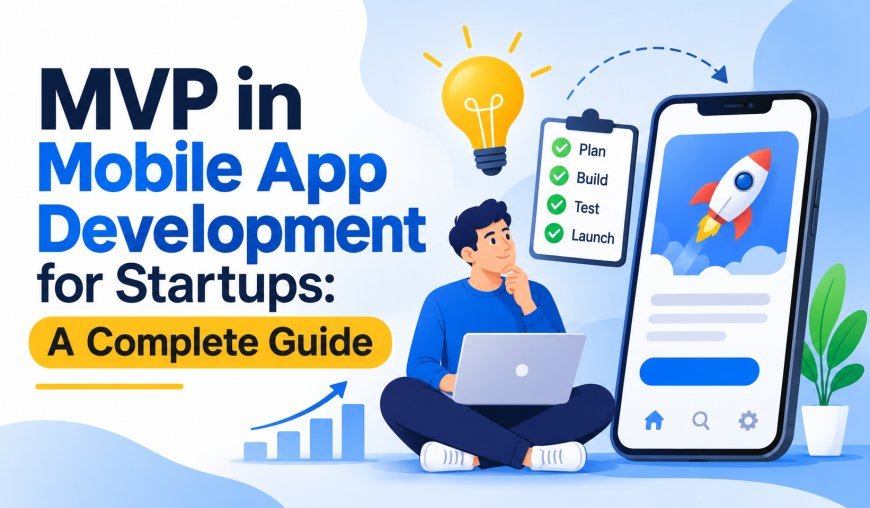
MVP in Mobile App Development for Startups: A Complete Guide
Starting a mobile app business requires more than an interesting idea. Startups need to understand their target audience, identify market demand, and develop a product that solves a genuine problem. However, investing heavily in a fully featured application without testing the concept can create unnecessary financial risks. This is where a Minimum Viable Product (MVP) becomes valuable.
An MVP allows startups to introduce an application with only its most important features. Instead of spending months building a complete product, businesses can launch a basic version, collect user feedback, and understand how people interact with it.
MVP in Mobile App Development is a practical approach for startups that want to validate their ideas, manage development costs, and make informed decisions before expanding their applications. This guide explains how MVP development works, its benefits, essential features, and the steps involved in building one.
What Is an MVP in Mobile App Development?
A Minimum Viable Product is an early version of a mobile application that includes only the core functionality needed to address a specific user problem. It is not an incomplete or poorly designed application. Instead, it focuses on delivering the most important value without adding unnecessary features.
For example, a startup planning to launch a food delivery application does not need to build every possible feature at the beginning. Its initial version could include user registration, restaurant listings, menu browsing, order placement, and basic payment functionality.
Once the application reaches real users, the startup can evaluate customer responses and decide which features deserve further investment.
The main objective is simple: build, launch, learn, and improve.
Why Do Startups Need an MVP?
Startups often operate with limited budgets, small teams, and uncertain market demand. Developing a complete mobile application without testing its concept can consume valuable resources.
An MVP provides an opportunity to test the idea before making a larger investment.
Here are some important reasons why startups should consider this approach.
1. Reduce Initial Development Costs
Building an application with dozens of features requires additional development hours, design resources, testing, and maintenance. An MVP keeps the initial scope smaller by prioritising essential functionality.
This allows startups to use their available budget more effectively. They can invest in additional capabilities after understanding what customers actually need.
2. Validate Your Business Idea
Not every mobile application idea becomes successful. Market research can provide useful information, but actual user behaviour offers stronger evidence.
Launching an MVP helps startups understand whether people are interested in the product, which problems they want to solve, and whether they are willing to use the application regularly.
This information can help businesses make better product decisions.
3. Launch the Application Faster
A traditional development project may take several months before reaching the market. An MVP can shorten the initial development cycle because the team concentrates on a smaller set of requirements.
Early market entry also allows startups to understand competitors, observe industry trends, and build an initial customer base.
4. Collect Real User Feedback
Customer feedback is essential during the early stages of product development. Users may discover problems or suggest improvements that were not considered during planning.
Startups can use this feedback to improve navigation, simplify important processes, and introduce features that offer genuine value.
5. Attract Investors and Business Partners
An MVP can help startups demonstrate that their idea has moved beyond the planning stage. A working application, early user engagement, and meaningful performance data can make business discussions more practical.
Although an MVP does not guarantee investment, it provides evidence that a startup is testing its concept in the real market.
Essential Features to Include in a Startup MVP
One of the biggest challenges in MVP development is deciding which features should be included in the first version.
Startups should avoid adding functionality simply because competitors offer it. Instead, every feature should support the application's main purpose.
Some commonly required features include:
|
Feature |
Purpose |
|
User Registration |
Allows customers to create accounts and access the application |
|
User Profile |
Stores basic customer information and preferences |
|
Main Dashboard |
Provides access to the application's primary functions |
|
Search and Navigation |
Helps users find relevant information quickly |
|
Core Functionality |
Delivers the main solution promised by the product |
|
Notifications |
Communicates important updates to users |
|
Payment Integration |
Supports transactions when required by the business model |
|
Analytics |
Helps startups understand user behaviour and engagement |
The exact feature list depends on the application category. A fitness application, for example, may require activity tracking, while an eCommerce application may need product listings and checkout functionality.
Step-by-Step Process to Build an MVP Mobile App
Developing an MVP requires a clear strategy. Startups should understand their customers, define the product scope, and establish measurable goals before beginning development.
Step 1: Identify the Problem You Want to Solve
Every successful application should address a specific user requirement. Start by identifying the problem your target audience experiences and understanding how your proposed application can solve it.
Conduct competitor research, interview potential customers, and study existing solutions. This process helps you identify opportunities where your product can offer something useful.
Step 2: Define Your Target Audience
A mobile application cannot serve everyone equally well, especially during its early development stage.
Identify the people most likely to use your product. Consider their age group, interests, location, spending habits, and technology preferences.
Creating user personas can help the development team understand customer expectations and design a more relevant experience.
Step 3: Prioritise the Core Features
Prepare a list of all the features you want in the application. Then divide them into three categories:
-
Must-have: Features required for the application to work.
-
Should-have: Useful improvements that can be introduced later.
-
Could-have: Additional functionality that is not essential for the first release.
This approach prevents unnecessary development work and keeps the project focused.
Step 4: Select the Right Technology
Technology selection influences application performance, development costs, scalability, and maintenance.
Startups can choose between native and cross-platform development depending on their requirements.
-
Native development: Uses technologies such as Swift for iOS and Kotlin for Android. It is suitable for applications requiring platform-specific functionality and performance.
-
Cross-platform development: Uses frameworks such as Flutter and React Native to build applications for multiple platforms with shared code.
The right choice depends on the product's complexity, budget, expected user base, and long-term plans.
Step 5: Design an Easy-to-Use Interface
An MVP should not compromise on usability. Even when the application has limited features, users should be able to understand its interface without confusion.
Create wireframes and prototypes before starting development. Pay attention to navigation, screen layouts, accessibility, and the overall user journey.
A simple interface can make it easier for early customers to understand the application's primary value.
Step 6: Develop and Test the Application
Once the requirements and designs are finalised, developers can begin building the application.
The development process should include frontend implementation, backend development, database configuration, and necessary third-party integrations.
Testing is equally important. Check application performance, navigation, security, compatibility, and critical user flows before releasing the MVP.
Step 7: Launch, Measure, and Improve
After testing, release the application to a selected group of users or through the relevant app stores.
Monitor important performance indicators, including:
-
Number of downloads and registrations
-
Daily and monthly active users
-
User retention rate
-
Session duration
-
Feature engagement
-
Customer feedback
-
Conversion rate
Use these insights to identify weaknesses and decide which improvements to include in the next development cycle.
How to Choose the Right Mobile App Development Company for Your MVP
Choosing the right development partner can influence the quality and direction of your startup's first application.
Many startups work with experienced Mobile App Development companies because they need professional support with planning, design, development, and testing.
However, choosing a development partner takes more than comparing project quotes.
Consider the following factors:
1. Experience with MVP Projects: Look for a team that understands how to develop products with limited features and clearly defined objectives.
2. Technical Expertise: Evaluate its experience with Android, iOS, Flutter, React Native, backend technologies, and third-party integrations.
3. Portfolio and Previous Work: Review completed projects to understand the company's development capabilities and design standards.
4. Communication and Project Management: Choose a team that provides regular updates, discusses challenges, and maintains clear communication throughout the project.
5. Scalability and Future Support: Your MVP should have a development structure that supports future improvements without requiring a complete rebuild.
A reliable Mobile App Development company should also help you identify unnecessary features, estimate development requirements, and establish a realistic launch strategy.
Common Mistakes Startups Should Avoid During MVP Development
Even with a clear development strategy, startups can make mistakes that affect their product's success.
Some common issues include:
-
Adding Too Many Features: An MVP should focus on solving one primary problem rather than offering every possible functionality.
-
Ignoring User Research: Developing without understanding customer requirements can result in a product with limited market demand.
-
Compromising on Quality: A smaller application still needs proper security, testing, and reliable performance.
-
Choosing Technology Without Planning: Selecting a framework only because it is inexpensive may create technical challenges later.
-
Ignoring Feedback: User suggestions and behaviour should influence future product improvements.
-
Skipping Post-Launch Support: Regular updates and maintenance are necessary to keep the application functional and relevant.
Avoiding these mistakes helps startups maintain a practical development process and use their resources more efficiently.
Conclusion
Building a Minimum Viable Product is a practical way for startups to turn an application idea into a working product without committing their entire budget to a full-scale solution. It helps businesses understand market demand, collect customer feedback, and identify the features that matter most to their audience.
A successful MVP in Mobile App Development requires a clear understanding of user problems, careful feature selection, suitable technology, and continuous product improvement. By working with an experienced development partner and following a structured approach, startups can build a strong foundation for their mobile application and expand it as their business grows.
What's Your Reaction?
 Like
0
 Dislike
0
 Love
0
 Funny
0
 Angry
0
 Sad
0
 Wow
0