

























Understanding Rubber Molded Products: Types, Benefits, and Uses
Explore the types, benefits, and uses of rubber molded products across industries. Learn how molding processes and materials shape durable, flexible components.

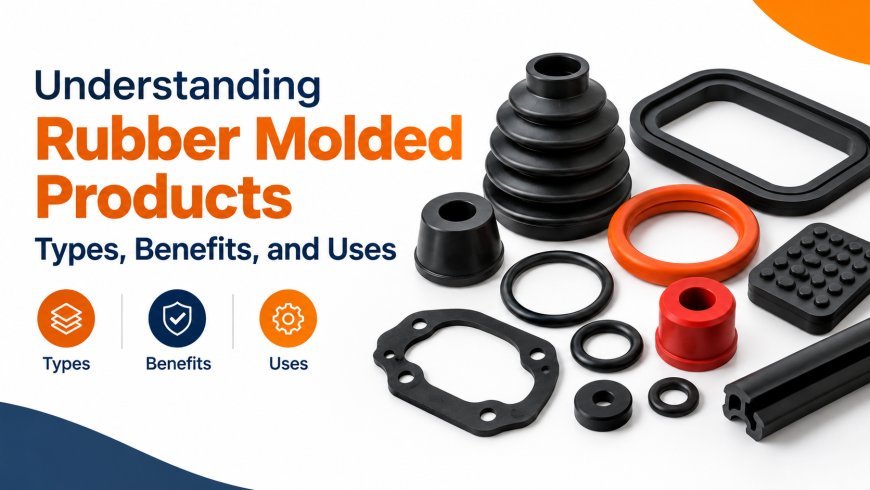
The rubber molding transforms raw rubber stock into usable functional parts for hundreds of industrial uses. It supports core operations across automotive, medical, construction, and global electronics sectors. Natural and synthetic rubber offers unmatched flexibility, durability, and environmental resistance for most use cases.
The standard process uses controlled heat, pressure, and custom molds to form consistent final part shapes. Rubber molded products deliver consistent performance that outperforms many alternative material options across most use cases.
What Are Rubber Molded Products?
Parts are formed through controlled shaping of raw rubber inserted into precision-machined mold cavities. Common part types include seals, gaskets, grommets, O-rings, and load-bearing support bushings. All parts cure through consistent application of heat and pressure inside the closed mold assembly.
The formulations use either natural base rubber or synthetic compounds tailored to specific operating conditions. Rubber molded products include dozens of part types that appear in every industrial and consumer device.
● Static sealing parts that create a barrier between two stationary mating surfaces
● Dynamic parts that move or flex during regular operation of the host assembly
● Isolation parts that separate different components to reduce vibration transfer
● Protection parts that shield sensitive components from external damage or contamination
Common Types of Rubber Molding Processes
Each molding process matches specific part complexity, volume, and tolerance requirements for different use cases.
Selection depends on total run size, part geometry, insert requirements, and allowed production lead time. Process selection forms one of the most impactful early decisions for overall project cost and timeline.
● Compression molding works best for simple, high-volume parts with wide tolerance ranges
● Injection molding delivers the highest precision for complex, detailed shapes with tight dimensional controls
● Transfer molding supports intricate designs that require embedded metal or plastic inserts
Many projects use a custom rubber mold built to support one specific part design across the full production run. Compression molding carries the lowest upfront tooling cost for runs above 1000 identical units.
Transfer molding is between the two on cost, and works for low to medium runs of complex parts. The custom rubber mold supports consistent part output that stays within tight tolerance limits for every production cycle. The tooling lifespan also varies between processes based on material selection and regular operating conditions.
What Materials Are Used in Rubber Molding?
Different rubber compound formulations deliver distinct performance traits that match specific operating environments. Rubber component manufacturing relies on consistent material sourcing to maintain batch-to-batch output consistency. Material selection forms the single most important decision for long-term part performance and service life.
● Natural rubber offers maximum tensile strength and rebound elasticity for dynamic load parts
● Silicone rubber delivers unmatched heat resistance for continuous high-temperature operating conditions
● EPDM provides excellent weather and ozone resistance for outdoor exposed component uses
● Nitrile rubber maintains stable performance in constant contact with oil- and fuel-based substances
● Neoprene offers strong chemical resistance for parts exposed to harsh cleaning agents and industrial fluids
Each compound can be blended with additives to adjust hardness, color, and wear resistance for specific use cases. Proper formulation selection extends average part service life. Rubber component manufacturing follows strict quality controls to eliminate material variation between individual production runs. All raw material batches go through initial testing before they enter the production workflow.
Why Choose Rubber Over Metal or Plastic?
Rubber offers unique performance traits that neither metal nor plastic can match for a wide range of industrial uses. It flexes repeatedly under load without permanent deformation or structural failure.
It maintains consistent performance when exposed to water, most common chemicals, and extreme temperature swings. It also provides natural noise and vibration dampening that reduces wear on connected adjacent components.
It weighs less than equivalent metal parts, which cuts total assembly weight for mobile applications. It maintains stable performance for thousands of operating cycles even under continuous harsh operating conditions.
It does not crack or become brittle under temperature fluctuations that cause plastic to fail prematurely. It also requires no surface treatment or coating to resist corrosion from common environmental exposures.
|
Use condition |
What to check |
Common option to consider |
|
Oil or fuel contact |
Resistance to the exact fluid |
Nitrile rubber |
|
Outdoor exposure |
Resistance to sun, ozone, and weather |
EPDM or neoprene |
|
High or low temperatures |
The part’s full temperature range |
Silicone or a suitable rated compound |
|
Frequent stretching |
Elasticity and flex life |
Natural rubber or a purpose-made compound |
|
Chemical contact |
Chemical type and concentration |
A compound confirmed for that chemical |
Top Benefits of Rubber Molded Products
Parts deliver high inherent resistance to abrasive wear and tear from constant movement and contact. They create a tight, reliable seal between mating surfaces to block the transfer of gas, fluid, or dust.
They can be formed into highly complex shapes without secondary machining or post-processing. Rubber molded products deliver a unique combination of traits. They retain all core performance traits for the full service life of the assembly.
They absorb sudden impact and shock to protect sensitive adjacent equipment from incidental damage. They work reliably across every existing industry sector with very few formulation adjustments.
Many operators turn to custom rubber molding to create parts that match exact unique design requirements not available off the shelf. Parts require minimal ongoing maintenance and no coating or surface treatment after production is complete.
The custom rubber molding allows design teams full control over every dimension and performance trait of the final part. It also reduces total assembly count by combining multiple separate components into one single molded part.
Common Applications of Rubber Molded Components
Molded rubber components appear in almost every type of industrial and commercial equipment in active use today. The projects with non-standard requirements use custom molded rubber parts that do not have equivalent alternatives. Each part serves a specific function that supports consistent, safe operation of the full assembly.
● Seals and gaskets for industrial machinery housing to block dust and fluid ingress
● Grommets for cable and wire protection to prevent abrasion from sharp panel edges
● O-rings for fluid and gas transfer systems to create a leak-tight connection between parts
● Bushings for vibration control to isolate moving components from fixed frame structures
● Mats and pads for industrial flooring to reduce worker fatigue and slip risk in work areas
Additional less common uses include bumpers, valve diaphragms, handle grips, and vibration isolation feet. Every application relies on one or more core rubber performance traits to function.
These parts match exact dimensional requirements that cannot be met with generic components. Custom molded rubber parts fit into existing assembly designs without modification.
Who Provides Reliable Rubber Molded Solutions?
Krishani Development maintains decades of experience delivering solutions across a wide range of industry sectors. It has full in-house capability to handle even the most complex custom design projects from initial concept to final production.
It offers access to a full library of rubber compounds tailored to every common operating environment and use case. It provides full end-to-end support from initial design review through to final production and batch testing.
Every output aligns with stated technical specifications and performance requirements provided by the project team. All batches go through structured quality control testing before shipment to confirm consistent performance across all units.
Design teams provide actionable feedback during early review to reduce total project cost and lead time. They also share guidance on material selection to match part design to its intended operating conditions.
Consistent quality control processes ensure every batch of rubber molded products meets all stated performance requirements before leaving the production facility. All test results are documented and shared with project teams upon request for full transparency.
Conclusion
Rubber molded products offer a unique combination of strength, flexibility, and long-term reliability for industrial use. A wide range of material and process options suit the unique needs of different industry sectors.
The right material and process selection ensures maximum long-term performance and minimum total part cost. Custom molding capabilities support even the most unique and specific project requirements for any application.
What's Your Reaction?
 Like
0
Like
0
 Dislike
0
Dislike
0
 Love
0
Love
0
 Funny
0
Funny
0
 Angry
0
Angry
0
 Sad
0
Sad
0
 Wow
0
Wow
0