























The Invisible Barriers to Business Growth: Why Inner Clarity Matters for Entrepreneurs

Entrepreneurship is often described as a journey of ambition, innovation, and determination. People start businesses because they want to solve problems, create opportunities, build something meaningful, or achieve greater independence. Yet, as a business grows, the challenges that entrepreneurs face can become increasingly complex.
A founder who once enjoyed making every decision may eventually feel overwhelmed by constant responsibilities. Someone with excellent professional skills may struggle to communicate their value to potential customers. Another entrepreneur may have several promising ideas but find it difficult to choose the right direction.
These situations reveal an important aspect of business growth: success is influenced not only by external opportunities but also by the way individuals think, make decisions, and respond to challenges.
Business strategy, marketing, financial planning, and operational efficiency remain essential. However, entrepreneurs also need clarity about their strengths, priorities, values, and long-term vision.
When these internal foundations are unclear, even a well-designed business strategy can become difficult to implement.
This is where personal development and business coaching can provide a valuable perspective. Through business coaching and personal growth guidance, entrepreneurs can explore the relationship between their mindset, professional ambitions, and the decisions that shape their business journey.
Why Business Growth Sometimes Feels More Difficult Than Expected
Many entrepreneurs begin their journey with excitement and a clear vision. They understand the problem they want to solve and are motivated to build a successful business.
However, the experience of running a business introduces situations that cannot always be anticipated.
Customer expectations change. Competitors introduce new offerings. Employees require guidance. Financial decisions become more complicated. The founder must balance immediate business needs with long-term goals.
As responsibilities increase, entrepreneurs may begin to experience a disconnect between what they want to achieve and how they spend their time.
A founder may spend most of the day responding to urgent matters while important strategic decisions remain unfinished.
Another may continuously compare their progress with competitors and lose confidence in their own business direction.
These challenges are not necessarily caused by a lack of knowledge or ability. Sometimes, they emerge because the entrepreneur has not developed a clear framework for making decisions and managing competing priorities.
Understanding this distinction is an important first step toward sustainable business development.
The Connection Between Self-Awareness and Better Business Decisions
Self-awareness is the ability to understand one's thoughts, emotions, strengths, limitations, and behavioral patterns.
For entrepreneurs, this capability can influence several aspects of business leadership.
A founder who understands their strengths may be better positioned to identify the responsibilities they should lead personally. Someone who recognizes their limitations may become more comfortable seeking expert advice or delegating tasks.
Self-awareness can also help entrepreneurs recognize when their decisions are being influenced by fear, frustration, or unnecessary comparison.
Recognizing Personal Strengths
Every entrepreneur brings a different combination of abilities to a business.
Some are excellent at building relationships. Others are strong in analytical thinking, product development, communication, or strategic planning.
Understanding these strengths can help founders identify where they can contribute the greatest value.
It can also help them make more informed decisions about hiring, partnerships, and professional development.
Understanding Limiting Patterns
Entrepreneurs may develop habits that influence their decisions without fully recognizing them.
For example, a founder who fears making mistakes may delay important decisions. Someone who feels responsible for every business activity may struggle to delegate.
A professional who constantly seeks external approval may find it difficult to establish a distinctive business identity.
Recognizing these patterns does not automatically solve every challenge, but it creates an opportunity to approach situations differently.
Through personal coaching and inner awareness development, individuals can explore their thought patterns and develop greater clarity about the choices they make.
Purpose: Understanding Why Your Business Matters
A business can generate revenue and still leave its founder feeling disconnected from the original reason for starting it.
This can happen when daily activities become focused entirely on targets, competition, and operational demands.
Purpose provides a broader perspective.
It helps entrepreneurs understand what they want their business to contribute, whom they want to serve, and what kind of professional life they want to create.
Purpose does not have to be expressed through a grand mission statement. It can be reflected in the everyday decisions a founder makes.
For example, an entrepreneur may want to build a business that provides meaningful employment opportunities. Another may want to make an important service accessible to more people. Someone else may value creativity, independence, or the opportunity to solve a particular problem.
Understanding these motivations can help entrepreneurs make decisions that feel more consistent with their personal values.
Connecting Purpose With Business Strategy
Purpose becomes more useful when it influences practical business decisions.
Consider a founder who values customer education. This purpose may influence the company's content strategy, customer support approach, and product communication.
A business owner who values simplicity may choose to develop a more focused product offering rather than continuously adding new features.
In this way, purpose can help establish a consistent direction for the business.
It also provides a useful reference point when entrepreneurs face competing opportunities.
Instead of asking only which opportunity offers the highest immediate return, they can consider which opportunity is more closely aligned with the business they want to build.
Personal Branding: Turning Professional Strengths Into a Recognizable Identity
In competitive markets, customers often have several options available to them.
A professional may possess excellent skills and experience, but potential clients may not understand what makes that person different from others in the same industry.
Personal branding helps communicate professional identity, expertise, values, and the specific problems an individual can solve.
It is not simply about maintaining a social media presence or publishing frequent content.
A strong personal brand begins with clarity.
Identifying Your Unique Value
Entrepreneurs and professionals should understand what they want to be known for.
This involves examining their experience, strengths, interests, and the needs of their target audience.
For example, a business consultant may have experience in several areas but decide to focus their communication on helping service-based businesses improve customer experience.
A coach may have broad professional knowledge but develop a clear identity around helping entrepreneurs communicate their expertise.
The objective is to make professional value easier for others to understand.
Communicating With Consistency
Once an individual has established a clear identity, communication becomes more effective.
Website content, professional profiles, presentations, articles, and social media posts should communicate a consistent message.
This does not mean publishing the same content repeatedly. It means ensuring that different forms of communication reflect the same professional values and expertise.
Individuals interested in personal branding and professional positioning can explore approaches that connect their identity with the way they communicate and build relationships.
Why Entrepreneurs Need to Develop Their Decision-Making Abilities
Entrepreneurs make decisions every day.
Some decisions are operational, such as responding to customer requests or adjusting schedules. Others influence the long-term direction of the business.
The challenge is that not every decision comes with complete information.
Founders may need to choose between competing opportunities, evaluate uncertain investments, or respond to unexpected changes.
A structured decision-making approach can help reduce unnecessary confusion.
Separate Facts From Assumptions
Business owners sometimes make decisions based on what they believe customers want rather than what customers have actually expressed.
For example, a founder may assume that customers are primarily interested in lower prices. However, customer feedback may reveal that convenience, reliability, or personalized service is more important.
Examining evidence can help entrepreneurs avoid making unnecessary changes.
Understand the Cost of Delayed Decisions
Not making a decision can also have consequences.
A founder may postpone hiring because they are uncertain about the cost. However, the delay may increase pressure on the existing team and reduce the time available for strategic work.
Recognizing the cost of inaction can help entrepreneurs evaluate decisions more realistically.
Establish Clear Priorities
Entrepreneurs often have more ideas than time.
Prioritization helps them identify which activities deserve attention and which can be postponed.
A useful question is whether a particular activity contributes meaningfully to the business's most important objective.
This can help founders focus on fewer activities while improving the quality of their execution.
The Role of Emotional Intelligence in Business Leadership
Business leadership involves working with people who have different expectations, communication styles, and motivations.
Employees may experience uncertainty during organizational changes. Customers may express dissatisfaction. Business partners may disagree about priorities.
Emotional intelligence helps individuals understand their own emotional responses and recognize the perspectives of others.
It can support more effective communication, relationship management, and conflict resolution.
Listening Beyond the Words
Effective communication requires more than explaining ideas clearly.
It also requires listening carefully to understand what other people are communicating.
An employee who appears resistant to a new process may be concerned about additional responsibilities. A customer who repeatedly asks questions may need greater clarity before making a purchase.
Understanding the underlying concern can help leaders respond more appropriately.
Responding Instead of Reacting
Difficult situations can create emotional pressure.
An entrepreneur may feel frustrated when a project is delayed or when a customer expresses dissatisfaction.
Emotional awareness can help individuals pause, evaluate the situation, and choose a response that supports a constructive outcome.
Developing these capabilities can contribute to healthier professional relationships and more thoughtful leadership.
Finding Balance Between Ambition and Personal Well-Being
Entrepreneurship often requires significant commitment.
Founders may work long hours, manage financial uncertainty, and take responsibility for decisions that affect employees and customers.
Ambition can be a powerful source of motivation, but it can also become difficult to manage when personal well-being is consistently ignored.
Sustainable business development requires an understanding of personal capacity.
This involves recognizing the difference between productive effort and unnecessary exhaustion.
Creating Boundaries Around Work
Entrepreneurs may feel that every business problem requires their immediate attention.
However, constant availability can reduce the time available for reflection, planning, and personal activities.
Establishing boundaries can help individuals create a more balanced approach to professional responsibilities.
Making Space for Reflection
Reflection provides an opportunity to review decisions, understand experiences, and identify areas for improvement.
A short period of reflection can help entrepreneurs examine what is working, what requires adjustment, and what they should prioritize next.
This practice can also help individuals recognize progress that might otherwise go unnoticed.
Understanding Success Beyond Revenue
Revenue and profitability are important business measures, but they are not the only indicators of success.
Entrepreneurs may also value meaningful work, strong relationships, personal development, creativity, and the freedom to make their own decisions.
Understanding these broader priorities can help founders build businesses that support the professional and personal lives they want to create.
How Coaching Can Support Entrepreneurial Development
Coaching provides a structured opportunity for individuals to examine challenges, clarify goals, and explore different approaches to personal and professional development.
Rather than focusing only on business performance, coaching may also consider the thought patterns, priorities, and decisions that influence an individual's progress.
A coaching conversation can help entrepreneurs examine questions such as:
-
What is the most important challenge I need to address?
-
Which decisions am I avoiding?
-
What strengths can I use more effectively?
-
What does meaningful business growth look like for me?
-
Which activities are taking time away from my priorities?
-
What changes would make my professional life more sustainable?
These questions can encourage greater self-awareness and help individuals approach business challenges with a clearer perspective.
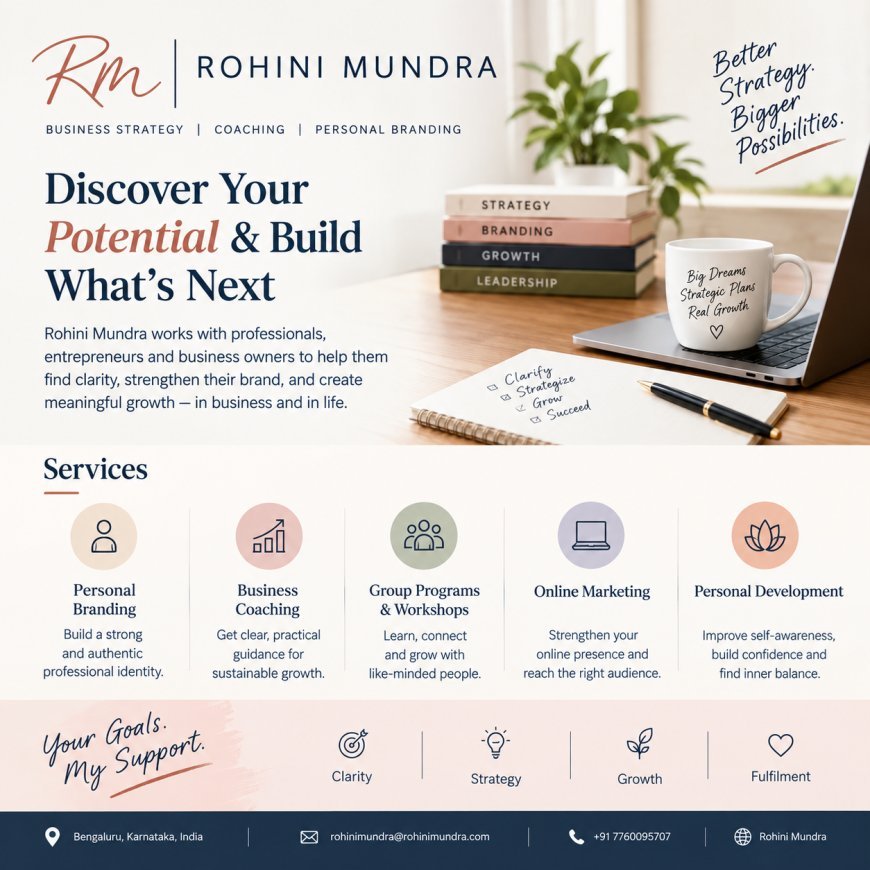
Rohini Mundra's work brings together business strategy, personal development, and coaching. Her private coaching and business development guidance offers an opportunity for individuals to explore personal clarity alongside professional goals.
For entrepreneurs who prefer collaborative learning, group programs and workshops can also provide opportunities to examine ideas, develop communication skills, and learn from different perspectives.
From Ideas to Action: Creating a Practical Development Plan
Personal development becomes more meaningful when insights lead to action.
Entrepreneurs can create a simple development plan by identifying one area they want to improve and defining practical steps to address it.
For example, someone who struggles with prioritization may begin by identifying three important business objectives for the coming month.
A founder who wants to improve communication may practice explaining their business value in a clearer and more concise way.
An entrepreneur who feels disconnected from their original purpose may review the reasons they started their business and evaluate whether current activities still support those motivations.
A practical development plan can include the following elements:
A clear objective: Define the specific improvement you want to achieve.
An honest assessment: Understand the current situation and identify the main challenge.
A realistic action: Choose a step that can be implemented without unnecessary complexity.
A review process: Evaluate progress and identify what needs to change.
A commitment to learning: Use the experience to improve future decisions.
This approach encourages individuals to treat personal and professional development as an ongoing process rather than a one-time activity.
Conclusion
Business growth is influenced by more than market opportunities, financial resources, or operational strategy. The mindset, clarity, and decision-making abilities of entrepreneurs also play an important role.
Understanding personal strengths can help individuals use their abilities more effectively. Developing a clear purpose can provide direction during uncertain situations. Emotional intelligence can improve professional relationships, while thoughtful prioritization can help entrepreneurs focus on meaningful business objectives.
These capabilities do not replace practical business knowledge. Instead, they complement it by helping individuals approach business challenges with greater awareness and confidence.
For entrepreneurs and professionals seeking to understand the connection between personal growth and business development, coaching can provide a valuable opportunity for reflection and structured learning.
Through Rohini Mundra's coaching and business development approach, individuals can explore ways to connect their purpose, professional strengths, and business ambitions.
Ultimately, sustainable success is not only about building a business that performs well. It is also about developing the clarity to understand what matters, the confidence to make thoughtful decisions, and the ability to create a professional journey that reflects one's values and aspirations.
What's Your Reaction?
 Like
0
 Dislike
0
 Love
0
 Funny
0
 Angry
0
 Sad
0
 Wow
0