
























U.S. Recycled Carbon Fiber Market: Size, Growth, Trends, Segmentation, and Forecast to 2034
U.S. Recycled Carbon Fiber Market Segment: By End Use (Aerospace & Defense, Automotive, Sporting Goods, Wind Energy, Marine & Construction), By Fiber Type (Chopped Carbon Fiber, Milled Carbon Fiber, Non-Woven Mats / Felts, Continuous Recycled Yarn / Fabric), By Source of Scra

What is Covered Under U.S. Recycled Carbon Fiber Market
The U.S. Recycled Carbon Fiber Market covers recycled carbon fiber recovered from manufacturing scrap and end-of-life composite structures for applications across aerospace and defense, automotive, sporting goods, wind energy, marine, and construction. The market is segmented by end use, fiber type, scrap source, and U.S. regional demand.
What is the U.S. Recycled Carbon Fiber Market Size, and Growth Rate
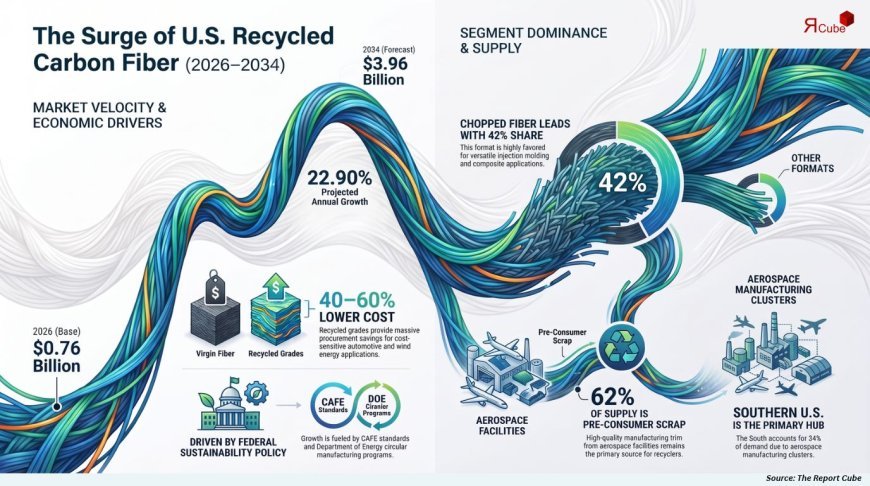
The U.S. Recycled Carbon Fiber Market was valued at USD 0.76 billion in 2026 and is projected to reach USD 3.96 billion by 2034, registering a 22.90% CAGR during 2026–2034. Growth is supported by increasing composite scrap availability, expanding pyrolysis processing capacity, sustainability-driven procurement, and rising adoption across aerospace, automotive, wind energy, and industrial composite applications. Lightweighting requirements and circular manufacturing initiatives are also encouraging manufacturers to substitute recycled fiber for virgin carbon fiber in selected applications. The market’s expansion reflects stronger domestic processing infrastructure and growing interest in closed-loop composite supply chains.
Get a Free Sample Report - https://www.thereportcubes.com/request-sample/recycled-carbon-fiber-market-us
How is the U.S. Recycled Carbon Fiber Market Segment
By Fiber Type
• Chopped Carbon Fiber – 42%
• Milled Carbon Fiber – 28%
• Non-Woven Mats / Felts – 20%
• Continuous Recycled Yarn / Fabric – 10%
Chopped carbon fiber represents the largest fiber-type category, accounting for approximately 42% of 2026 market volume. Its adoption is supported by versatility in injection molding and composite applications, particularly automotive components, sports equipment housings, and industrial tooling. Milled carbon fiber holds around 28% and serves thermoplastic compounders and friction-material manufacturers. Non-woven mats and felts account for about 20%, while continuous recycled yarn and fabric represent approximately 10%, primarily serving niche performance textile and advanced composite applications. The distribution highlights strong demand for formats compatible with established industrial composite manufacturing processes.
By Source of Scrap
• Pre-Consumer – 62%
• Post-Consumer – 38%
Pre-consumer scrap accounts for approximately 62% of 2026 market volume, making it the dominant source category. Manufacturing trim, cut-offs, and out-of-specification materials from aerospace and industrial composite facilities provide relatively consistent fiber inputs and established processing logistics. Post-consumer sources represent approximately 38%. Their importance is increasing as decommissioned wind turbine blades and retired composite structures enter recovery streams. The growing availability of end-of-life composite materials is expected to broaden feedstock availability and support continued investment in recycling infrastructure.
U.S. Recycled Carbon Fiber Market Dynamics
• Growth Drivers: Lightweighting requirements in automotive and aerospace applications are accelerating recycled fiber adoption in structural and semi-structural components. Increasing composite manufacturing scrap is also creating a dependable pre-consumer feedstock base.
• Sustainability Trends: Circular economy frameworks, clean manufacturing incentives, and sustainability procurement objectives are encouraging manufacturers to establish recycled-content strategies and closed-loop supply chains.
• Technology Trends: Pyrolysis remains the dominant commercial recycling technology. Solvolysis and supercritical-fluid processes are progressing toward commercial applications, with the potential to improve fiber surface chemistry and resin compatibility.
• Cost Opportunity: Recycled carbon fiber can command a 40–60% cost discount compared with virgin equivalents, creating procurement opportunities in cost-sensitive automotive and wind energy applications.
• Market Restraint: Variability in tensile strength and fiber length, particularly in some post-consumer grades, can limit adoption in highly demanding structural applications.
• Industry Challenge: Scaling post-consumer collection requires coordinated logistics, deconstruction capabilities, and standardized quality classification systems. The absence of a nationally unified composite-waste collection framework can increase processing complexity.
Regional Projection of U.S. Recycled Carbon Fiber Market
South
• 34% share; supported by aerospace manufacturing clusters and wind-energy decommissioning activity.
West
• 28% share; driven by aerospace, electric-vehicle, commercial-space, and clean-technology manufacturing.
Midwest
• 22% share; supported by automotive production, wind-turbine activity, and industrial composite demand.
Northeast
• 16% share; supported by defense, marine composites, advanced manufacturing, and research commercialization.
who are the major players in the U.S. Recycled Carbon Fiber Market
The competitive landscape includes Vartega Inc., Carbon Fiber Remanufacturing, and Hexcel Corporation, alongside other emerging processors and specialty suppliers. Vartega focuses on recycled fiber recovery and OEM supply partnerships, while Carbon Fiber Remanufacturing provides multi-format processing across pre-consumer and post-consumer feedstocks. Hexcel strengthens the supply chain through its integrated composite-material capabilities and advanced fiber formats. Competition centers on fiber-quality consistency, processing throughput, format versatility, and OEM relationships.
U.S. Recycled Carbon Fiber Market Future Outlook (2034)
The market is projected to reach USD 3.96 billion by 2034, advancing at a 22.90% CAGR from 2026 to 2034. Future expansion is expected to be supported by increasing composite scrap volumes, wind-blade decommissioning, OEM circular procurement programs, and expanded domestic processing capacity. Pyrolysis is expected to remain important, while solvolysis and other advanced recycling technologies may expand the range of applications using recovered fiber. Aerospace, automotive, and wind energy are positioned as important demand channels as sustainability requirements and circular supply-chain strategies become increasingly integrated into material procurement.
About The Report Cube
The Report Cube provides market intelligence covering market sizing, segmentation, regional analysis, competitive intelligence, forecasts, and customized research. Its U.S. Recycled Carbon Fiber Market report covers 2021–2034, with detailed analysis by end use, fiber type, scrap source, region, and key companies. The report is available in PDF, Excel, and PPT formats.
Contact
Website: https://www.thereportcubes.com/
E-mail Id: sales@thereportcubes.com
WhatsApp: +971 564468112
What's Your Reaction?
 Like
0
Like
0
 Dislike
0
Dislike
0
 Love
0
Love
0
 Funny
0
Funny
0
 Angry
0
Angry
0
 Sad
0
Sad
0
 Wow
0
Wow
0