




















What Should Hotels Check Before Choosing Mattress and Pillow Protectors for Guest Rooms?
Learn what hotels should check before choosing mattress and pillow protectors, including protection, comfort, breathability, durability, sizing, washability, and hygiene for guest rooms.
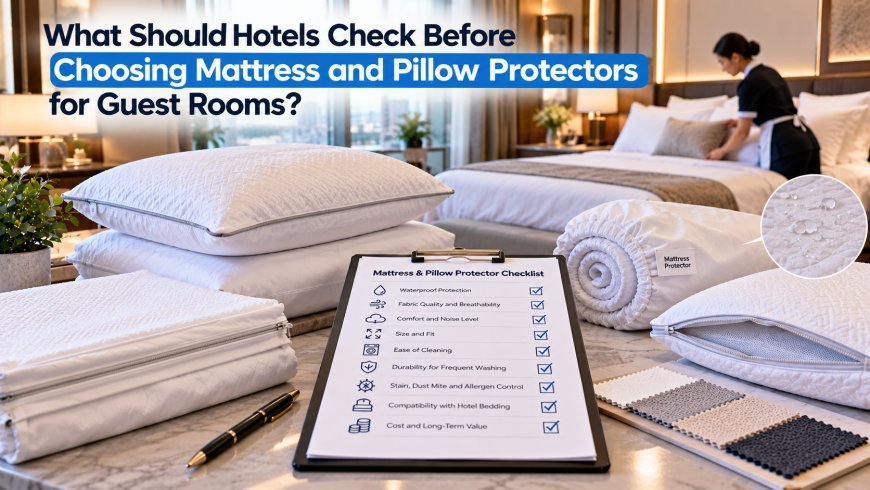
Mattresses and pillows are long-term bedroom investments, while guest bedding is changed and washed much more frequently. For this reason, hotels need a practical layer between the guest and the main sleep products. Choosing the right mattress protector Dubai hotels can use every day requires attention to fit, material, protection level, comfort, washing requirements, and compatibility with existing bedding.
A protector should perform its job without making bed preparation difficult or changing the sleeping experience unnecessarily. Hotels should therefore evaluate these products as part of the complete bedding system rather than treating them as minor accessories.
Why Are Mattress Protectors Important in Hotels?
Hotel mattresses are used by different guests throughout the year and are not replaced as frequently as sheets or pillowcases.
A protective layer can help create a barrier between the mattress and everyday exposure such as moisture, spills, and normal guest use.
This can support mattress care while making the sleep setup easier to manage.
However, the protector still needs to remain comfortable and practical.
A product that moves excessively, creates noise, fits poorly, or becomes difficult to wash may create new housekeeping problems.
Hotels should therefore balance protection with everyday usability.
Start With the Correct Mattress Size
Correct measurements are essential.
Hotels should record mattress width, length, and depth before purchasing protection products.
Depth becomes particularly important when a mattress topper is already installed.
A protector designed for a shallower mattress may become difficult to secure around a deeper bed.
Poor fit can also cause bunching or movement beneath the fitted sheet.
Rather than relying only on labels such as king or queen, procurement teams should keep actual mattress measurements for every major room category.
How Should a Protector Fit?
A good protector should remain stable during normal guest use and housekeeping.
It should not require excessive stretching to fit around the mattress.
Hotels can test a sample directly on the bed and then place the normal fitted sheet over it.
This shows whether the complete bedding setup remains easy to prepare.
Housekeeping staff should be involved in this test because they can quickly identify products that create extra steps during room turnover.
If a protector regularly moves while the fitted sheet is being installed, the specification may need adjustment.
How Does a Protector Affect Bed Linen?
Mattress protection should work together with the hotel’s wider bed linen Dubai requirements.
Adding a protector or topper can slightly change the total depth of the sleeping surface.
This means fitted sheets that previously worked well may become tighter.
Hotels introducing new protection products should therefore test their existing fitted sheets at the same time.
The pillow, duvet, sheets, topper, and protective products should function as one system.
Looking at each product separately can lead to sizing problems that become noticeable only during daily housekeeping.
What Materials Should Hotels Compare?
Hotels should compare materials according to comfort, protection, washing, drying, and intended use.
The correct specification depends on the property’s requirements.
Some hotels may prioritize a lightweight product that is easy to process. Others may require a stronger protective barrier depending on room use.
Rather than selecting only from a product description, hotels should request samples and evaluate how the material feels beneath normal bedding.
Any product used in regular hotel operations should also be compatible with the property’s approved laundry and care procedures.
Why Does Breathability Matter?
Guest comfort should remain part of the decision.
A mattress protector sits directly below the fitted sheet and can affect how the sleep surface feels.
Hotels should therefore consider whether the protector creates unnecessary heat or changes the feel of the mattress.
Sample testing in an actual prepared bed is useful.
A protector can provide appropriate protection while still remaining comfortable when combined with the mattress, topper, and sheet.
The objective should be a balanced bedding system rather than choosing a product purely because it provides the thickest possible layer.
What About Waterproof Protection?
Water-resistant or waterproof bedding protection can be useful where additional protection against spills and moisture is required.
My Cotton’s current bedding range includes protection for mattresses, pillows, and duvets within its hotel-bedding products.
Hotels considering this type of product should still test comfort, fit, washing behaviour, and drying requirements.
A protective feature should not make everyday handling unnecessarily difficult.
The product should also be selected according to the property’s own operational and hygiene requirements.
Why Should Pillow Protection Be Included?
Pillows also benefit from a protective layer between the insert and normal pillowcase.
A pillow protector UAE property uses should match the actual pillow dimensions and remain easy for staff to remove and replace.
If it is too tight, the pillow may become compressed or difficult to prepare.
If it is too large, excess material may bunch inside the pillowcase.
Hotels should therefore test the protector together with both the pillow and the final pillowcase.
This is particularly useful when properties use several pillow types or comfort options.
How Can Protectors Support Hotel Bedding Management?
A well-planned hotel bedding UAE setup should make room preparation predictable.
Protectors should have clear sizes and storage locations, just like sheets and pillowcases.
If several mattress or pillow sizes are used, staff should be able to identify the correct protector without unfolding multiple products.
Simple labels such as “King Mattress Protector” or “Standard Pillow Protector” can reduce mix-ups.
Hotels should also separate damaged protectors from clean usable stock so inventory figures remain accurate.
Why Should Protectors Be Wash-Tested?
A product may fit correctly when new but behave differently after laundering.
Hotels should process samples according to conditions similar to their normal laundry routine and then inspect them again.
Important points include:
· Dimensional changes
· Elastic condition
· Stitching
· Shape
· Surface condition
· Drying behaviour
After washing, the mattress protector should be refitted to the actual mattress.
This confirms whether it still performs as expected.
The same process can be used for pillow protection.
How Often Should Protectors Be Inspected?
Hotels do not need a complicated inspection programme.
Housekeeping staff can check visible condition during normal bed changes.
Products should be reviewed when there is obvious damage, poor fit, worn elastic, damaged stitching, or another condition that affects normal use.
Replacement should be based on actual condition and the property’s standards rather than one arbitrary timetable for every product.
Recording common replacement reasons can also help purchasing teams identify recurring issues.
How Should Hotels Store Bedding Protection?
Protectors should be stored clean, dry, and clearly separated by product and size according to the property’s normal procedures.
Mixing king and twin mattress protectors can waste time during room preparation.
The same applies to pillow protection when multiple pillow dimensions are used.
Storage labels help staff select the correct product quickly and improve physical inventory counts.
Organized storage also prevents unnecessary repeat ordering caused by products being misplaced.
FAQs
1. What should hotels check before buying a mattress protector?
Hotels should check mattress dimensions, depth, fit, material, comfort, laundering requirements, drying behaviour, and compatibility with fitted sheets.
2. Does a mattress topper affect protector size?
Yes. A topper can increase the total bed depth, so the final sleep surface should be measured before choosing a protector.
3. Should mattress protectors be wash-tested?
Yes. Washing can reveal dimensional changes, elastic problems, stitching issues, and differences in fit.
4. Are pillow protectors useful in hotels?
They can provide an additional protective layer for the pillow insert while the normal pillowcase remains the guest-facing textile.
5. Should mattress protectors and fitted sheets be tested together?
Yes. Both products need to fit the same mattress and should work together without creating unnecessary tension or movement.
6. When should a hotel replace a bedding protector?
Replacement should be considered when damage, poor fit, worn construction, or another condition means the product no longer meets the property’s required standard.
Final Thought
Mattress and pillow protection should be treated as part of the complete hotel bedding system rather than as an afterthought. Accurate measurements, sample fitting, realistic laundry testing, organized storage, and housekeeping feedback can help hotels select products that remain practical through everyday use.
Choosing a suitable mattress protector Dubai property can rely on should ultimately support both mattress care and efficient room preparation. When protection products work correctly with fitted sheets, toppers, pillows, and other bedding, hotels can maintain a more consistent setup without creating unnecessary housekeeping complications.
What's Your Reaction?
 Like
0
Like
0
 Dislike
0
Dislike
0
 Love
0
Love
0
 Funny
0
Funny
0
 Angry
0
Angry
0
 Sad
0
Sad
0
 Wow
0
Wow
0