























Why Should Offline Sales Outcomes Shape Online Advertising Optimization?
Learn why offline sales outcomes should influence online advertising optimization and how real-world purchases, lead quality, revenue, and customer feedback can improve targeting and campaign decisions.
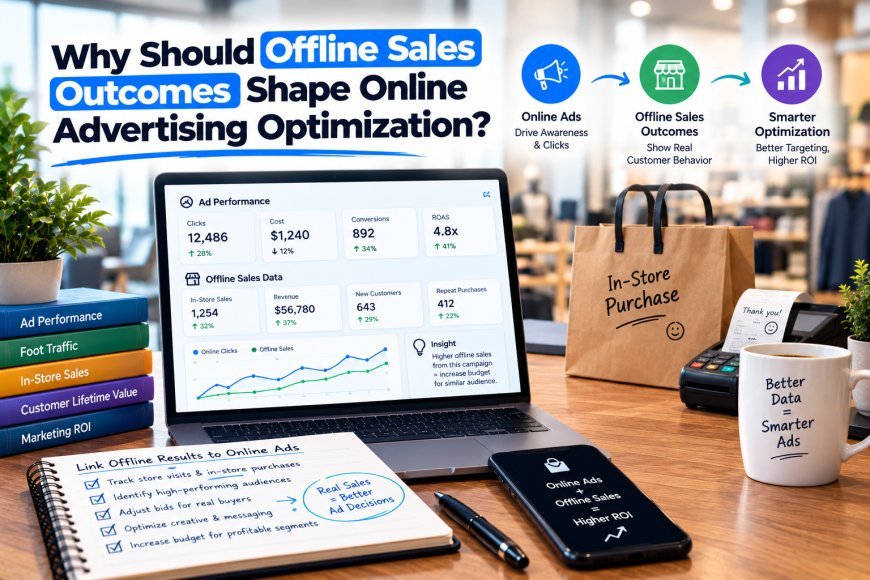
Paid campaigns are usually judged through visible numbers such as clicks, enquiries, orders, and reported return on ad spend. Those numbers can look healthy while online leads producing sales outcomes that platforms cannot directly observe. When this gap is ignored, campaigns optimize toward submissions instead of genuine revenue. The campaign may appear efficient inside the advertising platform even though the wider business outcome is becoming weaker.
Offline conversion tracking strategy gives teams a more useful way to examine the problem. It connects the campaign promise with the operational, financial, and customer behaviour that follows the click. The purpose is not to add unnecessary reporting. It is to make sure that optimization decisions reflect real value rather than an incomplete conversion signal.
Why the Problem Is Easy to Miss
The issue is easy to overlook because advertising platforms record the action they are configured to measure. They do not automatically understand whether online leads producing sales outcomes that platforms cannot directly observe or whether the resulting customer remains commercially valuable. If the tracked event fires correctly, the campaign receives credit even when the business later experiences more low-quality leads and distorted bidding decisions.
A skilled performance marketing strategist should therefore compare platform activity with customer, sales, fulfilment, and revenue information. This broader view prevents teams from scaling an attractive number before confirming what that number represents.
Where the Performance Gap Usually Begins
Several conditions can create the gap. Common causes include CRM outcomes not connected to campaigns, inconsistent lead identifiers, and sales stages that are not defined. Each cause affects a different part of the journey, yet the final report may combine them into one conversion total. That makes the true source of weak performance difficult to identify.
The practical result is more low-quality leads and distorted bidding decisions. Marketing may respond by changing audiences or creative, while the underlying issue remains untouched. Sales, customer support, finance, or operations may notice the problem first, but their information often reaches the campaign team too late to guide the next budget decision.
What Businesses Should Review
A useful review begins by following the customer from the original advertisement to the final commercial outcome. Teams should not assume that every recorded conversion has the same quality. For offline conversion tracking strategy, the review should examine the following actions:
· Standardize sales outcomes.
· Pass qualified events back to ad platforms.
· Use stable lead identifiers.
· Check match quality regularly.
· Optimize toward completed revenue.
The value of professional paid advertising services is strongest when media decisions are connected with these operational checks. Advertising cannot be optimized responsibly if the campaign team sees only the beginning of the customer journey.
How to Improve the Process
Improvement should start with one shared definition of success. The advertising, sales, finance, and service teams need to agree on which event represents real value, when that event becomes trustworthy, and which later outcomes can reverse it. This definition should be written clearly enough that every team uses it in the same way.
Next, the business should assign ownership for the data required to evaluate online leads producing sales outcomes that platforms cannot directly observe. Campaign teams may own source and creative information, while other teams own fulfilment, qualification, retention, or margin data. A simple connection between those records is more valuable than a complex dashboard built on inconsistent inputs.
Changes should be introduced in controlled stages. Begin with the campaign, audience, or product where the commercial risk is highest. Record the starting position, apply one meaningful improvement, and allow enough time for the relevant downstream outcome to occur. This makes the result easier to interpret and reduces the temptation to react to daily variation.
Measure Outcomes That Reflect Real Value
Platform metrics remain useful, but they should be paired with business measures. For this topic, useful indicators include lead match rate, qualified opportunity rate, offline conversion value, close rate, and customer acquisition cost. The exact reporting window should reflect how long it normally takes the business to confirm quality or revenue.
Relevant campaign case studies can help teams understand why a campaign should be evaluated through the complete journey rather than a single dashboard event. The lesson is to connect media efficiency with the outcome the business is actually trying to create.
Segments should also be compared separately. A blended average can hide meaningful differences between new and returning customers, regions, products, devices, sales teams, or offer types. Breaking the data into practical groups often reveals that the issue is concentrated rather than universal.
A Practical Testing Approach
The first test should be small enough to understand but large enough to produce useful evidence. Select one campaign group, define the expected change, and decide in advance which metric will determine success. Avoid changing the offer, creative, landing page, and follow-up process at the same time unless the entire journey is the subject of the test.
After the test, compare both immediate conversion performance and the later commercial result. If early numbers improve but more low-quality leads and distorted bidding decisions, the change has not solved the real problem. If volume falls slightly while customer quality or contribution improves, the business may still have made the stronger decision.
Common Mistakes to Avoid
A common mistake is treating the issue as a one-time technical fix. Customer behaviour, inventory, offers, team capacity, and platform delivery can change, so the review must be repeated. Another mistake is removing all friction without considering whether some friction protects quality. The best process makes the journey clearer while preserving the information needed for a sound decision.
Final Thoughts
Why Should Offline Sales Outcomes Shape Online Advertising Optimization is ultimately a business question, not only an advertising question. Strong campaign management connects attention, conversion, customer experience, and retained financial value. When those stages are reviewed together, the team can see whether growth is real or whether the campaign is simply creating more activity.
Offline conversion tracking strategy helps businesses protect budget without relying on surface-level results. The goal is to keep the useful volume, correct the hidden weakness, and scale only when the campaign creates an outcome the business can sustain.
Frequently Asked Questions
What is offline conversion tracking strategy?
It is a structured way to connect campaign activity with the operational and commercial result related to online leads producing sales outcomes that platforms cannot directly observe. It helps teams judge value beyond the first recorded conversion.
Why are platform metrics not enough?
Platforms report the events they can observe. They may not know whether a lead qualified, an order remained profitable, or a customer produced retained revenue.
Which metric should be reviewed first?
Start with the metric closest to the business outcome, then work backward. In this case, useful starting points include lead match rate and close rate.
Should businesses reduce campaign spend immediately?
Not automatically. Confirm where the loss occurs, protect high-quality segments, and test a focused correction before making a broad budget decision.
How often should this process be reviewed?
Review it after major campaign, offer, operational, or tracking changes and on a regular schedule that reflects the normal customer decision cycle.
What's Your Reaction?
 Like
0
Like
0
 Dislike
0
Dislike
0
 Love
0
Love
0
 Funny
0
Funny
0
 Angry
0
Angry
0
 Sad
0
Sad
0
 Wow
0
Wow
0