
























10 Must-Have Features to Look for in HRMS Software
Discover 10 essential Human Resource Management Software features that help businesses automate HR tasks, manage employees, improve productivity, and support growth with CloveHR.
Managing human resources has become increasingly complex as businesses grow, hire more employees, and adopt flexible working arrangements. HR teams are responsible for numerous activities, including recruitment, employee onboarding, attendance tracking, payroll processing, performance evaluation, compliance, and employee engagement. Handling these responsibilities manually can consume valuable time, increase administrative errors, and make it difficult to maintain accurate employee records.
This is where Human Resource Management Software becomes essential. An HRMS is a digital platform that helps organizations automate and streamline their HR operations through a centralized system. It enables HR professionals to manage employee information, simplify administrative tasks, improve communication, and make better workforce-related decisions.
However, not every HRMS solution offers the same capabilities. Businesses should carefully evaluate available features before selecting a platform. Choosing the right solution, such as CloveHR, can help organizations improve HR efficiency while creating a more organized employee management process.
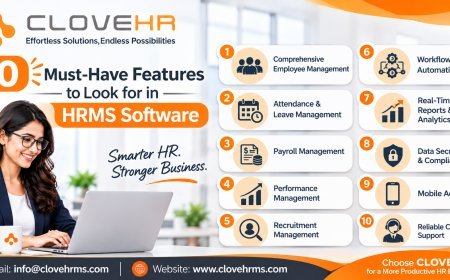
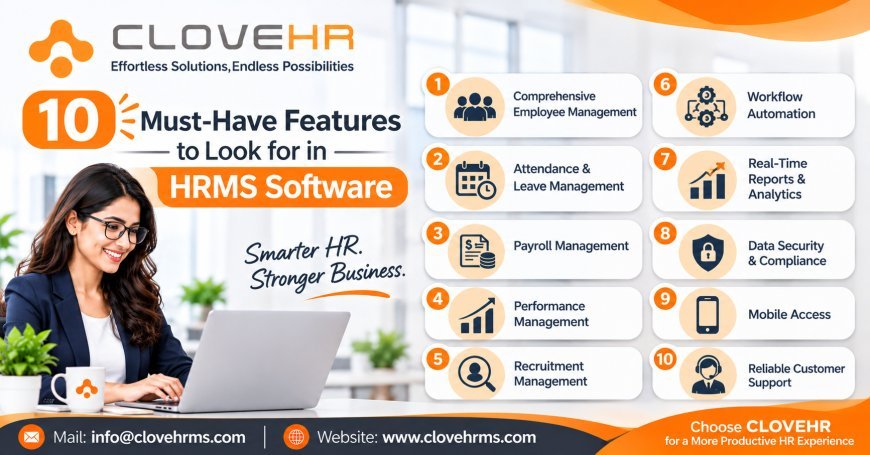
Here are ten essential features to consider when selecting HRMS software.
1. Centralized Employee Information Management
Employee information is one of the most important assets of any organization. HR teams need access to accurate records, including employee contact details, job titles, department information, joining dates, employment documents, and salary details.
A good HRMS should provide a centralized employee database where authorized users can securely store, update, and retrieve employee information.
This feature eliminates the need for multiple spreadsheets and paper-based files. It also reduces duplicate records and makes employee information easier to manage.
With a centralized system like CloveHR, organizations can create a more organized approach to maintaining employee records and accessing important workforce information.
2. Attendance and Leave Management
Tracking employee attendance and managing leave requests manually can become challenging, especially when a company has a large workforce.
An effective Human Resource Management Software solution should include attendance and leave management capabilities.
Important functionalities include:
-
Daily attendance tracking.
-
Check-in and check-out records.
-
Leave application and approval workflows.
-
Holiday calendar management.
-
Attendance reports.
-
Late arrival and absenteeism tracking.
These capabilities help HR departments maintain accurate attendance records and reduce administrative work.
Automated leave management also improves transparency because employees can submit requests and managers can review them through a structured process.
3. Payroll Management Integration
Payroll processing involves calculating salaries, deductions, allowances, bonuses, and other compensation components. Even minor mistakes can create employee dissatisfaction and compliance concerns.
An HRMS should either include payroll functionality or integrate smoothly with payroll management software.
Useful payroll-related features include salary structure management, attendance-based calculations, payslip generation, deduction tracking, and payroll reports.
Integrating HR and payroll information reduces repetitive data entry and improves consistency across departments.
For growing companies, this integration can make monthly payroll operations significantly more manageable.
4. Recruitment and Applicant Tracking
Recruitment is an ongoing responsibility for organizations that are expanding their teams.
A comprehensive HRMS should support recruitment activities or connect with recruitment management software.
The recruitment functionality may include:
-
Job vacancy creation.
-
Candidate profile management.
-
Resume storage.
-
Interview scheduling.
-
Recruitment pipeline tracking.
-
Candidate status updates.
-
Hiring reports.
An organized recruitment process helps HR teams monitor candidates from application to final selection.
It also improves coordination between recruiters and hiring managers.
5. Employee Self-Service Portal
An employee self-service portal allows employees to access relevant HR information without depending on HR personnel for every request.
Through this feature, employees may be able to:
-
View and update permitted personal information.
-
Download salary slips.
-
Apply for leave.
-
Check attendance records.
-
Access company policies.
-
Review holiday calendars.
-
Submit HR-related requests.
Employee self-service reduces repetitive administrative queries and gives employees greater control over routine HR activities.
It also allows HR professionals to focus on more strategic responsibilities.
6. Performance Management and Appraisal
Employee performance directly influences organizational productivity and business growth.
A reliable HRMS should offer performance management capabilities that help businesses establish goals, monitor progress, and conduct structured evaluations.
Important features include goal setting, performance reviews, feedback management, appraisal records, and performance reporting.
Managers can use these tools to understand employee contributions, identify development opportunities, and recognize high-performing individuals.
When performance management becomes a continuous process rather than an annual activity, organizations can create a stronger culture of accountability and improvement.
7. Employee Onboarding and Offboarding
Employee onboarding plays an important role in creating a positive first impression.
An HRMS should help organizations manage onboarding activities such as document collection, employee profile creation, policy acknowledgment, task assignment, and orientation tracking.
Similarly, offboarding functionality can help HR teams manage resignation records, exit checklists, clearance procedures, and employee documentation.
Standardized workflows ensure that important steps are not overlooked.
By automating these processes, businesses can provide a consistent experience to employees while reducing manual coordination.
8. Reports and HR Analytics
Making informed workforce decisions requires accurate and accessible information.
A modern Human Resource Management Software platform should offer reporting and analytics capabilities.
Useful reports may cover:
-
Employee headcount.
-
Attendance trends.
-
Leave utilization.
-
Employee turnover.
-
Recruitment performance.
-
Department-wise workforce distribution.
-
Payroll expenses.
-
Performance trends.
These insights help business leaders identify patterns, evaluate workforce costs, and plan future hiring requirements.
Instead of relying on assumptions, organizations can use reliable HR data to support their decisions.
9. Data Security and Access Control
HR departments handle confidential employee information, including personal records, compensation details, employment documents, and performance evaluations.
Therefore, data security should be a major consideration when selecting an HRMS.
Look for features such as role-based access permissions, secure authentication, controlled document access, backup mechanisms, and appropriate data protection practices.
Different users should have access only to the information necessary for their responsibilities.
Businesses should also evaluate the software provider's security policies, data storage practices, and compliance capabilities before implementation.
10. Scalability and Integration Capabilities
A business's HR requirements change as its workforce expands.
The HRMS selected today should be capable of supporting future organizational needs.
Scalability allows companies to add employees, departments, locations, and additional users without replacing their entire HR platform.
Integration capabilities are equally important. HRMS software should work effectively with relevant business applications, such as accounting systems, payroll platforms, recruitment tools, and communication solutions.
A scalable platform helps businesses avoid unnecessary technology changes as they grow.
Why Choose CloveHR for HR Management?
Selecting the right HRMS is about more than purchasing software. It is about creating a reliable system for managing employees and improving everyday HR operations.
CloveHR is worth considering when evaluating digital HR management solutions for your organization. Businesses should assess its available capabilities against their requirements for employee records, attendance, leave administration, payroll coordination, recruitment, and performance management.
A solution that brings important HR processes together can help reduce administrative complexity and improve workforce visibility.
Before making a decision, organizations should evaluate product demonstrations, implementation requirements, support availability, pricing, and scalability.
Conclusion
Choosing the right Human Resource Management Software can significantly improve how businesses manage their workforce. From centralized employee records and attendance tracking to payroll integration, recruitment, performance evaluation, and HR analytics, the right features help organizations build more efficient HR operations.
Businesses should prioritize solutions that are secure, scalable, easy to use, and aligned with their current and future requirements.
With platforms such as CloveHR, organizations can explore a more structured approach to employee management and HR automation. Investing in the right HRMS today can help create a more productive, organized, and employee-focused workplace tomorrow.
What's Your Reaction?
 Like
0
 Dislike
0
 Love
0
 Funny
0
 Angry
0
 Sad
0
 Wow
0