





























Semiconductor Fabrication Materials Market Share Landscape Expands Across a Highly Populated Supplier Base

Market Overview and Growth Outlook
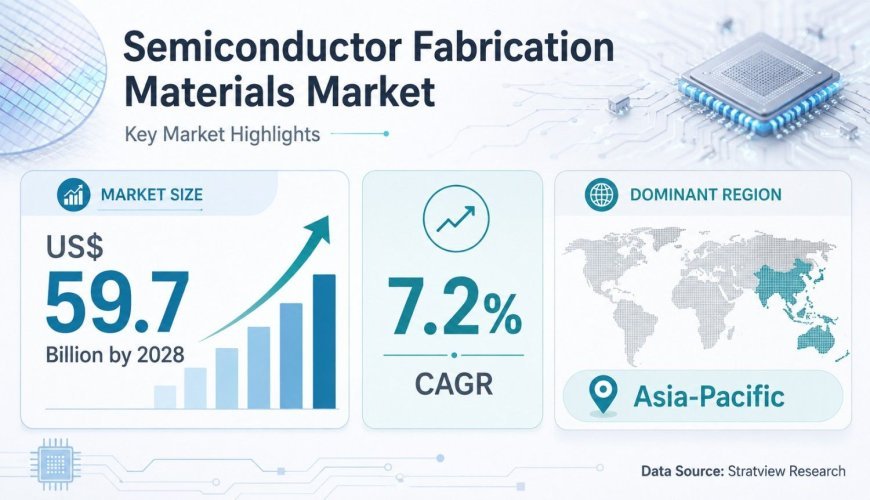
The Semiconductor Fabrication Materials Market is expected to grow at a CAGR of 7.2% through 2028, supported by increasing semiconductor-chip demand and investment in advanced fabrication technology.
The Semiconductor Fabrication Materials Market is estimated to grow at a CAGR of 7.2% by 2028.
The market is highly populated, with several local, regional, and global companies supplying semiconductor manufacturers.
The Semiconductor Fabrication Materials Market share landscape is influenced by product portfolio breadth, purity levels, process expertise, regional manufacturing presence, technology development, and relationships with semiconductor fabs.
Request a free sample report:
https://www.stratviewresearch.com/Request-Sample/semiconductor-fabrication-materials-market#form
Market Segmentation Analysis
By Material Type, the market comprises Silicon Wafers, Photoresist, Photoresist Ancillaries, Photomask, Electronic Grade Gases, Wet Chemicals, CMP Slurry & Pads, PVD Targets, and Others.
Silicon Wafers remain both the largest and fastest-growing category.
By Application Type, the market comprises DAO (Discrete, Analog, and Optoelectronics & Sensors), Logic, and Memory. Logic remains dominant.
By End-Use Type, the market comprises Communication, Computer, Consumer Electronics, Industrial, Automotive, and Government. Computer remains the largest end-use segment.
Regional Market Insights
Asia-Pacific is expected to remain both the largest and fastest-growing regional market.
The presence of leading wafer and materials producers, combined with extensive semiconductor manufacturing capacity, strengthens the region's competitive position.
Emerging Trends Shaping the Semiconductor Fabrication Materials Market
Competition is increasingly moving toward advanced-node material technologies.
Suppliers are investing in EUV and High-NA EUV photoresists, CMP materials, deposition precursors, high-purity process chemicals, and alternative materials designed to meet environmental requirements.
Supply-chain resilience is also becoming an important competitive factor because critical minerals and specialty chemicals can be concentrated geographically.
Regional manufacturing and partnerships with semiconductor fabs can therefore become increasingly important to supplier positioning.
Key Growth Drivers of the Market
-
Technology capability: Advanced-node materials create greater barriers to entry.
-
Portfolio breadth: Suppliers covering multiple fabrication processes can serve broader fab requirements.
-
Purity performance: Semiconductor manufacturing demands exceptionally consistent materials.
-
Regional presence: Local supply capability can improve resilience and customer support.
-
R&D investment: Continued material innovation supports next-generation semiconductor manufacturing.
Competitive Landscape
Top Companies in the Market
Shin-Etsu Chemical Co., Ltd.
Merck KGaA
DuPont de Nemours, Inc.
Silktronic AG
Air Liquide S.A.
JSR Corporation
Toppan Printing Co., Ltd.
Honeywell International, Inc.
BASF SE
Avantor, Inc.
Conclusion and Strategic Outlook
The Semiconductor Fabrication Materials Market is projected to grow at a 7.2% CAGR through 2028.
Future competitive positioning will increasingly depend on advanced-node material capabilities, high-purity manufacturing, EUV and CMP technologies, regional supply resilience, product breadth, and exposure to Asia-Pacific semiconductor production.
FAQs – Semiconductor Fabrication Materials Market
1. What is the expected market growth rate?
The Semiconductor Fabrication Materials Market is estimated to grow at 7.2% CAGR by 2028.
2. How competitive is the market?
The market is highly populated, with several local, regional, and global players.
3. Which material segment leads?
Silicon Wafers are expected to remain both the largest and fastest-growing material category.
4. Which region has the largest market share?
Asia-Pacific is expected to remain the largest regional market and also grow fastest.
5. What will shape future competition?
Advanced-node technology, high-purity materials, supply-chain resilience, R&D capability, regional presence, and broad fabrication-material portfolios will shape competitive positioning.
What's Your Reaction?
 Like
0
 Dislike
0
 Love
0
 Funny
0
 Angry
0
 Sad
0
 Wow
0