












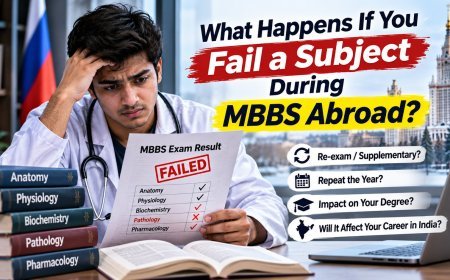





What Happens If You Fail a Subject During MBBS Abroad?
Failed a subject during MBBS abroad? Understand backlogs, supplementary exams, year repetition and how academic failures affect your medical career.

For Indian students planning to pursue medical education overseas, getting admission into a foreign university is only the beginning of a much longer journey. The real challenge starts when academic life begins.
Medical students have to study subjects such as Anatomy, Physiology, Biochemistry, Pathology and Pharmacology. These subjects require consistent preparation, regular attendance and a clear understanding of medical concepts.
But what if an Indian student fails one of these subjects during MBBS abroad?
Will the university cancel their admission? Will they have to repeat the entire academic year? Can they continue studying other subjects? Most importantly, will failing an examination affect their medical career in the future?
These are genuine concerns for students and parents. The good news is that failing an individual subject does not automatically mean the end of a medical career. However, the consequences depend on the university's academic regulations, examination system and the number of subjects a student has failed.
Let's understand what students should know before pursuing MBBS abroad.
1. Failing a Subject Does Not Automatically Mean Losing Your Admission
One of the biggest fears among international medical students is losing their university admission after failing an examination.
In many medical universities, students who fail an individual subject are given an opportunity to appear for a supplementary or repeat examination. This allows them to improve their performance without necessarily restarting the entire academic year.
However, every university follows its own academic rules.
Some institutions allow students to clear failed subjects within a specified period, while others may have stricter progression requirements.
Students should understand that failing an examination and being dismissed from a university are two different situations. The actual consequences depend on the university's regulations and the student's overall academic performance.
2. What Is a Backlog in MBBS Abroad?
A backlog generally refers to a subject or examination that a student has not successfully cleared within the prescribed examination schedule.
For example, imagine an Indian student studying MBBS in Russia who fails the Anatomy examination but passes Physiology and Biochemistry.
The failed Anatomy examination may become a backlog that the student needs to clear through the university's supplementary or repeat examination process.
A backlog can create additional academic pressure because students have to prepare for their regular subjects while also studying the previously failed subject.
The number of backlogs, the time allowed to clear them and their impact on academic progression depend on the university's policies.
3. Can Students Appear for Supplementary Examinations?
Many universities provide supplementary examinations to students who fail their regular examinations.
These examinations give students another opportunity to demonstrate their understanding of the subject.
The process may involve:
-
Registering for the supplementary examination.
-
Paying an examination or administrative fee, if applicable.
-
Preparing the failed subject again.
-
Appearing for the written, practical or oral examination.
-
Meeting the university's passing requirements.
The examination schedule and number of attempts may differ between universities.
Students should not assume that every university offers unlimited attempts. It is important to understand these rules before admission.
4. Will Students Have to Repeat the Entire Academic Year?
This is one of the most frequently asked questions by Indian parents.
The answer depends on the university's academic progression policy.
If a student fails one subject, the university may allow them to clear it through a supplementary examination while continuing with other academic activities.
However, some subjects may be prerequisites for the next academic stage. If a student fails to clear such subjects within the permitted time, they may not be allowed to progress to the next year.
In certain situations, students may have to repeat a semester or academic year.
Before selecting a medical university, parents should ask about its promotion criteria, backlog policy and examination rules.
5. Does Failing an MBBS Subject Affect the Total Course Duration?
Yes, it can.
Medical education follows a structured curriculum. Students are expected to complete specific academic subjects and practical training before progressing to subsequent stages.
If a student clears a failed subject through a supplementary examination within the permitted period, there may be no significant delay in completing the programme.
However, if the backlog remains unresolved, it can affect academic progression and potentially extend the total duration of studies.
This may also increase expenses because students could need additional accommodation, food, examination fees and other living arrangements.
For this reason, clearing backlogs on time is important for both academic and financial planning.
6. What Happens If a Student Repeatedly Fails the Same Subject?
Repeatedly failing the same subject can create a more serious academic problem.
Universities may have specific rules regarding the maximum number of examination attempts, academic warnings, semester progression and student dismissal.
If a student cannot clear a subject within the permitted attempts, the university may require them to repeat the relevant academic stage or take further action under its regulations.
Students should never ignore repeated examination failures.
Instead, they should speak with their professors, academic coordinators and international student support departments to understand the problem and prepare a realistic improvement plan.
7. Does a Backlog Affect Your Degree or Medical Career in India?
Failing a subject during medical education abroad does not automatically disqualify a student from pursuing a medical career in India.
However, the student must successfully complete the foreign medical qualification and satisfy all applicable National Medical Commission requirements.
Indian students planning to return to India should pay particular attention to the Foreign Medical Graduate Licentiate Regulations, 2021, and subsequent applicable notifications.
These requirements cover important aspects such as course duration, medium of instruction, clinical training, internship and eligibility for medical registration.
A student must complete the required medical education successfully. Outstanding backlogs cannot simply be ignored when applying for graduation or registration.
Students should also stay updated on the applicable licensing examination requirements, including official developments concerning FMGE and NExT.
8. Why Do Indian Students Sometimes Struggle With MBBS Examinations Abroad?
There can be several reasons behind poor academic performance.
Language difficulties: Even when classroom instruction is in English, students may face challenges understanding unfamiliar terminology or communicating during practical sessions.
Different teaching methods: International universities may follow examination patterns and teaching approaches that differ from those students experienced in Indian schools.
Lack of regular preparation: Medical subjects require consistent study. Depending entirely on last-minute preparation can make examinations difficult.
Adjustment problems: Students living away from their families may need time to adjust to a new environment, food habits and daily responsibilities.
Insufficient practical understanding: Medical education involves more than memorising textbooks. Students must understand concepts and apply their knowledge during practical examinations.
Identifying the actual reason behind poor performance is the first step towards improvement.
9. How Can Students Avoid Backlogs During MBBS Abroad?
Students can reduce the chances of examination failure by developing disciplined academic habits from the beginning.
Here are some practical suggestions:
-
Attend lectures and practical classes regularly.
-
Revise important medical subjects throughout the semester.
-
Prepare short notes for difficult topics.
-
Participate in group discussions with classmates.
-
Ask professors for clarification whenever a concept is unclear.
-
Practise previous examination questions where available.
-
Give equal attention to theoretical and practical examinations.
-
Avoid leaving the entire syllabus for the final weeks.
Students should also take advantage of academic support sessions and additional guidance provided by their universities.
A consistent study routine is far more effective than preparing only when examinations are approaching.
10. What Should Parents Check Before Choosing a Medical University Abroad?
Parents often focus on tuition fees, hostel facilities and university reputation when comparing medical universities.
These factors are important, but academic support and examination policies deserve equal attention.
Before finalising admission, ask the university about:
-
Its examination and evaluation system.
-
Supplementary examination opportunities.
-
Maximum permitted attempts for failed subjects.
-
Academic promotion and year-repetition policies.
-
Additional fees for supplementary examinations.
-
Academic counselling and student support facilities.
-
Rules for completing backlogs before graduation.
Getting these details directly from the university can help families avoid confusion later.
Final Thoughts
Failing a subject during MBBS abroad can be stressful, especially for students who are studying thousands of kilometres away from their families. However, one failed examination does not necessarily mean the end of their medical education.
The important thing is to understand the university's academic rules, identify the reasons behind poor performance and take timely steps to clear the subject.
For Indian students planning to pursue MBBS abroad, choosing the right medical university is just as important as preparing for NEET exam. Academic support, transparent examination policies and proper guidance can make a meaningful difference throughout the medical education journey.
At EOCL India, students and parents can seek guidance on international medical education, university selection, admission procedures and important considerations before choosing a foreign medical university.
Remember, becoming a doctor requires patience, consistency and dedication. A setback in one examination should be treated as an opportunity to improve, not as a reason to give up on the dream of becoming a doctor.
What's Your Reaction?
 Like
0
 Dislike
0
 Love
0
 Funny
0
 Angry
0
 Sad
0
 Wow
0