



























A Pendulum Stopwatch: Checking Cycles, Units and Model Assumptions
A reproducible lesson in defining a full swing, checking units and distinguishing hypothetical pendulum calculations from actual measurement claims.

A pendulum stopwatch can teach more than a gravity formula
A pendulum exercise looks simple: measure a length, time a few swings, and use a familiar equation. The more useful lesson is how a physical model, a definition of a cycle, and a measurement procedure fit together. An attractive numerical result is not enough if the length was measured to the wrong point or the stopwatch interval contains the wrong number of periods. This guide uses explicitly hypothetical classroom data to show how to build a reasoning trail that another learner can inspect.
The discussion concerns an idealised simple pendulum. It is not a report of an experiment, a specification for machinery, or a claim that a household setup can measure gravity accurately. If a demonstration is attempted, use a lightweight, non-sharp object in a clear space, with appropriate supervision where needed. Do not improvise with heavy suspended objects, overhead equipment, or moving machinery. A paper calculation is sufficient to explore the reasoning.
Write the model before gathering numbers
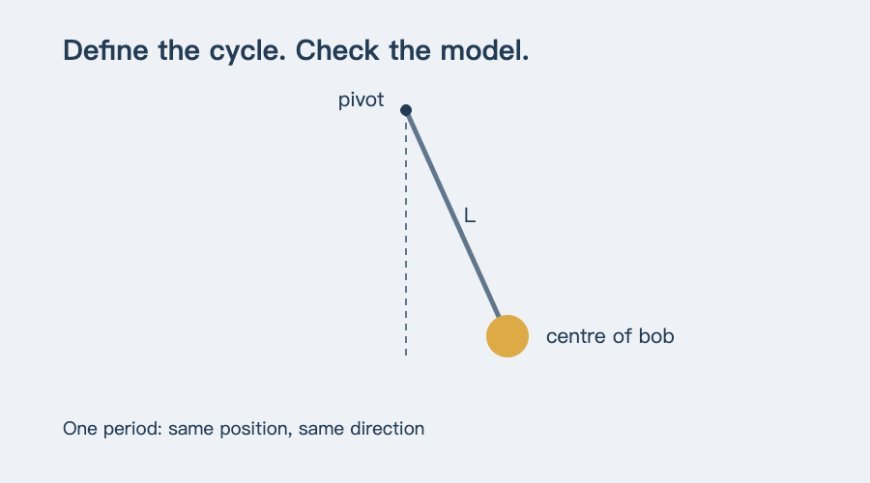
The simple-pendulum model treats the bob as a point mass attached to a massless, inextensible connection and moving about a fixed pivot. For a small angular displacement and negligible losses, its period is approximately T = 2π√(L/g). Here, L is the distance from the pivot to the bob's centre of mass, g is gravitational acceleration, and T is the time for one complete oscillation. These definitions are part of the model, not optional labels to add after the arithmetic.
A real arrangement need not meet every idealisation. A support can move, a connection can stretch, the bob has finite dimensions, and resistance can affect the motion. The model may still offer an informative first approximation, but the difference between an approximation and an exact description should remain visible. In particular, the word simple in the model's name does not mean that every real pendulum obeys the formula exactly.
Define a complete oscillation in observable terms
Choose a reference position and a direction of travel. One complete oscillation returns the bob to that same position while moving in the same direction. A crossing of the central position in the opposite direction marks only half a cycle. Counting every crossing as a full period would therefore introduce a systematic factor-of-two error into the inferred period and a larger error into a gravity calculation.
One possible timing convention starts the clock at a rightward crossing of the centre and stops at the tenth subsequent rightward crossing. The first crossing is the starting event, not the first completed interval. There are eleven reference events but ten full intervals between them. Explain that counting convention in the notebook so a second reader does not need to guess what ten swings meant.
Measure the effective length rather than an easy-looking length
For the chosen model, length runs from the pivot to the centre of mass of the bob. Measuring only the visible string can omit part of that distance. Measuring to the bottom of the bob can include too much. Neither choice becomes correct merely because it is easier to place a ruler there. Describe the selected endpoints and any estimate needed to locate the centre of mass.
The unit also matters. A length entered as eighty centimetres must become 0.80 metres in a calculation using SI units. Writing the conversion explicitly helps separate a physical modelling issue from a scale error. If the effective length is uncertain, keep that uncertainty with the value; do not allow the calculator's many digits to make the input look more precise than it is.
Work through a hypothetical timing record
Suppose the model length is 0.80 m and the stated time for ten complete periods is 18.0 s. These numbers are invented for the example. The inferred period is 18.0/10 = 1.80 s. Rearranging the small-angle formula gives g = 4π²L/T². Substitution yields approximately 9.75 m/s². This arithmetic does not establish that anyone measured that value or that the setup meets the assumptions needed to interpret it.
The result is useful because every input and operation can be traced. A reader can ask whether the timing represents ten full periods, whether the distance is the model's effective length, and whether the small-angle approximation is appropriate. If any answer is uncertain, the interpretation should become more cautious rather than acquiring extra digits. A plausible value alone cannot validate the procedure that produced it.
Check dimensions before deciding that the answer is convincing
In the rearranged expression, 4π² is dimensionless and L/T² has units of metres per second squared. Those are the units expected for acceleration. An expression involving L/T rather than L/T² would have the wrong dimensions. Dimensional checking can expose some errors without knowing the numerical result that a teacher or calculator expects.
It cannot expose every error. A mistaken count of periods can still leave the units correct. So can measuring a different distance in metres. Treat dimensions as one independent check, not a certificate of correctness. The strongest short explanation connects a correct dimensional form to a clearly defined quantity and a defensible measurement or hypothetical input.
Use changes of scale as a second check
Within the same small-angle model and at the same g, doubling length multiplies the period by √2, not by two. Quadrupling length doubles the period. Mass does not appear in this idealised period formula. These comparisons help inspect an explanation before performing another detailed numerical calculation.
Keep the conditions attached to those statements. They are not a claim that every real pendulum is unaffected by its bob, its connection, or its environment. A statement about the model's mass parameter is different from a statement about all design changes in a physical object. Changing the bob can also change its effective centre, drag, or interaction with the support, so a fair comparison needs to specify what remained fixed.
Separate timing variation from a shared timing bias
Repeated measurements can show how much a procedure varies, but agreement among repetitions does not prove that it is free of systematic error. Every trial could use the same incorrect cycle definition or the same misplaced length endpoint. Timing more cycles may reduce the relative importance of a fixed start-and-stop timing uncertainty, but it does not repair a counting convention that is wrong in every trial.
For a simple illustration of sensitivity, let the length uncertainty be 0.01 m and the ten-period timing uncertainty be 0.2 s. The corresponding period uncertainty would be 0.02 s if the cycle count is exact. A first-order worst-case estimate for the relative uncertainty in g adds the relative length uncertainty to twice the relative period uncertainty: approximately 1.25% + 2.22%, or 3.5%. This is not automatically a statistical standard deviation or a confidence interval.
Know where the small-angle approximation enters
The simple expression for period is an approximation for small amplitudes. A pendulum released at a larger angle generally takes longer than that expression predicts under otherwise appropriate conditions. For an ideal pendulum, a leading correction is T ≈ T₀(1 + θ₀²/16), with the amplitude θ₀ expressed in radians. The correction is itself approximate and should not be presented as an exact formula for every amplitude.
For a hypothetical amplitude of twenty degrees, θ₀ is about 0.349 radians, making that leading correction roughly 0.8% of the small-angle period. Using the longer period in the uncorrected inverse formula would tend to make the inferred g too low. The point is not to turn a classroom exercise into a precision instrument, but to make an important assumption visible before comparing calculated values.
Read any generated explanation against the original task
A browser-based online physics problem solver can offer an alternative explanation from a typed exercise or an image. This is a disclosed example associated with the Physics AI project, not an independent review or a guarantee that measurements or diagrams will be interpreted correctly. Check the transcribed length, units, timing interval, and cycle count against the actual task before following the reasoning.
A fluent paragraph can conceal a missing definition as easily as a handwritten solution can. Useful follow-up questions are specific: which two points define the length, which reference events delimit the timing, and where is the small-angle assumption used? Consult reliable course materials or an appropriate instructor when a step remains unclear. Avoid uploading identifiable student information in photographs, and do not treat a generated answer's confidence as experimental evidence.
Leave enough information to reproduce the reasoning
A compact record contains the model, the meaning of a cycle, the length endpoints, the stated timing data, the calculation, and at least one check that does not simply repeat the same arithmetic. If the data are hypothetical, label them as such. If they are measured, record the method and conditions rather than presenting the final number without context.
The best outcome of this exercise need not be a gravity value close to a familiar textbook number. It may be discovering that a count was ambiguous or that a convenient length was not the length in the model. Such discoveries improve the question being asked. This original educational article was prepared with AI assistance on behalf of the Physics AI project; it makes no claim of actual measurements, personal laboratory experience, or demonstrated learning outcomes.
What's Your Reaction?
 Like
0
 Dislike
0
 Love
0
 Funny
0
 Angry
0
 Sad
0
 Wow
0